
Ewer
1560-1586 (made)
| Artist/Maker | |
| Place of origin |
Object Type
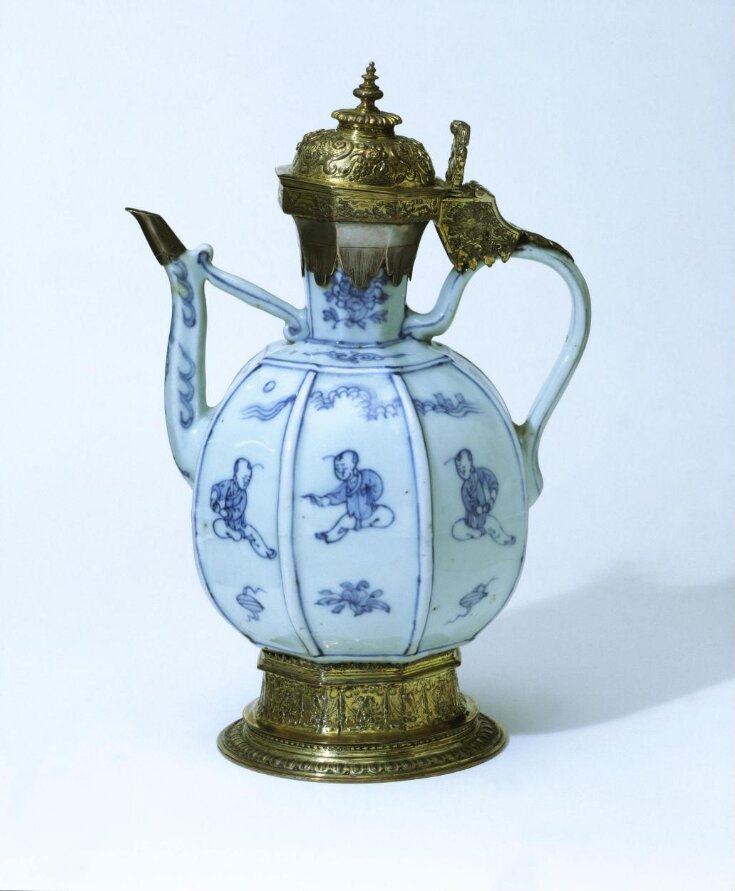
This is a porcelain ewer of not especially high quality. It was made in Jingdezhen, a city in central southern China that mass-produced thousands of similar pieces. Some were for the home market and some for export.
Materials & Making
In late 16th century Europe, porcelain was a valuable and expensive material. Many people were still not certain what it was. Some said it was a precious stone, or a composite material made from crushed shells. The possession of such items made of hard, white, translucent material and decorated in fine detail, denoted wealth and high social standing. For this reason such 'exotica' were often enhanced with metal mounts.
This is a porcelain ewer of not especially high quality. It was made in Jingdezhen, a city in central southern China that mass-produced thousands of similar pieces. Some were for the home market and some for export.
Materials & Making
In late 16th century Europe, porcelain was a valuable and expensive material. Many people were still not certain what it was. Some said it was a precious stone, or a composite material made from crushed shells. The possession of such items made of hard, white, translucent material and decorated in fine detail, denoted wealth and high social standing. For this reason such 'exotica' were often enhanced with metal mounts.
Object details
| Categories | |
| Object type | |
| Materials and techniques | Porcelain, painted with underglaze blue, with gilt-metal mounts |
| Brief description | Chinese porcelain ewer, mounted in silver-gilt, English 16th century |
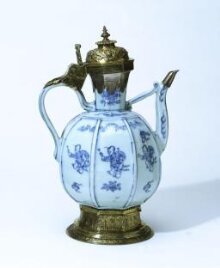
| Physical description | A Wan Li porcelain ewer with silver-gilt foot-ring, neck mount and lid; silver spout, lip and neck-band added later. The octagonal vessel has a U-shaped handle and curved spout held by a porcelain stay. The foot-ring has applied bands of die-struck ovolo in high relief. Eight heavy-guage vertical strips are shaped to the porcelain foot; applied to the exterior is a light-gauge strip struck seven times with a bird and swag repeat. Below the neck a white silver band rises from a pierced border crudely engraved with a linear repeat. The (restored) neck has a gilt mount attached to a silver lining. The spout tip is sheathed with white silver, lightly engraved. Seven panels of the octagonal neck mount are engraved respectively with a wolf, a dog, a hare, two more dogs, a boar and a dog in foliage. The hinge-box (now cemented to the handle) was originally secured by three pins, now missing. The shaped side panels of the hinge-box are engraved with birds, the curved centre panel with a fruit pendant terminating in a pierced acanthus chased and shaped to the handle. The cast mermaid and cornucopia thumb-piece is soldered to an extension of the cover. The octagonal cover is embossed and chased with three variant horned masks in elaborate burnished cartouches between fruit pendants on a matted ground. (P. Glanville, Silver in Tudor and Early Stuart England, No 98) |
| Dimensions |
|
| Marks and inscriptions |
|
| Gallery label | British Galleries:
LUXURY IMPORTED MATERIALS Aristocrats and wealthy merchants used decorative and expensive tableware to demonstrate their wealth and social status to guests. Splendid rarities, such as the pieces here, created lavish settings for a dessert of wine and sweetmeats. The weight and high quality of the silver mounts indicated the prestige associated with imported Chinese porcelain and other exotic materials.(27/03/2003) |
| Object history | Acquisition method and source not identified in the Asia Department registers, accessioned in 1862. This acquisition information reflects that found in the Asia Department registers, as part of a 2022 provenance research project. Porcelain made at Jingdezhen kilns in Jiangxi Province, China; mounts made in London |
| Historical context | The details of the mounts (the stamps and the carefully cast thumb-piece) indicate a slightly higher level of discrimination in the customer than the general run of mounted wares. (P. Glanville, Silver in Tudor and Early Stuart England, No. 98) |
| Production | Some later 17th century additions; The goldsmith whose mark was three trefoils slipped (perhaps an alien) was active between ca. 1575 and 1615; his mark is known on particularly high-quality mounts attached to exotic materials. (P. Glanville, Silver in Tudor and Early Stuart England, cat. no. 98) |
| Subjects depicted | |
| Summary | Object Type This is a porcelain ewer of not especially high quality. It was made in Jingdezhen, a city in central southern China that mass-produced thousands of similar pieces. Some were for the home market and some for export. Materials & Making In late 16th century Europe, porcelain was a valuable and expensive material. Many people were still not certain what it was. Some said it was a precious stone, or a composite material made from crushed shells. The possession of such items made of hard, white, translucent material and decorated in fine detail, denoted wealth and high social standing. For this reason such 'exotica' were often enhanced with metal mounts. |
| Collection | |
| Accession number | 7915-1862 |
About this object record
Explore the Collections contains over a million catalogue records, and over half a million images. It is a working database that includes information compiled over the life of the museum. Some of our records may contain offensive and discriminatory language, or reflect outdated ideas, practice and analysis. We are committed to addressing these issues, and to review and update our records accordingly.
You can write to us to suggest improvements to the record.
Suggest feedback
You can write to us to suggest improvements to the record.
Suggest feedback
| Record created | June 1, 1998 |
| Record URL |
Download as: JSONIIIF Manifest
