1801 (printed)
| Artist/Maker | |
| Place of origin |
Object Type
This print is an etching. The action of acid was used to make a pattern of grooves on a copper printing plate. The grooves were then filled with ink and the image was transferred onto a blank sheet of paper.
Design
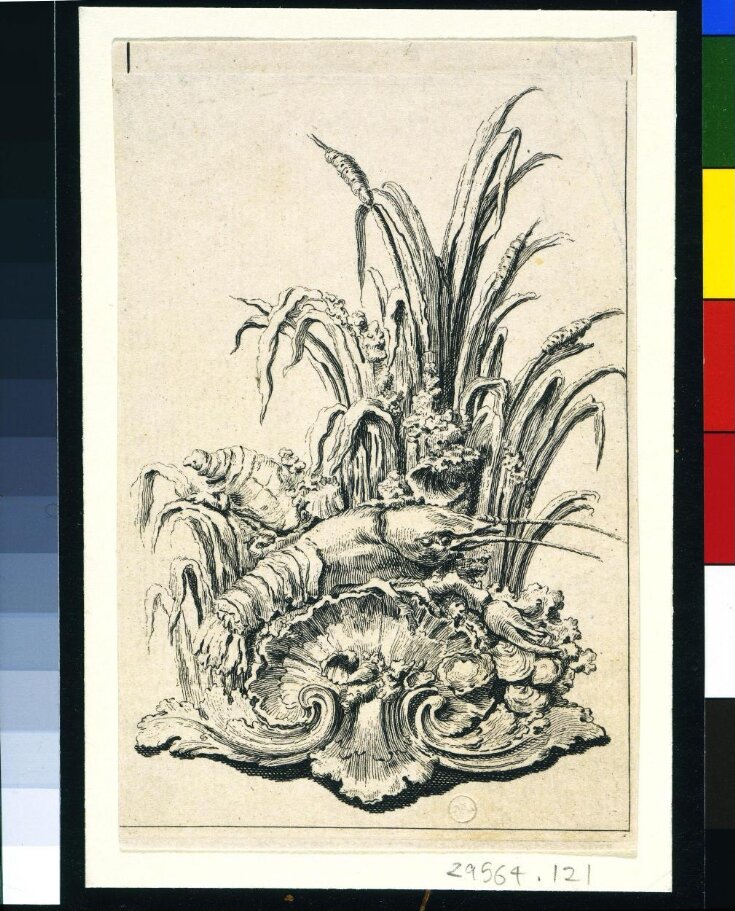
The concept of a crayfish, reeds and a shell-like motif was copied from a design by Juste-Aurèle Meissonnier that was published in 1734 in a collection of designs entitled Livre de Légumes.
Prints like this, with naturalistic plants and animals arranged ornamentally, had a strong influence on British Rococo porcelain and silver design. In fact, a silver salt cellar in the form of a crayfish, probably based on this print, was produced in 1742-1743 by the silversmith, designer and porcelain manufacturer Nicolas Sprimont. The design of the salt cellar was then repeated in porcelain at Sprimont's Chelsea porcelain factory (see museum no. C.73-1938).
People
Juste-Aurèle Meissonnier was a versatile and inventive designer, producing designs for a wide range of items, from table-wares and clocks to firework displays and buildings. He is an important figure in the history of the Rococo style, introducing asymmetry and picturesque irregularity through designs such as this.
This print is an etching. The action of acid was used to make a pattern of grooves on a copper printing plate. The grooves were then filled with ink and the image was transferred onto a blank sheet of paper.
Design
The concept of a crayfish, reeds and a shell-like motif was copied from a design by Juste-Aurèle Meissonnier that was published in 1734 in a collection of designs entitled Livre de Légumes.
Prints like this, with naturalistic plants and animals arranged ornamentally, had a strong influence on British Rococo porcelain and silver design. In fact, a silver salt cellar in the form of a crayfish, probably based on this print, was produced in 1742-1743 by the silversmith, designer and porcelain manufacturer Nicolas Sprimont. The design of the salt cellar was then repeated in porcelain at Sprimont's Chelsea porcelain factory (see museum no. C.73-1938).
People
Juste-Aurèle Meissonnier was a versatile and inventive designer, producing designs for a wide range of items, from table-wares and clocks to firework displays and buildings. He is an important figure in the history of the Rococo style, introducing asymmetry and picturesque irregularity through designs such as this.
Object details
| Categories | |
| Object type | |
| Materials and techniques | Engraving and etching |
| Brief description | Plate from a volume of interior decorations, one of 73 bound together, Paris, 1801. |
| Physical description | Engravings and etchings, designs for furniture |
| Dimensions |
|
| Gallery label | British Galleries:
Jean-Baptiste Chatelain copied this design from one published in 1734 by Juste-Aurèle Meissonnier, a leading French Rococo designer and goldsmith. Meissonnier's print was probably the design source for Chelsea's crayfish salt cellars, one of which is exhibited below.(27/03/2003) |
| Object history | Probably etched in London by Jean-Baptiste Chatelain (probably born in London, 1710, died in London, 1758) after Juste-Aurèle Meissonnier (born in Turin, Italy, 1695, died in Paris, 1750) |
| Subjects depicted | |
| Summary | Object Type This print is an etching. The action of acid was used to make a pattern of grooves on a copper printing plate. The grooves were then filled with ink and the image was transferred onto a blank sheet of paper. Design The concept of a crayfish, reeds and a shell-like motif was copied from a design by Juste-Aurèle Meissonnier that was published in 1734 in a collection of designs entitled Livre de Légumes. Prints like this, with naturalistic plants and animals arranged ornamentally, had a strong influence on British Rococo porcelain and silver design. In fact, a silver salt cellar in the form of a crayfish, probably based on this print, was produced in 1742-1743 by the silversmith, designer and porcelain manufacturer Nicolas Sprimont. The design of the salt cellar was then repeated in porcelain at Sprimont's Chelsea porcelain factory (see museum no. C.73-1938). People Juste-Aurèle Meissonnier was a versatile and inventive designer, producing designs for a wide range of items, from table-wares and clocks to firework displays and buildings. He is an important figure in the history of the Rococo style, introducing asymmetry and picturesque irregularity through designs such as this. |
| Bibliographic reference | Lambert, Susan (ed.) Pattern & Design: Designs for the Decorative Arts 1480-1980 London: Victoria and Albert Museum, 1983 |
| Collection | |
| Accession number | 29564:121 |
About this object record
Explore the Collections contains over a million catalogue records, and over half a million images. It is a working database that includes information compiled over the life of the museum. Some of our records may contain offensive and discriminatory language, or reflect outdated ideas, practice and analysis. We are committed to addressing these issues, and to review and update our records accordingly.
You can write to us to suggest improvements to the record.
Suggest feedback
You can write to us to suggest improvements to the record.
Suggest feedback
| Record created | March 27, 2003 |
| Record URL |
Download as: JSONIIIF Manifest
