
andiron
Andiron
1876 -1884 (made)
1876 -1884 (made)
| Artist/Maker | |
| Place of origin |
Object Type
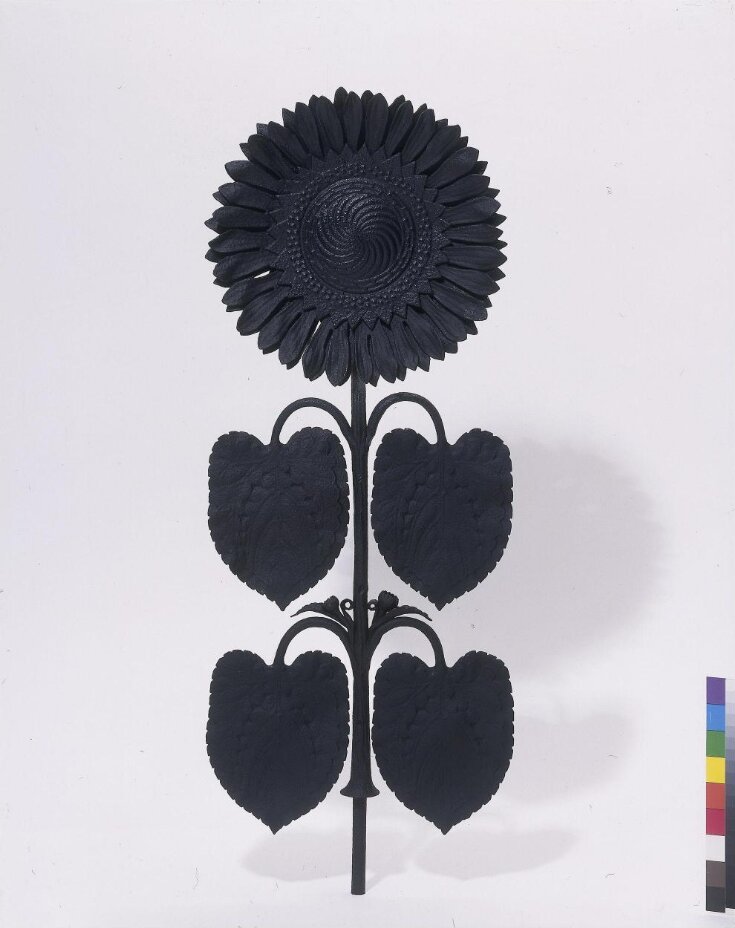
This wrought-iron sunflower would originally have slotted into an andiron, or fire-dog. Designed by Thomas Jeckyll (1827-1881) around 1876, this type of andiron was not produced in great quantity. However, Jeckyll's reworking of the simple lines of Japanese prints, their imagery inspired by nature, proved popular; it is perhaps partly thanks to this design that the sunflower became a motif closely associated with the Aesthetic Movement. When the sunflower was given to the Museum in 1952, it was believed to be a section of railing from the railings that encircled the Japanese Pavilion at the Centennial Exhibition of 1876 in Philadelphia, and the Paris exhibition of 1878. The two-storey, wrought and cast-iron pavilion had also been designed by Thomas Jeckyll and made by Barnard, Bishop and Barnard.
People
Thomas Jeckyll trained as an architect and was active, both as an architect and designer, in London and Norfolk. In the 1860s he came into contact with James Abbot McNeil Whistler (1834-1903) and E.W. Godwin (1833-1886). By the 1870s, Jeckyll was one of the leading architects of the Aesthetic Movement. He designed an interior for the Holland Park house of the collector, Alexander Ionides (1833-1900) (who bequeathed much of his collection of paintings to the V&A) and the dining room of a house in Princes Gate. (Due to its later painted decoration by Whistler, this room became known as the Peacock Room, and is currently on display in the Freer Art Gallery, Washington, D.C.) Jeckyll became mentally unstable in 1877 and died in an asylum in 1881.
Design & Designing
The Aesthetic or Art Movement was triggered by the display of Japanese decorative art at the London International Exhibition of 1862. Strongly influenced by Japanese design, the Aesthetic Movement was a reaction to the Gothic revival of the mid-19th century. In the new movement, the pursuit of 'art for art's sake' became a justifiable goal in itself. The Aesthetic Movement was established when the magazine Punch paid it the tribute of making a mockery of it.
This wrought-iron sunflower would originally have slotted into an andiron, or fire-dog. Designed by Thomas Jeckyll (1827-1881) around 1876, this type of andiron was not produced in great quantity. However, Jeckyll's reworking of the simple lines of Japanese prints, their imagery inspired by nature, proved popular; it is perhaps partly thanks to this design that the sunflower became a motif closely associated with the Aesthetic Movement. When the sunflower was given to the Museum in 1952, it was believed to be a section of railing from the railings that encircled the Japanese Pavilion at the Centennial Exhibition of 1876 in Philadelphia, and the Paris exhibition of 1878. The two-storey, wrought and cast-iron pavilion had also been designed by Thomas Jeckyll and made by Barnard, Bishop and Barnard.
People
Thomas Jeckyll trained as an architect and was active, both as an architect and designer, in London and Norfolk. In the 1860s he came into contact with James Abbot McNeil Whistler (1834-1903) and E.W. Godwin (1833-1886). By the 1870s, Jeckyll was one of the leading architects of the Aesthetic Movement. He designed an interior for the Holland Park house of the collector, Alexander Ionides (1833-1900) (who bequeathed much of his collection of paintings to the V&A) and the dining room of a house in Princes Gate. (Due to its later painted decoration by Whistler, this room became known as the Peacock Room, and is currently on display in the Freer Art Gallery, Washington, D.C.) Jeckyll became mentally unstable in 1877 and died in an asylum in 1881.
Design & Designing
The Aesthetic or Art Movement was triggered by the display of Japanese decorative art at the London International Exhibition of 1862. Strongly influenced by Japanese design, the Aesthetic Movement was a reaction to the Gothic revival of the mid-19th century. In the new movement, the pursuit of 'art for art's sake' became a justifiable goal in itself. The Aesthetic Movement was established when the magazine Punch paid it the tribute of making a mockery of it.
Object details
| Categories | |
| Object type | |
| Title | andiron (generic title) |
| Materials and techniques | Wrought iron |
| Brief description | Part, Wrought iron, made by Barnard, Bishop and Barnard, Norwich, designed by Thomas Jeckyll, 1876-1884. |
| Physical description | Section from an andiron or firedog in the form of a sunflower with four, stylised leaves pointing downwards. |
| Dimensions |
|
| Gallery label |
|
| Credit line | Given by Messrs Barnards Ltd. |
| Object history | Designed by Thomas Jeckyll (born in Norwich, 1827, died there in 1881); made by the firm of Barnard, Bishop and Barnard, Norwich. The wrought iron sunflower was lent to the Museum by Barnards Limited of Norwich in 1952, for an exhibition to commemorate the centenary of the Museum, 'Victorian and Edwardian Decorative Art'. Peter Floud, the exhibition organiser, contacted the directors of the Norwich ironworks Barnards Ltd (as the firm was then called) to ask whether they had - and could lend - a cast-iron panel from the Japanese Pavilion at the 1876 Philadelphia Centennial Exhibition, which had been designed by Jeckyll and erected by the company. In his reply, dated 10 June 1952, W. le Neve Bower, one of the firm's directors, explains that 'we much regret to inform you that we have been unable to find a complete fire basket or panels of the pagoda. We have, however, a complete sun-flower assembly which was used for the surrounding railings of the pagoda, and would be very happy to lend this to you'. Shortly afterwards, the loan was transformed into a gift. Research by Jonathan Asher, of the Friends of Heigham Park, Norwich, has shown that this account of the sunflower's provenance is incorrect. The design of the piece now in the V&A has only four leaves, and not the six of the pavilion railings. Moreover, the stem on the V&A example lacks naturalistic detail below the leaves, where it also narrows - features which suggest it was designed to slot into a base element. Given this, the sunflower in the Museum can no longer be considered a section of railing, but instead must be an element from an andiron, or firedog. The 1952 confusion over the function of the piece probably lies in the fact that Jeckyll seems to have designed the motif for andirons in around 1876, and then adapted it to his design for the railings that enclosed the Japanese Pavilion in the same year. Sunflower andirons were also displayed in the Pavilion. Only two sections of the Pavilion railings survive toda, and these were transformed into gates in the 1920s and erected in the newly-created Heigham Park, Norwich. |
| Subject depicted | |
| Summary | Object Type This wrought-iron sunflower would originally have slotted into an andiron, or fire-dog. Designed by Thomas Jeckyll (1827-1881) around 1876, this type of andiron was not produced in great quantity. However, Jeckyll's reworking of the simple lines of Japanese prints, their imagery inspired by nature, proved popular; it is perhaps partly thanks to this design that the sunflower became a motif closely associated with the Aesthetic Movement. When the sunflower was given to the Museum in 1952, it was believed to be a section of railing from the railings that encircled the Japanese Pavilion at the Centennial Exhibition of 1876 in Philadelphia, and the Paris exhibition of 1878. The two-storey, wrought and cast-iron pavilion had also been designed by Thomas Jeckyll and made by Barnard, Bishop and Barnard. People Thomas Jeckyll trained as an architect and was active, both as an architect and designer, in London and Norfolk. In the 1860s he came into contact with James Abbot McNeil Whistler (1834-1903) and E.W. Godwin (1833-1886). By the 1870s, Jeckyll was one of the leading architects of the Aesthetic Movement. He designed an interior for the Holland Park house of the collector, Alexander Ionides (1833-1900) (who bequeathed much of his collection of paintings to the V&A) and the dining room of a house in Princes Gate. (Due to its later painted decoration by Whistler, this room became known as the Peacock Room, and is currently on display in the Freer Art Gallery, Washington, D.C.) Jeckyll became mentally unstable in 1877 and died in an asylum in 1881. Design & Designing The Aesthetic or Art Movement was triggered by the display of Japanese decorative art at the London International Exhibition of 1862. Strongly influenced by Japanese design, the Aesthetic Movement was a reaction to the Gothic revival of the mid-19th century. In the new movement, the pursuit of 'art for art's sake' became a justifiable goal in itself. The Aesthetic Movement was established when the magazine Punch paid it the tribute of making a mockery of it. |
| Bibliographic references |
|
| Collection | |
| Accession number | CIRC.530-1953 |
About this object record
Explore the Collections contains over a million catalogue records, and over half a million images. It is a working database that includes information compiled over the life of the museum. Some of our records may contain offensive and discriminatory language, or reflect outdated ideas, practice and analysis. We are committed to addressing these issues, and to review and update our records accordingly.
You can write to us to suggest improvements to the record.
Suggest feedback
You can write to us to suggest improvements to the record.
Suggest feedback
| Record created | June 1, 1998 |
| Record URL |
Download as: JSONIIIF Manifest
