
Snuffer
1830-1840 (made)
| Artist/Maker | |
| Place of origin |
Object Type
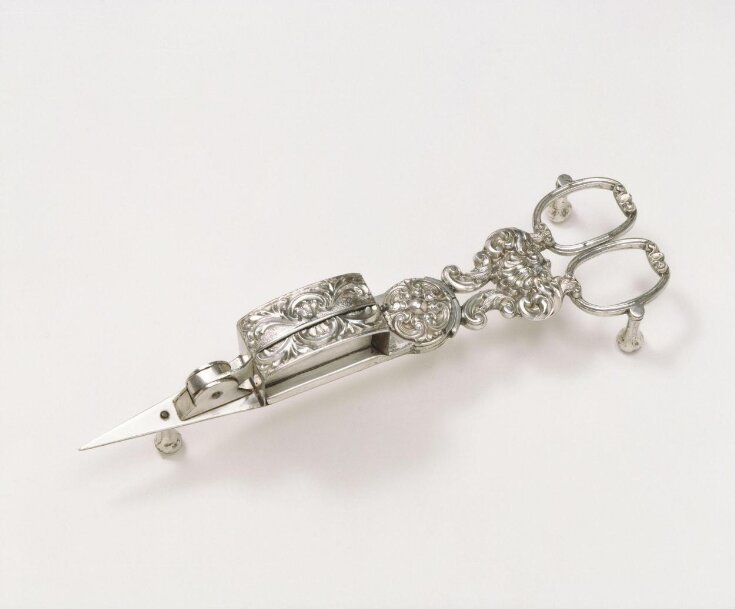
Snuffers were first invented to cut off and retain the burned wicks of candles when the wax around them had melted; they were not necessarily used to extinguish the candle's flame. The point at the end was for retrieving the tip of the wick if it fell into molten wax. Snuffers are first recorded in the 15th century. Numerous patents for them are known from the mid-18th century, regularly reappearing with new improvements until 1840, when candles that completely consumed their wicks were first developed, rendering snuffers superfluous.
Materials & Making
These snuffers have been close-plated. Close-plating was the application of a sheet of silver foil to a polished steel surface. The whole surface to be plated is first made smooth, then dipped in sal-ammoniac and then into molten tin, the sal-ammoniac serving as a flux. A thin foil of silver of the correct size is laid on and pressed evenly and smoothly over the surface. A hot soldering iron when passed over the foil serves to melt the tin, which acts as a solder between the iron and the silver, after which the piece is burnished. With close-plated articles, rust tended to appear relatively quickly, but it was none the less commonly used for buckles, knife blades, skewers, spurs, snuffers and other steel articles.
Time
The mark of a crown between the letters' WR' dates the snuffers to the reign of William IV (1830-1837), though the use of the sprung cutter was superseded in a patent of 1810.
Snuffers were first invented to cut off and retain the burned wicks of candles when the wax around them had melted; they were not necessarily used to extinguish the candle's flame. The point at the end was for retrieving the tip of the wick if it fell into molten wax. Snuffers are first recorded in the 15th century. Numerous patents for them are known from the mid-18th century, regularly reappearing with new improvements until 1840, when candles that completely consumed their wicks were first developed, rendering snuffers superfluous.
Materials & Making
These snuffers have been close-plated. Close-plating was the application of a sheet of silver foil to a polished steel surface. The whole surface to be plated is first made smooth, then dipped in sal-ammoniac and then into molten tin, the sal-ammoniac serving as a flux. A thin foil of silver of the correct size is laid on and pressed evenly and smoothly over the surface. A hot soldering iron when passed over the foil serves to melt the tin, which acts as a solder between the iron and the silver, after which the piece is burnished. With close-plated articles, rust tended to appear relatively quickly, but it was none the less commonly used for buckles, knife blades, skewers, spurs, snuffers and other steel articles.
Time
The mark of a crown between the letters' WR' dates the snuffers to the reign of William IV (1830-1837), though the use of the sprung cutter was superseded in a patent of 1810.
Object details
| Categories | |
| Object type | |
| Materials and techniques | Close-plated iron or steel, with lead-filled silver |
| Brief description | Candle snuffers |
| Dimensions |
|
| Marks and inscriptions | Marked 'WR' with a crown |
| Gallery label | British Galleries:
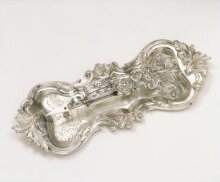
This pair of snuffers is made in a complex way. The main structure and working parts are made of steel, close-plated in silver. The decoration is carried out in stamped silver filled with lead. Snuffers were not primarily for putting out candles but for trimming their wicks.(27/03/2003) |
| Credit line | Given by C. B. Farmer |
| Object history | Made by the firm of J. Hobday, Birmingham |
| Summary | Object Type Snuffers were first invented to cut off and retain the burned wicks of candles when the wax around them had melted; they were not necessarily used to extinguish the candle's flame. The point at the end was for retrieving the tip of the wick if it fell into molten wax. Snuffers are first recorded in the 15th century. Numerous patents for them are known from the mid-18th century, regularly reappearing with new improvements until 1840, when candles that completely consumed their wicks were first developed, rendering snuffers superfluous. Materials & Making These snuffers have been close-plated. Close-plating was the application of a sheet of silver foil to a polished steel surface. The whole surface to be plated is first made smooth, then dipped in sal-ammoniac and then into molten tin, the sal-ammoniac serving as a flux. A thin foil of silver of the correct size is laid on and pressed evenly and smoothly over the surface. A hot soldering iron when passed over the foil serves to melt the tin, which acts as a solder between the iron and the silver, after which the piece is burnished. With close-plated articles, rust tended to appear relatively quickly, but it was none the less commonly used for buckles, knife blades, skewers, spurs, snuffers and other steel articles. Time The mark of a crown between the letters' WR' dates the snuffers to the reign of William IV (1830-1837), though the use of the sprung cutter was superseded in a patent of 1810. |
| Collection | |
| Accession number | 284-1899 |
About this object record
Explore the Collections contains over a million catalogue records, and over half a million images. It is a working database that includes information compiled over the life of the museum. Some of our records may contain offensive and discriminatory language, or reflect outdated ideas, practice and analysis. We are committed to addressing these issues, and to review and update our records accordingly.
You can write to us to suggest improvements to the record.
Suggest feedback
You can write to us to suggest improvements to the record.
Suggest feedback
| Record created | March 27, 2003 |
| Record URL |
Download as: JSONIIIF Manifest
