Button
1785-1800 (made)
| Artist/Maker | |
| Place of origin |
Object Type
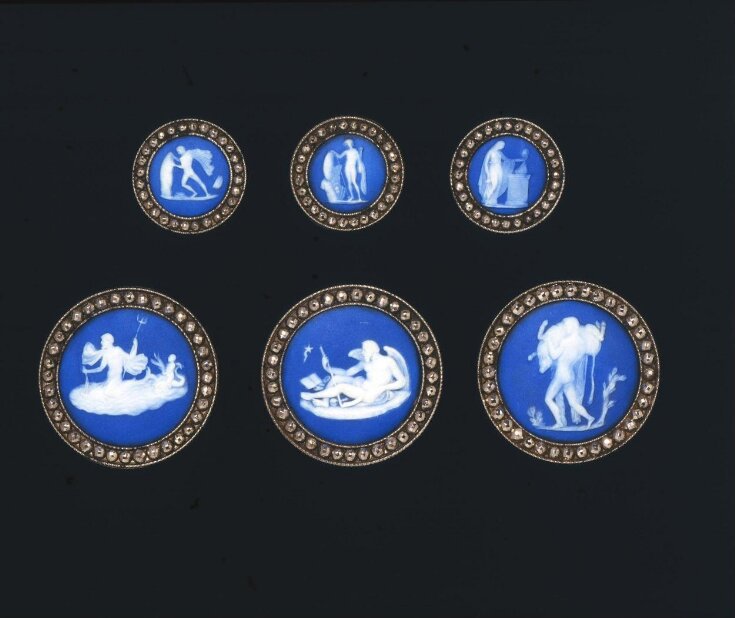
These buttons are for a man's formal coat. Large buttons became fashionable in the 1780s. By this date they were entirely decorative, as the coat was usually worn open over a matching waistcoat. The waistcoat would have had a set of smaller, matching buttons.
Trading
The Staffordshire potter Josiah Wedgwood (1730-1795) sold small quantities of steel-mounted Jasper medallions in his London showrooms, but the majority were mounted and sold by other manufacturers. According to his catalogue of 1779, the price of cameos with 'several Figures' was 'ten Times less than any other durable Imitations that have ever been made in Europe'.
Materials & Making
Steel was relatively inexpensive, but the labour-intensive facetting on the best cut-steel work made it costly. The cut-steel mounts on Wedgwood's Jasper are often attributed to the great Birmingham industrialist Matthew Boulton (1728-1809), a friend and rival of Wedgwood's. However, Wedgwood also sold Jasper for mounting to others, including Green & Vale of Birmingham and Vernon & Hasselwood of Wolverhampton. Birmingham, Wolverhampton and Woodstock were the chief centres for cut-steel.
These buttons are for a man's formal coat. Large buttons became fashionable in the 1780s. By this date they were entirely decorative, as the coat was usually worn open over a matching waistcoat. The waistcoat would have had a set of smaller, matching buttons.
Trading
The Staffordshire potter Josiah Wedgwood (1730-1795) sold small quantities of steel-mounted Jasper medallions in his London showrooms, but the majority were mounted and sold by other manufacturers. According to his catalogue of 1779, the price of cameos with 'several Figures' was 'ten Times less than any other durable Imitations that have ever been made in Europe'.
Materials & Making
Steel was relatively inexpensive, but the labour-intensive facetting on the best cut-steel work made it costly. The cut-steel mounts on Wedgwood's Jasper are often attributed to the great Birmingham industrialist Matthew Boulton (1728-1809), a friend and rival of Wedgwood's. However, Wedgwood also sold Jasper for mounting to others, including Green & Vale of Birmingham and Vernon & Hasselwood of Wolverhampton. Birmingham, Wolverhampton and Woodstock were the chief centres for cut-steel.
Object details
| Categories | |
| Object type | |
| Parts | This object consists of 14 parts.
|
| Materials and techniques | Jasperware, mounted in cut steel |
| Brief description | A set of twelve buttons, blue jasperware with a white relief, mounted in cut steel, made by Josiah Wedgwood and Sons in Etruria, the steel probably Birmingham, 1785-1800 |
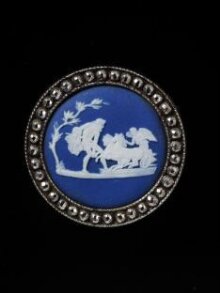
| Physical description | Buttons of blue jasperware with white relief, mounted in cut steel. |
| Dimensions |
|
| Gallery label | British Galleries:
The vogue for large buttons began in France and was taken up in England in the 1780s. It encouraged the use of decorative materials like cut steel. The large buttons are from a man's dress coat; the smaller ones are from the waistcoat or cuffs of the coat sleeves.(27/03/2003) |
| Object history | Steel probably made in Birmingham; Jasper made at Josiah Wedgwood's factory, Etruria, Staffordshire |
| Summary | Object Type These buttons are for a man's formal coat. Large buttons became fashionable in the 1780s. By this date they were entirely decorative, as the coat was usually worn open over a matching waistcoat. The waistcoat would have had a set of smaller, matching buttons. Trading The Staffordshire potter Josiah Wedgwood (1730-1795) sold small quantities of steel-mounted Jasper medallions in his London showrooms, but the majority were mounted and sold by other manufacturers. According to his catalogue of 1779, the price of cameos with 'several Figures' was 'ten Times less than any other durable Imitations that have ever been made in Europe'. Materials & Making Steel was relatively inexpensive, but the labour-intensive facetting on the best cut-steel work made it costly. The cut-steel mounts on Wedgwood's Jasper are often attributed to the great Birmingham industrialist Matthew Boulton (1728-1809), a friend and rival of Wedgwood's. However, Wedgwood also sold Jasper for mounting to others, including Green & Vale of Birmingham and Vernon & Hasselwood of Wolverhampton. Birmingham, Wolverhampton and Woodstock were the chief centres for cut-steel. |
| Bibliographic reference | Mason, Shena (Ed.), Matthew Boulton: selling what all the world desires, Birmingham, Birmingham City Council, 2009
ill. p.147 |
| Collection | |
| Accession number | 276 to N-1866 |
About this object record
Explore the Collections contains over a million catalogue records, and over half a million images. It is a working database that includes information compiled over the life of the museum. Some of our records may contain offensive and discriminatory language, or reflect outdated ideas, practice and analysis. We are committed to addressing these issues, and to review and update our records accordingly.
You can write to us to suggest improvements to the record.
Suggest feedback
You can write to us to suggest improvements to the record.
Suggest feedback
| Record created | March 27, 2003 |
| Record URL |
Download as: JSONIIIF Manifest
