Plate
1850-1864 (made)
| Artist/Maker | |
| Place of origin |
Object Type
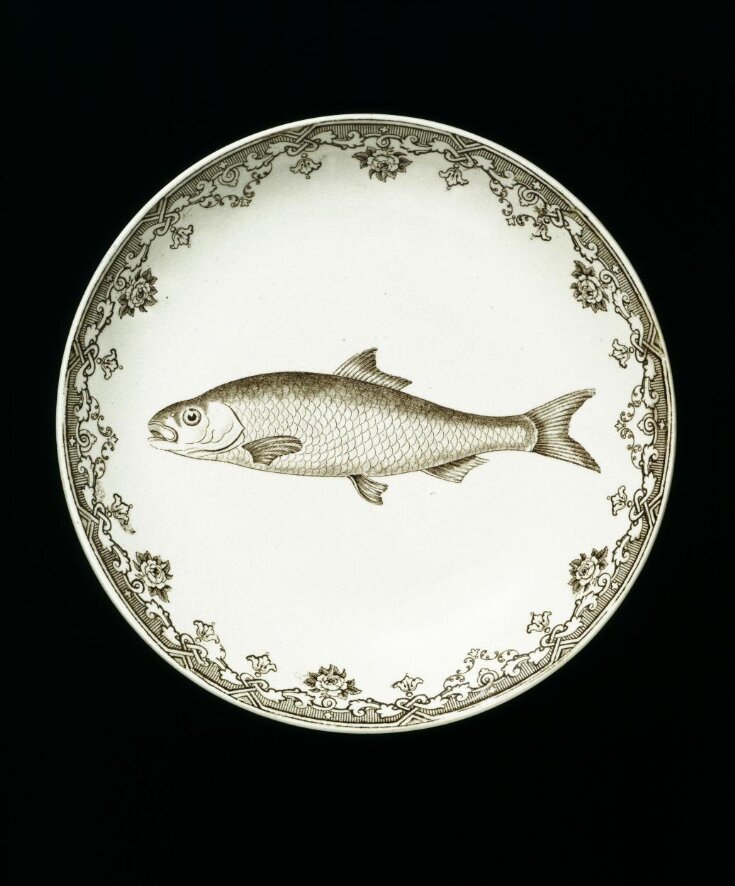
This plate comes from a service specifically for fish, or from a larger service in which each set of plates was decorated with the food appropriate for a particular course. This is a comparatively inexpensive plate in earthenware, decorated by transfer-printing only, with no hand-colouring.
Design & Designing
This plate recalls the characteristic design used for char-pots, containers used for serving potted char (a Lake District trout), which were made of English delftware, pearlware or creamware and had the image of a fish modelled on the lid. Although this plate is from a comparatively little-known factory, the quality of print is sharp and accurate and the fish is clearly identifiable as a herring. The print was presumably taken from one of the many anthologies of natural history published during the mid- and late 19th century.
Time
Close & Co. of Church Street, Stoke-on-Trent, was apparently in operation for only a short period , from around 1855 to around 1864 or 1869. The owner was John Theophilus Close, who is also recorded as at Brook Street and High Street. Many 19th-century factories were short-lived as markets and fortunes fluctuated, and the names of many makers have been lost.
This plate comes from a service specifically for fish, or from a larger service in which each set of plates was decorated with the food appropriate for a particular course. This is a comparatively inexpensive plate in earthenware, decorated by transfer-printing only, with no hand-colouring.
Design & Designing
This plate recalls the characteristic design used for char-pots, containers used for serving potted char (a Lake District trout), which were made of English delftware, pearlware or creamware and had the image of a fish modelled on the lid. Although this plate is from a comparatively little-known factory, the quality of print is sharp and accurate and the fish is clearly identifiable as a herring. The print was presumably taken from one of the many anthologies of natural history published during the mid- and late 19th century.
Time
Close & Co. of Church Street, Stoke-on-Trent, was apparently in operation for only a short period , from around 1855 to around 1864 or 1869. The owner was John Theophilus Close, who is also recorded as at Brook Street and High Street. Many 19th-century factories were short-lived as markets and fortunes fluctuated, and the names of many makers have been lost.
Object details
| Categories | |
| Object type | |
| Materials and techniques | Earthenware, transfer-printed in black enamel |
| Brief description | Plate of earthenware, transfer-printed in black enamel with an image of fish, Close & Co., Hanley, Stoke-on-Trent, 1850-1864 |
| Physical description | Plate of earthenware, transfer-printed in black enamel with a fish in the middle and a border of roses and scrolls round the rim. |
| Dimensions |
|
| Marks and inscriptions |
|
| Gallery label |
|
| Credit line | Transferred from the Museum of Practical Geology, Jermyn Street |
| Object history | Manufactured by Close & Co., Stoke-on-Trent, Staffordshire. Jermyn Street Collection. |
| Subjects depicted | |
| Summary | Object Type This plate comes from a service specifically for fish, or from a larger service in which each set of plates was decorated with the food appropriate for a particular course. This is a comparatively inexpensive plate in earthenware, decorated by transfer-printing only, with no hand-colouring. Design & Designing This plate recalls the characteristic design used for char-pots, containers used for serving potted char (a Lake District trout), which were made of English delftware, pearlware or creamware and had the image of a fish modelled on the lid. Although this plate is from a comparatively little-known factory, the quality of print is sharp and accurate and the fish is clearly identifiable as a herring. The print was presumably taken from one of the many anthologies of natural history published during the mid- and late 19th century. Time Close & Co. of Church Street, Stoke-on-Trent, was apparently in operation for only a short period , from around 1855 to around 1864 or 1869. The owner was John Theophilus Close, who is also recorded as at Brook Street and High Street. Many 19th-century factories were short-lived as markets and fortunes fluctuated, and the names of many makers have been lost. |
| Collection | |
| Accession number | 2561-1901 |
About this object record
Explore the Collections contains over a million catalogue records, and over half a million images. It is a working database that includes information compiled over the life of the museum. Some of our records may contain offensive and discriminatory language, or reflect outdated ideas, practice and analysis. We are committed to addressing these issues, and to review and update our records accordingly.
You can write to us to suggest improvements to the record.
Suggest feedback
You can write to us to suggest improvements to the record.
Suggest feedback
| Record created | March 27, 2003 |
| Record URL |
Download as: JSONIIIF Manifest
