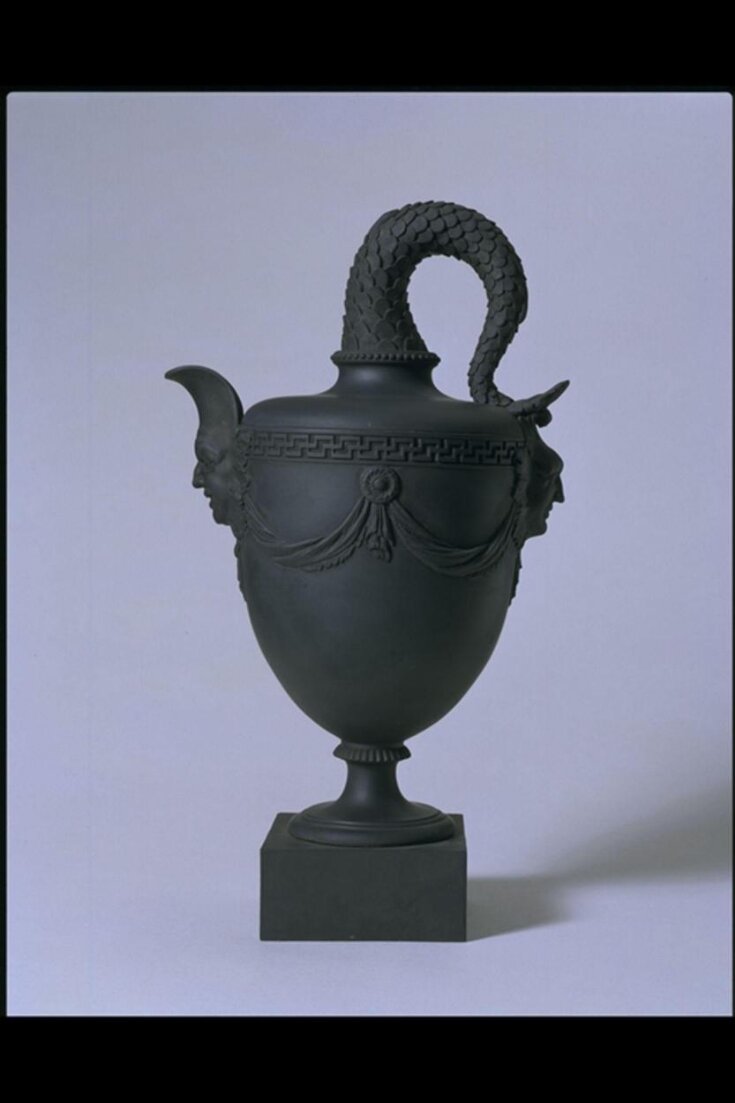

Ewer
1769-1780 (made)
| Artist/Maker | |
| Place of origin |
Object Type
The vase was purely decorative and would have been displayed in a domestic interior, possibly on a mantelpiece, where it may have been flanked by other, smaller vases.
Design & Designing
Josiah Wedgwood's move into vase production coincided with the fashionable world taking up the vase as a symbol of the new 'antique' style. The demand for 'antique' vases was so great that, in addition to copying surviving Classical antiquities, manufacturers took designs from prints of the 17th and 18th centuries. Some of these prints were highly fanciful inventions, which were not seriously intended as models for production. Wedgwood adapted the design here from the Livre de Vases put together by the French painter Jacques Stella (1596-1657). Wedgwood further dramatised Stella's design by adding scales to the fish tail and increasing the height of the plinth. He described Stella's book, published in 1667, as 'an admirable one indeed', and commented that 'many good things may be made out of [it]'. Wedgwood based at least four of his vase shapes on designs by Stella.
Materials & Making
The vase is made of Black Basalt, one of several types of pottery that Wedgwood (1730-1795) introduced or refined. The colour came from 'Carr', an oxide of iron suspended in water that had flowed through coal seams and mines.
The vase was purely decorative and would have been displayed in a domestic interior, possibly on a mantelpiece, where it may have been flanked by other, smaller vases.
Design & Designing
Josiah Wedgwood's move into vase production coincided with the fashionable world taking up the vase as a symbol of the new 'antique' style. The demand for 'antique' vases was so great that, in addition to copying surviving Classical antiquities, manufacturers took designs from prints of the 17th and 18th centuries. Some of these prints were highly fanciful inventions, which were not seriously intended as models for production. Wedgwood adapted the design here from the Livre de Vases put together by the French painter Jacques Stella (1596-1657). Wedgwood further dramatised Stella's design by adding scales to the fish tail and increasing the height of the plinth. He described Stella's book, published in 1667, as 'an admirable one indeed', and commented that 'many good things may be made out of [it]'. Wedgwood based at least four of his vase shapes on designs by Stella.
Materials & Making
The vase is made of Black Basalt, one of several types of pottery that Wedgwood (1730-1795) introduced or refined. The colour came from 'Carr', an oxide of iron suspended in water that had flowed through coal seams and mines.
Object details
| Categories | |
| Object type | |
| Materials and techniques | Black basalt with applied and moulded decoration in relief |
| Brief description | Ewer, black basalt with applied and moulded decoration in relief, based on a design in the Livre de vases, published in 1667, by Jacques Stella, made at Josiah Wedgwood's factory, Etruria, Staffordshire, 1769-1780 |
| Physical description | Vase of black basalt, with applied and moulded decoration in relief. The ovoid body and flattened top are in one piece decorated with a band of fret-pattern round the shoulder and festoons of drapery below; tall circular foot resting on a high square plinth. From the top rises a dolphin's tail, arched to form a handle at the base of which is applied a grotesque mask; a similar mask is placed on the front of the body forming the spout. |
| Dimensions |
|
| Marks and inscriptions | 'WEDGWOOD & BENTLEY: ETRURIA' (Maker's identification; in applied circular seal) |
| Gallery label | Ewer
made at the factory of Josiah Wedgwood, Etruria, Staffordshire, 1769-1780
Mark: 'WEDGWOOD & BENTLEY, ETRURIA'
Black Basalt
2398-1901 Jermyn Street Collection
The source for the design of this vase is a print of 1667 by Jacques Stella.(23/05/2008) |
| Credit line | Transferred from the Museum of Practical Geology, Jermyn Street |
| Object history | Jermyn Street Collection. Based on a design in the Livre de vases, published in 1667, by Jacques Stella (born in Lyon, France, in 1596, died in Paris in 1657); Made at Josiah Wedgwood's factory, Etruria, Staffordshire |
| Subjects depicted | |
| Summary | Object Type The vase was purely decorative and would have been displayed in a domestic interior, possibly on a mantelpiece, where it may have been flanked by other, smaller vases. Design & Designing Josiah Wedgwood's move into vase production coincided with the fashionable world taking up the vase as a symbol of the new 'antique' style. The demand for 'antique' vases was so great that, in addition to copying surviving Classical antiquities, manufacturers took designs from prints of the 17th and 18th centuries. Some of these prints were highly fanciful inventions, which were not seriously intended as models for production. Wedgwood adapted the design here from the Livre de Vases put together by the French painter Jacques Stella (1596-1657). Wedgwood further dramatised Stella's design by adding scales to the fish tail and increasing the height of the plinth. He described Stella's book, published in 1667, as 'an admirable one indeed', and commented that 'many good things may be made out of [it]'. Wedgwood based at least four of his vase shapes on designs by Stella. Materials & Making The vase is made of Black Basalt, one of several types of pottery that Wedgwood (1730-1795) introduced or refined. The colour came from 'Carr', an oxide of iron suspended in water that had flowed through coal seams and mines. |
| Bibliographic reference | Young, Hilary (ed.). The Genius of Wedgwood. London : Victoria & Albert Museum, 1995
E8 |
| Collection | |
| Accession number | 2398-1901 |
About this object record
Explore the Collections contains over a million catalogue records, and over half a million images. It is a working database that includes information compiled over the life of the museum. Some of our records may contain offensive and discriminatory language, or reflect outdated ideas, practice and analysis. We are committed to addressing these issues, and to review and update our records accordingly.
You can write to us to suggest improvements to the record.
Suggest feedback
You can write to us to suggest improvements to the record.
Suggest feedback
| Record created | March 27, 2003 |
| Record URL |
Download as: JSONIIIF Manifest
