Plate
ca. 1790 (made)
| Artist/Maker | |
| Place of origin |
Object Type
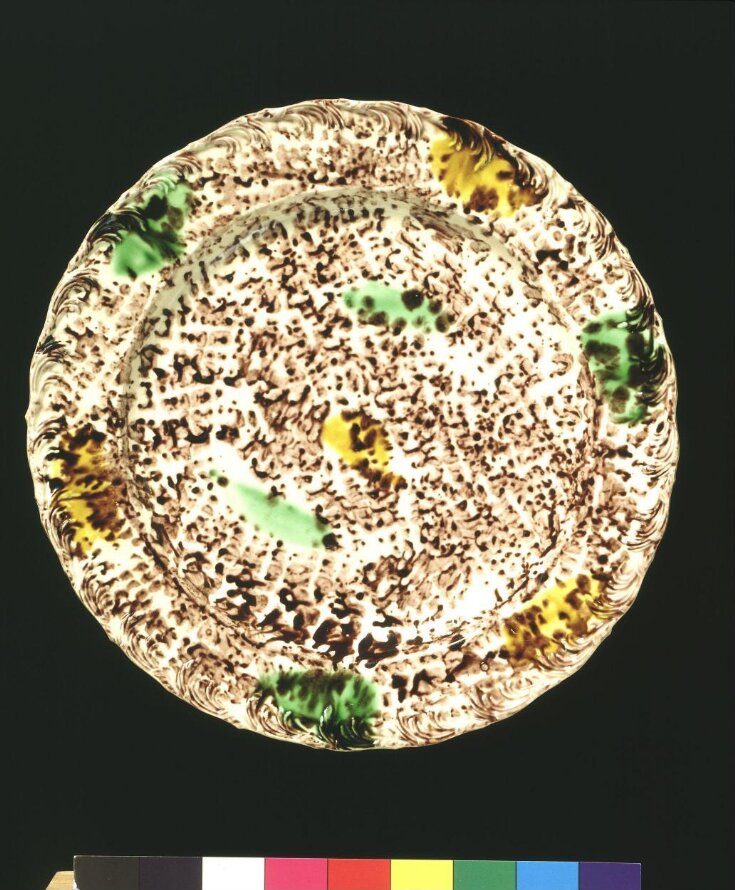
One would certainly have thought that this late version of a tortoiseshell plate was made in the English Midlands, but archaeological evidence has shown that it was made at the Swinton Pottery in Yorkshire (the unique 'cock's tail' moulded border of the plate matches fragments excavated there). It would also have been thought to date 20 or 30 years earlier, tortoiseshell decoration being firmly associated with the Rococo style and not with Neo-classicism.
Materials & Making
Although the potteries in the Leeds area of Yorkshire were famed for their plain - and especially their pierced - creamwares, of the type perfected by the Staffordshire potter Josiah Wedgwood as 'Queen's Ware' in the 1760s, demand continued for other types of pottery. These included Pearlwares, with their blue-tinted glaze and sketchy blue-painted decoration; creamwares with a dark-brown underside copying earlier Chinese 'Batavian' wares (a type of brown-glazed Chinese porcelain, named after the Dutch trading post through which much of it passed on its way to Britain); and tortoiseshell decoration produced by sponging iron and manganese oxides onto the unglazed biscuit body. This last technique would have added considerably to the cost: an advertisement of the 1750s for tortoiseshell ware lists plates at four times the price of plain ones. There is no doubt, therefore, that there was a ready market - quite probably on the Continent - for these plates. By 1800, however, they must have appeared quite old fashioned.
People & Place
The Brameld family who worked the Swinton Pottery at Wentworth Woodhouse, South Yorkshire, at this period followed the tradition of making enough money from producing good-quality earthenware in order to experiment with porcelain. By 1826, when the Swinton Pottery was renamed the Rockingham Works, 'Rockingham Work' pottery was making ambitious porcelains under the patronage of the landlord, William Wentworth Fitzwilliam, 2nd Earl Fitzwilliam (1748-1833).
One would certainly have thought that this late version of a tortoiseshell plate was made in the English Midlands, but archaeological evidence has shown that it was made at the Swinton Pottery in Yorkshire (the unique 'cock's tail' moulded border of the plate matches fragments excavated there). It would also have been thought to date 20 or 30 years earlier, tortoiseshell decoration being firmly associated with the Rococo style and not with Neo-classicism.
Materials & Making
Although the potteries in the Leeds area of Yorkshire were famed for their plain - and especially their pierced - creamwares, of the type perfected by the Staffordshire potter Josiah Wedgwood as 'Queen's Ware' in the 1760s, demand continued for other types of pottery. These included Pearlwares, with their blue-tinted glaze and sketchy blue-painted decoration; creamwares with a dark-brown underside copying earlier Chinese 'Batavian' wares (a type of brown-glazed Chinese porcelain, named after the Dutch trading post through which much of it passed on its way to Britain); and tortoiseshell decoration produced by sponging iron and manganese oxides onto the unglazed biscuit body. This last technique would have added considerably to the cost: an advertisement of the 1750s for tortoiseshell ware lists plates at four times the price of plain ones. There is no doubt, therefore, that there was a ready market - quite probably on the Continent - for these plates. By 1800, however, they must have appeared quite old fashioned.
People & Place
The Brameld family who worked the Swinton Pottery at Wentworth Woodhouse, South Yorkshire, at this period followed the tradition of making enough money from producing good-quality earthenware in order to experiment with porcelain. By 1826, when the Swinton Pottery was renamed the Rockingham Works, 'Rockingham Work' pottery was making ambitious porcelains under the patronage of the landlord, William Wentworth Fitzwilliam, 2nd Earl Fitzwilliam (1748-1833).
Object details
| Categories | |
| Object type | |
| Materials and techniques | Earthenware, with lead-glazed 'tortoiseshell' decoration |
| Brief description | Plate with coloured lead-glaze tortoiseshell decorations |
| Dimensions |
|
| Gallery label | British Galleries:
Many types of decoration continued in production for a long time. 'Tortoiseshell' wares were first made from the mid-18th century but as late as 1796 Greens, Bingley & Co. of the Swinton Pottery were still advertising 'Cream-coloured...Nankeen Blue, Tortoise Shell, Fine Egyptian Black, Brown China etc.'.(27/03/2003) |
| Object history | Probably made at the Swinton Pottery, Swinton, South Yorkshire |
| Summary | Object Type One would certainly have thought that this late version of a tortoiseshell plate was made in the English Midlands, but archaeological evidence has shown that it was made at the Swinton Pottery in Yorkshire (the unique 'cock's tail' moulded border of the plate matches fragments excavated there). It would also have been thought to date 20 or 30 years earlier, tortoiseshell decoration being firmly associated with the Rococo style and not with Neo-classicism. Materials & Making Although the potteries in the Leeds area of Yorkshire were famed for their plain - and especially their pierced - creamwares, of the type perfected by the Staffordshire potter Josiah Wedgwood as 'Queen's Ware' in the 1760s, demand continued for other types of pottery. These included Pearlwares, with their blue-tinted glaze and sketchy blue-painted decoration; creamwares with a dark-brown underside copying earlier Chinese 'Batavian' wares (a type of brown-glazed Chinese porcelain, named after the Dutch trading post through which much of it passed on its way to Britain); and tortoiseshell decoration produced by sponging iron and manganese oxides onto the unglazed biscuit body. This last technique would have added considerably to the cost: an advertisement of the 1750s for tortoiseshell ware lists plates at four times the price of plain ones. There is no doubt, therefore, that there was a ready market - quite probably on the Continent - for these plates. By 1800, however, they must have appeared quite old fashioned. People & Place The Brameld family who worked the Swinton Pottery at Wentworth Woodhouse, South Yorkshire, at this period followed the tradition of making enough money from producing good-quality earthenware in order to experiment with porcelain. By 1826, when the Swinton Pottery was renamed the Rockingham Works, 'Rockingham Work' pottery was making ambitious porcelains under the patronage of the landlord, William Wentworth Fitzwilliam, 2nd Earl Fitzwilliam (1748-1833). |
| Collection | |
| Accession number | 2134-1901 |
About this object record
Explore the Collections contains over a million catalogue records, and over half a million images. It is a working database that includes information compiled over the life of the museum. Some of our records may contain offensive and discriminatory language, or reflect outdated ideas, practice and analysis. We are committed to addressing these issues, and to review and update our records accordingly.
You can write to us to suggest improvements to the record.
Suggest feedback
You can write to us to suggest improvements to the record.
Suggest feedback
| Record created | March 27, 2003 |
| Record URL |
Download as: JSONIIIF Manifest
