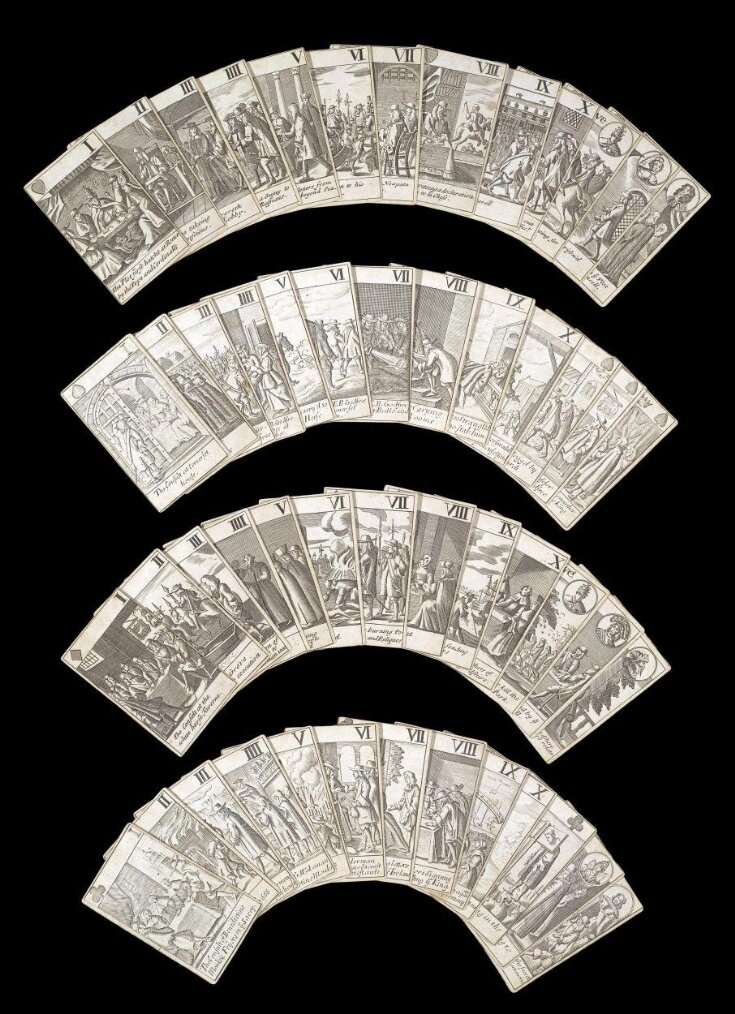

The Popish Plot
Playing Card Pack
ca. 1679 (made)
ca. 1679 (made)
| Artist/Maker | |
| Place of origin |
Object Type
These playing cards are engravings. The images were made by cutting lines into the surface of a flat piece of metal, inking the plate and then transferring the ink held in the lines onto a sheet of paper. Francis Barlow's original drawings for the engravings are in the British Museum, London.
Subject
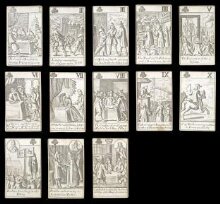
The Popish Plot was a fictitious Catholic conspiracy to kill Charles II that the Reverend Titus Oates claimed to have uncovered in 1678.The pictures on these cards tell the story of the plot and show the dire penalties meted out to alleged Roman Catholic enemies of the state. Sets of playing cards depicting historical events were very popular in the last quarter of the 17th century. There are other political packs from the time of the Popish Plot depicting 'All the Popish Plots' and the Rye House Plot, a conspiracy to assassinate Charles II and his brother, James, Duke of York.
Historical Context
There was great fear in Britain at the time of Catholic intrigue and a very real apprehension that on the death of Charles his Roman Catholic brother, James, would be placed on the throne. Prints were used to fuel public anxiety, and playing cards were another ideal means of spreading political propaganda at a low cost. Many packs were designed and engraved by leading artists of the day.
These playing cards are engravings. The images were made by cutting lines into the surface of a flat piece of metal, inking the plate and then transferring the ink held in the lines onto a sheet of paper. Francis Barlow's original drawings for the engravings are in the British Museum, London.
Subject
The Popish Plot was a fictitious Catholic conspiracy to kill Charles II that the Reverend Titus Oates claimed to have uncovered in 1678.The pictures on these cards tell the story of the plot and show the dire penalties meted out to alleged Roman Catholic enemies of the state. Sets of playing cards depicting historical events were very popular in the last quarter of the 17th century. There are other political packs from the time of the Popish Plot depicting 'All the Popish Plots' and the Rye House Plot, a conspiracy to assassinate Charles II and his brother, James, Duke of York.
Historical Context
There was great fear in Britain at the time of Catholic intrigue and a very real apprehension that on the death of Charles his Roman Catholic brother, James, would be placed on the throne. Prints were used to fuel public anxiety, and playing cards were another ideal means of spreading political propaganda at a low cost. Many packs were designed and engraved by leading artists of the day.
Object details
| Categories | |
| Object type | |
| Parts | This object consists of 52 parts.
|
| Title | The Popish Plot (popular title) |
| Materials and techniques | engraving print, ink on paper |
| Brief description | Pack of 52 politico-historical playing cards depicting 'The Popish Plot' (1678-1681); Backs with geometrical pattern; Lettered with captions and numerals; Engraving print on paper; By an unidentified engraver, after Francis Barlow; England; ca. 1679. |
| Physical description | 'The Popish Plot'; Pack of 52 politico-historical playing cards, dealing with the Titus Oates conspiracy and the murder of Sir Edmund Berry Godfrey; |
| Dimensions |
|
| Marks and inscriptions | Lettered with captions and numerals. |
| Gallery label | British Galleries:
These cards were probably published in late 1679, as rumours about the 'Popish Plot' grew. Surviving advertisements show that the cards were sold in packs, or in sheets 'to adorn studies and houses'. They cost eight old pence (just under 3p). The cards were so popular that at least three sets were published.(27/03/2003) |
| Object history | Made in England by an unknown engraver after pencil drawings by Francis Barlow (born, possibly in Lincolnshire, about 1626, died in London, 1704). The designs for this pack are in an album of drawings in the British Museum (E Hodnett, Francis Barlow First Master of English Book Illustration, London 1978, pp.25, 26). The cards were available either as a pack or in two broadsheets ‘fit to adorn studios or houses’, at a cost of 8d each. Thirty-six cards (from a pack of 52) have the same back pattern as this pack, and depict incidents in the defeat of the Spanish Armada, see E.1184-1219-1921. |
| Historical context | The 'Popish Plot' was a fictitious conspiracy concocted by Titus Oates that gripped England in anti-Catholic hysteria between 1678 and 1681. Oates alleged that there was Catholic conspiracy to assassinate Charles II. The hysteria that these accusations generated, led to a 'purge', where almost anyone even suspected of being Catholic was driven out of London. It also resulted in the execution of at least 15 men and precipitated the Exclusion Bill Crisis. By mid-1681, public opinion was turning against Oates and he was arrested for sedition, fined and imprisoned. |
| Production | Thirty-six cards have the same back pattern as this pack, and depict incidents in the defeat of the Spanish Armada, see E.1184-1219-1921. |
| Subjects depicted | |
| Summary | Object Type These playing cards are engravings. The images were made by cutting lines into the surface of a flat piece of metal, inking the plate and then transferring the ink held in the lines onto a sheet of paper. Francis Barlow's original drawings for the engravings are in the British Museum, London. Subject The Popish Plot was a fictitious Catholic conspiracy to kill Charles II that the Reverend Titus Oates claimed to have uncovered in 1678.The pictures on these cards tell the story of the plot and show the dire penalties meted out to alleged Roman Catholic enemies of the state. Sets of playing cards depicting historical events were very popular in the last quarter of the 17th century. There are other political packs from the time of the Popish Plot depicting 'All the Popish Plots' and the Rye House Plot, a conspiracy to assassinate Charles II and his brother, James, Duke of York. Historical Context There was great fear in Britain at the time of Catholic intrigue and a very real apprehension that on the death of Charles his Roman Catholic brother, James, would be placed on the throne. Prints were used to fuel public anxiety, and playing cards were another ideal means of spreading political propaganda at a low cost. Many packs were designed and engraved by leading artists of the day. |
| Associated object | |
| Bibliographic references |
|
| Collection | |
| Accession number | 20366:1 to 52 |
About this object record
Explore the Collections contains over a million catalogue records, and over half a million images. It is a working database that includes information compiled over the life of the museum. Some of our records may contain offensive and discriminatory language, or reflect outdated ideas, practice and analysis. We are committed to addressing these issues, and to review and update our records accordingly.
You can write to us to suggest improvements to the record.
Suggest feedback
You can write to us to suggest improvements to the record.
Suggest feedback
| Record created | March 27, 2003 |
| Record URL |
Download as: JSONIIIF Manifest
