
Panel
1520-1530 (made)
| Artist/Maker | |
| Place of origin |
Object Type
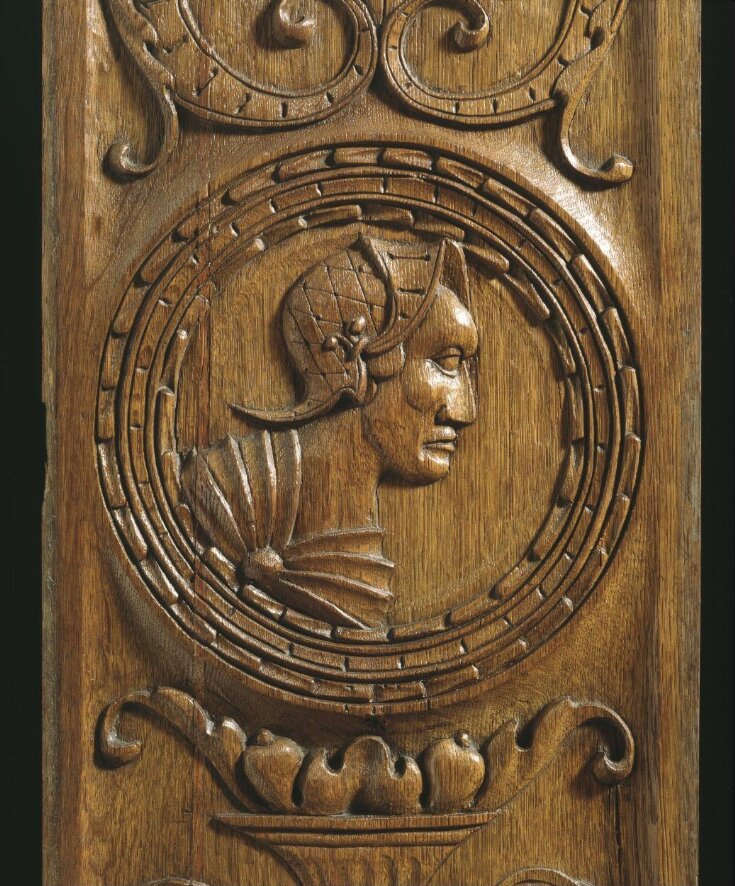
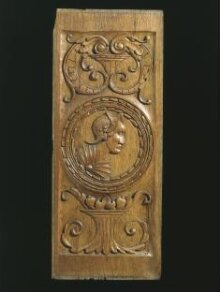
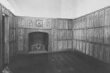
This is part of a set of carved oak panelling that originally covered the walls of a room in the Abbey House, Waltham Abbey, Essex.
Place
Abbey House was acquired by Sir Anthony Denny (1501-1549), after the Dissolution of the Monasteries in the 1530s, and finally demolished in 1770. The carvings were placed in a town house in Waltham Abbey, before being acquired by the V&A in 1899.
Time
This frame is a very early example of 'Antique' or 'Romayne' (Roman) decoration, which derived from Italy and became widespread in England from about 1520.
Historical Association
Other panels from this room contain the portcullis and Tudor rose of Henry VIII (reigned 1509-1547) and the pomegranate, the emblem of Katherine of Aragon, whom he divorced in 1529. These emblems were potent symbols of Pre-Reformation England. They suggest that the panelling was installed before Sir Anthony Denny bought the house, since he was a loyal supporter of the King during the last years of his reign.
Four large sections of panelling are on loan to Epping Forest District Museum; a single panel is on display in the British Galleries (gallery 57).
This is part of a set of carved oak panelling that originally covered the walls of a room in the Abbey House, Waltham Abbey, Essex.
Place
Abbey House was acquired by Sir Anthony Denny (1501-1549), after the Dissolution of the Monasteries in the 1530s, and finally demolished in 1770. The carvings were placed in a town house in Waltham Abbey, before being acquired by the V&A in 1899.
Time
This frame is a very early example of 'Antique' or 'Romayne' (Roman) decoration, which derived from Italy and became widespread in England from about 1520.
Historical Association
Other panels from this room contain the portcullis and Tudor rose of Henry VIII (reigned 1509-1547) and the pomegranate, the emblem of Katherine of Aragon, whom he divorced in 1529. These emblems were potent symbols of Pre-Reformation England. They suggest that the panelling was installed before Sir Anthony Denny bought the house, since he was a loyal supporter of the King during the last years of his reign.
Four large sections of panelling are on loan to Epping Forest District Museum; a single panel is on display in the British Galleries (gallery 57).
Object details
| Categories | |
| Object type | |
| Parts | This object consists of 18 parts.
|
| Materials and techniques | Oak, carved |
| Brief description | Carved panel in the Renaissance style. Probably made for Robert Fuller (died in 1540), prior at Waltham Abbey, Essex, Probably 1520-1530 |
| Physical description | Panelling of oak, composed of 110 panels within a moulded framework, of two basic types. Type A: 100 of the panels (of narrow width) are arranged in three rows, and are carved with profile busts (male and female) within circular medallions, Gothic arches, heraldic devices, and other renaissance ornament; the Tudor rose and portcullis, and the pomegranate of Katharine of Aragon are repeated several times as well as the arms of Blackett (ar. a chevron sa. Between three mullets az.) and other charges not identified. Type B: The remaining ten panels are wider and unlike the rest in design, with vases, arabesques and scrolls or profile heads within circular wreaths. They are carved in an accomplished Italian or Franco-Italian style. It has been suggested that two distinct hands can be recognised. |
| Dimensions |
|
| Gallery label |
|
| Credit line | Bought from Mr Thomas G. Nevill, Esq. |
| Object history | Bought for £375 from Thomas G. Nevill, 15 Canonbury Park, London; purchased 'in situ' froma house in the Green Yard, Waltham Abbey. RFs 33293/1899. Condition on acquisition: "The panelling has been restored. The carved wood mouldings round the fireplace are of the 18th century. Two of the original panels have been withdrawn, their place being taken by modern copies of two of the other panels." This panelling probably formed part of the decoration of the abbey-house at Waltham Abbey, which was granted at the dissolution of the monasteries by Henry VIII., on lease to Sir Anthony Denny. In the early part of the 17th century Edward Denny, grandson of Sir Anthony, Baron of Waltham and Earl of Norwich, is supposed to have used this panelling in his new house erected in the abbey grounds. This mansion was pulled down in 1770, and the carvings now in the Museum were placed in a house in the town. Probably made for Robert Fuller (d. 1540), abbot of the Augustinian Abbey at Waltham, between 1526 and 1540, the year he surrendered the property to the King's Commissioners, following the dissolution of the monasteries in 1535. It is unlikely to have been made for Denny, who was not ennobled, (the family only gained their title in 17th century). |
| Production | Probably made for Robert Fuller (died in 1540), prior at Waltham Abbey, Essex |
| Summary | Object Type This is part of a set of carved oak panelling that originally covered the walls of a room in the Abbey House, Waltham Abbey, Essex. Place Abbey House was acquired by Sir Anthony Denny (1501-1549), after the Dissolution of the Monasteries in the 1530s, and finally demolished in 1770. The carvings were placed in a town house in Waltham Abbey, before being acquired by the V&A in 1899. Time This frame is a very early example of 'Antique' or 'Romayne' (Roman) decoration, which derived from Italy and became widespread in England from about 1520. Historical Association Other panels from this room contain the portcullis and Tudor rose of Henry VIII (reigned 1509-1547) and the pomegranate, the emblem of Katherine of Aragon, whom he divorced in 1529. These emblems were potent symbols of Pre-Reformation England. They suggest that the panelling was installed before Sir Anthony Denny bought the house, since he was a loyal supporter of the King during the last years of his reign. Four large sections of panelling are on loan to Epping Forest District Museum; a single panel is on display in the British Galleries (gallery 57). |
| Bibliographic references |
|
| Collection | |
| Accession number | 2011 to Q-1899 |
About this object record
Explore the Collections contains over a million catalogue records, and over half a million images. It is a working database that includes information compiled over the life of the museum. Some of our records may contain offensive and discriminatory language, or reflect outdated ideas, practice and analysis. We are committed to addressing these issues, and to review and update our records accordingly.
You can write to us to suggest improvements to the record.
Suggest feedback
You can write to us to suggest improvements to the record.
Suggest feedback
| Record created | March 27, 2003 |
| Record URL |
Download as: JSONIIIF Manifest
