
Pair of Gloves
1603-1625 (made)
| Artist/Maker | |
| Place of origin |
Object Type
Gloves served several purposes in early 17th-century England. Many were solely decorative, to display the wealth and status of their owner. They were worn in the hat or belt, as well as carried in the hand. Gloves were popular as gifts and were often given by a young gallant to his favourite mistress. In combat, a glove was thrown down as a gage, or challenge.
Materials & Making
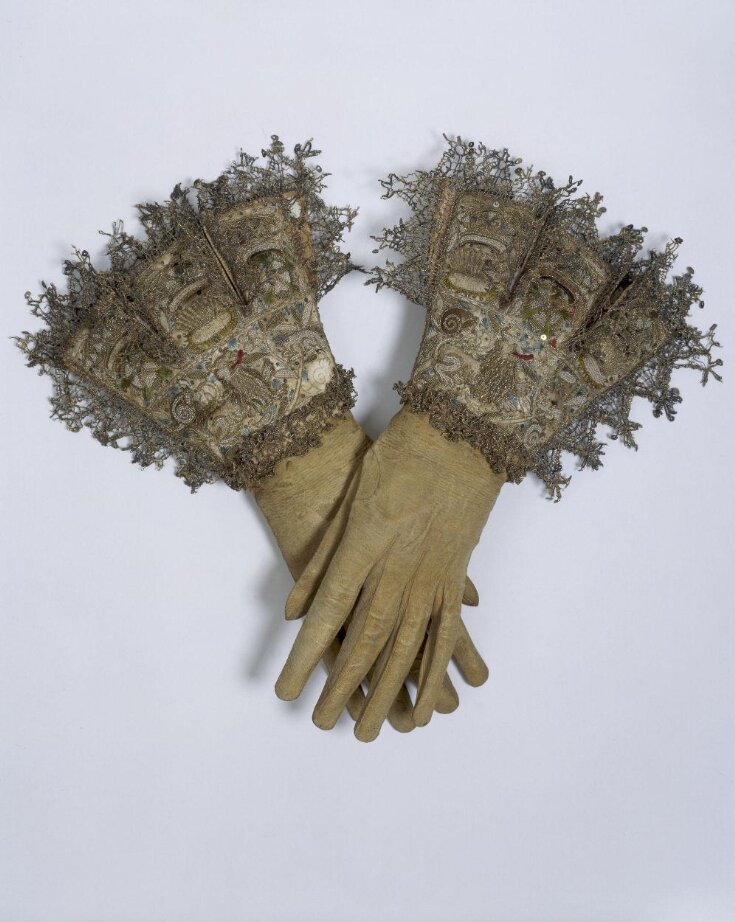
Seed pearls decorate this very richly embellished glove. Silver and silver-gilt thread and purl (short lengths of metal thread curled tightly together like a minute spring), spangles (an old term for sequins) and coloured silks cover the densely embroidered satin gauntlet. Each motif is heavily padded underneath with additional stitches to give a pronounced three-dimensional effect.
Subjects Depicted
A snail, a lion and a sheep are embroidered on the gloves. These animals may relate to the heraldry of the owner. They could also be personal devices of the wearer, chosen to represent some individual quality or virtue. Many of the motifs that appear in Jacobean embroidery were copied from emblem books. This was a popular form of literature, which linked visual images with moral virtues.
Gloves served several purposes in early 17th-century England. Many were solely decorative, to display the wealth and status of their owner. They were worn in the hat or belt, as well as carried in the hand. Gloves were popular as gifts and were often given by a young gallant to his favourite mistress. In combat, a glove was thrown down as a gage, or challenge.
Materials & Making
Seed pearls decorate this very richly embellished glove. Silver and silver-gilt thread and purl (short lengths of metal thread curled tightly together like a minute spring), spangles (an old term for sequins) and coloured silks cover the densely embroidered satin gauntlet. Each motif is heavily padded underneath with additional stitches to give a pronounced three-dimensional effect.
Subjects Depicted
A snail, a lion and a sheep are embroidered on the gloves. These animals may relate to the heraldry of the owner. They could also be personal devices of the wearer, chosen to represent some individual quality or virtue. Many of the motifs that appear in Jacobean embroidery were copied from emblem books. This was a popular form of literature, which linked visual images with moral virtues.
Object details
| Categories | |
| Object type | |
| Parts | This object consists of 2 parts.
|
| Materials and techniques | Leather, silk, gold, silver; tanned, hand-woven, hand-embroidered, hand-sewn |
| Brief description | Pair of men's leather gloves, England, 1603-1625; with cuff of satin embroidered with silk, metal thread, seed pearls |
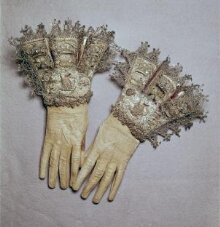
| Physical description | Pair of gloves of kidskin, dyed golden brown with tops [cuffs or gauntlets] of white silk satin embroidered with coloured silks, silver-gilt filé and purl, seed pearls over padding in a design of lion, lamb and crowned roses and thistles. The tops are lined with carnation silk taffeta and edged with bobbin lace of silver-gilt filé and spangles. Around each wrist is a gathered length of carnation silk ribbon edged with narrow, silver-gilt filé bobbin lace. |
| Dimensions |
|
| Gallery label |
|
| Credit line | Given by Sir Edward Denny |
| Object history | These gloves are either the pair reputedly given by King Henry VIII to Sir Anthony Denny, or the pair reputedly given by King James I of England to Anthony's son, Edward Denny. The style of the gloves is appropriate for the period of James I rather than Henry VIII. However, Edward Denny died in 1599/1600. From the Annual Register of 1759: “At the sale of the Earl of Arran’s curiosities in Covent Garden the Gloves given by King Henry the 8th to Sir Anthy. Denny were sold for £38.17.0, the Gloves given by King James the 1st to Edwd. Denny Esq (son of Sir Anthy.) for £22.1.0, the mittens given by Queen Elizth. to Sir Edwd. Denny’s lady for £25.4.0 and the Scarf given by King Charles the 1st for £10.10.0, all of which were bought for Sir Thomas Denny of Ireland, who is lineally descended from the said Sir Anthony Denny, one of the Executors of King Henry the VIII.” |
| Summary | Object Type Gloves served several purposes in early 17th-century England. Many were solely decorative, to display the wealth and status of their owner. They were worn in the hat or belt, as well as carried in the hand. Gloves were popular as gifts and were often given by a young gallant to his favourite mistress. In combat, a glove was thrown down as a gage, or challenge. Materials & Making Seed pearls decorate this very richly embellished glove. Silver and silver-gilt thread and purl (short lengths of metal thread curled tightly together like a minute spring), spangles (an old term for sequins) and coloured silks cover the densely embroidered satin gauntlet. Each motif is heavily padded underneath with additional stitches to give a pronounced three-dimensional effect. Subjects Depicted A snail, a lion and a sheep are embroidered on the gloves. These animals may relate to the heraldry of the owner. They could also be personal devices of the wearer, chosen to represent some individual quality or virtue. Many of the motifs that appear in Jacobean embroidery were copied from emblem books. This was a popular form of literature, which linked visual images with moral virtues. |
| Bibliographic reference | John Lea Nevinson, Catalogue of English Domestic Embroidery of the Sixteenth & Seventeenth Centuries, Victoria and Albert Museum, Department of Textiles, London: HMSO, p.93, 1938, plate LXVI |
| Collection | |
| Accession number | 1506&A-1882 |
About this object record
Explore the Collections contains over a million catalogue records, and over half a million images. It is a working database that includes information compiled over the life of the museum. Some of our records may contain offensive and discriminatory language, or reflect outdated ideas, practice and analysis. We are committed to addressing these issues, and to review and update our records accordingly.
You can write to us to suggest improvements to the record.
Suggest feedback
You can write to us to suggest improvements to the record.
Suggest feedback
| Record created | March 27, 2003 |
| Record URL |
Download as: JSONIIIF Manifest
