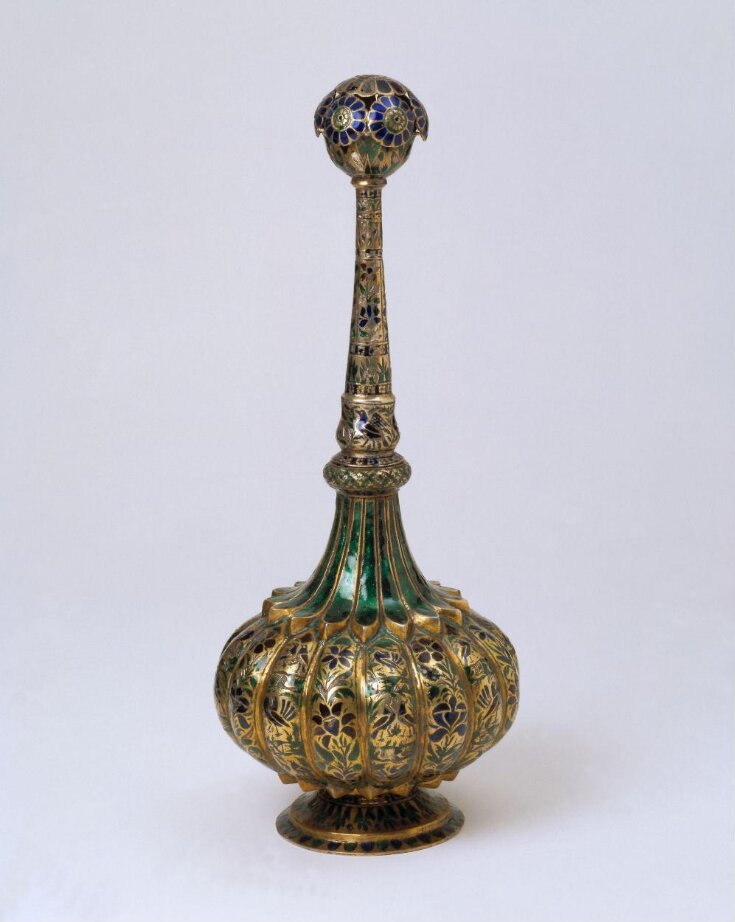

Rosewater Sprinkler
ca. 1850 (made)
| Artist/Maker | |
| Place of origin |
Object Type
The sprinkler is cast in several sections: the neck unscrews from the body and the rose at the top unscrews from the neck. The distinctive palette of vivid translucent blue and green, and the design of birds, irises and other flowers, are typical of the work of Lucknow enamellers in the 19th century.
Ownership & Use
Rosewater sprinklers have been used in the Indian subcontinent from the Mughal period (1526-1857) to the present day. Among the finest surviving examples are a 17th-century pair made of enamelled gold set with precious stones and looted from the Mughal royal treasury in Delhi in 1738 by the Iranian ruler Nadir Shah. They were sent to Russia as ambassadorial gifts three years later and are now in the Hermitage Museum, St Petersburg. Many less sumptuous examples are to be found in public and private collections throughout the world, often made of gilt silver and sometimes also enamelled.
Time
The rosewater sprinkler belonged to a small group of Lucknow enamelled objects sent to the Great Exhibition in 1851 and was probably made specially for it. It was bought by the Museum of Ornamental Art for £10.
The sprinkler is cast in several sections: the neck unscrews from the body and the rose at the top unscrews from the neck. The distinctive palette of vivid translucent blue and green, and the design of birds, irises and other flowers, are typical of the work of Lucknow enamellers in the 19th century.
Ownership & Use
Rosewater sprinklers have been used in the Indian subcontinent from the Mughal period (1526-1857) to the present day. Among the finest surviving examples are a 17th-century pair made of enamelled gold set with precious stones and looted from the Mughal royal treasury in Delhi in 1738 by the Iranian ruler Nadir Shah. They were sent to Russia as ambassadorial gifts three years later and are now in the Hermitage Museum, St Petersburg. Many less sumptuous examples are to be found in public and private collections throughout the world, often made of gilt silver and sometimes also enamelled.
Time
The rosewater sprinkler belonged to a small group of Lucknow enamelled objects sent to the Great Exhibition in 1851 and was probably made specially for it. It was bought by the Museum of Ornamental Art for £10.
Object details
| Categories | |
| Object type | |
| Materials and techniques | Silver, cast, engraved and enamelled |
| Brief description | Rosewater sprinkler |
| Dimensions |
|
| Gallery label | British Galleries:
Indian enamelled work was almost entirely unknown to Europeans before the Great Exhibition. It was exhibited to bring it to the attention of potential purchasers and to encourage British investment in the colonies. Rosewater was traditionally sprinkled on guests in India to cool and refresh them during ceremonies and feasts. Depending on the occasion, the bottles were made of gold, silver or glass.(27/03/2003) |
| Object history | Probably made in Lucknow, India |
| Summary | Object Type The sprinkler is cast in several sections: the neck unscrews from the body and the rose at the top unscrews from the neck. The distinctive palette of vivid translucent blue and green, and the design of birds, irises and other flowers, are typical of the work of Lucknow enamellers in the 19th century. Ownership & Use Rosewater sprinklers have been used in the Indian subcontinent from the Mughal period (1526-1857) to the present day. Among the finest surviving examples are a 17th-century pair made of enamelled gold set with precious stones and looted from the Mughal royal treasury in Delhi in 1738 by the Iranian ruler Nadir Shah. They were sent to Russia as ambassadorial gifts three years later and are now in the Hermitage Museum, St Petersburg. Many less sumptuous examples are to be found in public and private collections throughout the world, often made of gilt silver and sometimes also enamelled. Time The rosewater sprinkler belonged to a small group of Lucknow enamelled objects sent to the Great Exhibition in 1851 and was probably made specially for it. It was bought by the Museum of Ornamental Art for £10. |
| Bibliographic reference | Darby, Michael, The Islamic Perspective, 1983. Exhibition catalogue, 143p., ill. ISBN 0 905035313
Catalogue n. 92, p105 |
| Collection | |
| Accession number | 130-1852 |
About this object record
Explore the Collections contains over a million catalogue records, and over half a million images. It is a working database that includes information compiled over the life of the museum. Some of our records may contain offensive and discriminatory language, or reflect outdated ideas, practice and analysis. We are committed to addressing these issues, and to review and update our records accordingly.
You can write to us to suggest improvements to the record.
Suggest feedback
You can write to us to suggest improvements to the record.
Suggest feedback
| Record created | March 27, 2003 |
| Record URL |
Download as: JSONIIIF Manifest
