
Panel
1590-1600 (made)
| Artist/Maker | |
| Place of origin |
Object Type
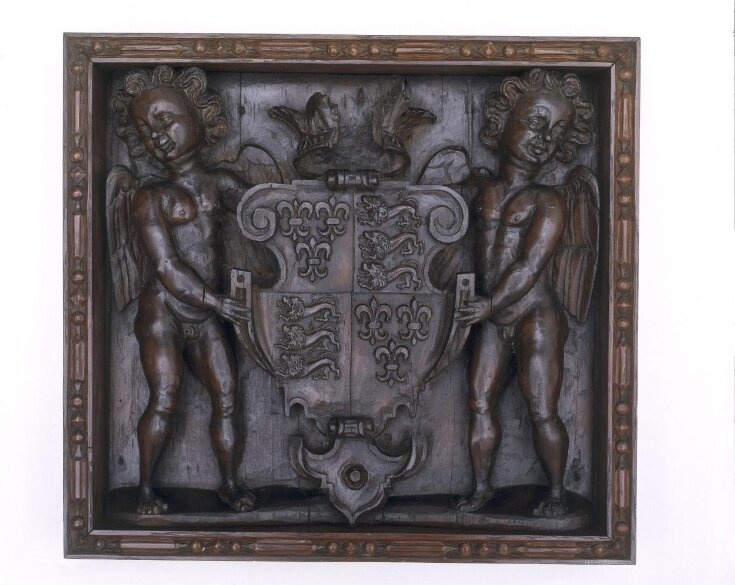
Royal coats of arms decorated not only the palaces of monarchs but also the buildings, public or private, of their loyal subjects. They were mostly painted and were often placed next to those of the institution, perhaps a guild hall, school or university college, or indeed those of the owner of a private house. They were positioned where they could be seen, above a doorway, at the top of the panelling of a chamber or on the minstrels' gallery in a dining hall. Larger versions were placed over chimney-pieces. In this example the ornamental frame was probably added at a much later date, so that it could be hung on a wall as if it were a picture.
Materials & Makings
The traces of paint and gesso (a thin layer of plaster) indicate that the coat of arms was originally coloured and gilded, so as to stand out. This decoration was probably removed by the 1890s, when dealers and collectors associated objects made in the reigns of Elizabeth I (1558-1603) and James I (1603-1625) with a dark-stained finish.
Time
The coat of arms is decorated with strapwork decoration. This was based on strips of leather or ribbons and became known in England through engravings by Netherlandish artists such as Hans Vredeman de Vries (1527-?1606), Jacob Floris (1524-1582) and Cornelius Bos (around 1510-1555). It was widely used until about 1630.
Royal coats of arms decorated not only the palaces of monarchs but also the buildings, public or private, of their loyal subjects. They were mostly painted and were often placed next to those of the institution, perhaps a guild hall, school or university college, or indeed those of the owner of a private house. They were positioned where they could be seen, above a doorway, at the top of the panelling of a chamber or on the minstrels' gallery in a dining hall. Larger versions were placed over chimney-pieces. In this example the ornamental frame was probably added at a much later date, so that it could be hung on a wall as if it were a picture.
Materials & Makings
The traces of paint and gesso (a thin layer of plaster) indicate that the coat of arms was originally coloured and gilded, so as to stand out. This decoration was probably removed by the 1890s, when dealers and collectors associated objects made in the reigns of Elizabeth I (1558-1603) and James I (1603-1625) with a dark-stained finish.
Time
The coat of arms is decorated with strapwork decoration. This was based on strips of leather or ribbons and became known in England through engravings by Netherlandish artists such as Hans Vredeman de Vries (1527-?1606), Jacob Floris (1524-1582) and Cornelius Bos (around 1510-1555). It was widely used until about 1630.
Object details
| Categories | |
| Object type | |
| Materials and techniques | Carved oak, with traces of paint and gesso |
| Brief description | Royal arms carved in a panel, England, 1590-1600 with later frame |
| Physical description | Panel, of plane wood, carved with the Royal Arms of England surmounted by a crown and supported by two cupids, with a later oak frame |
| Dimensions |
|
| Gallery label |
|
| Object history | Bought for £41 17s 11d from the collection of Mr. G. W. Braikenridge (Christie's, Feb. 27, 1908, lot 113). |
| Historical context | George Weare Braikenridge, from whose collection this panel was purchased in 1908 (some decades after his death), was a West India merchant and slave-owner. He was, with business partners John Braikenridge and Richard Honnywill, awarded £2911 in compensation for 157 enslaved people on Bagdale Estate and Fullerswood Pen in Jamaica and also held mortgages on several other Jamaican estates. (Taken from research carried out into the provenance of V&A objects by Hannah Young c2018) |
| Production | Frame made later |
| Subjects depicted | |
| Summary | Object Type Royal coats of arms decorated not only the palaces of monarchs but also the buildings, public or private, of their loyal subjects. They were mostly painted and were often placed next to those of the institution, perhaps a guild hall, school or university college, or indeed those of the owner of a private house. They were positioned where they could be seen, above a doorway, at the top of the panelling of a chamber or on the minstrels' gallery in a dining hall. Larger versions were placed over chimney-pieces. In this example the ornamental frame was probably added at a much later date, so that it could be hung on a wall as if it were a picture. Materials & Makings The traces of paint and gesso (a thin layer of plaster) indicate that the coat of arms was originally coloured and gilded, so as to stand out. This decoration was probably removed by the 1890s, when dealers and collectors associated objects made in the reigns of Elizabeth I (1558-1603) and James I (1603-1625) with a dark-stained finish. Time The coat of arms is decorated with strapwork decoration. This was based on strips of leather or ribbons and became known in England through engravings by Netherlandish artists such as Hans Vredeman de Vries (1527-?1606), Jacob Floris (1524-1582) and Cornelius Bos (around 1510-1555). It was widely used until about 1630. |
| Bibliographic reference | From: H. Clifford Smith, Catalogue of English Furniture & Woodwork
(London 1930), 659
|
| Collection | |
| Accession number | 115-1908 |
About this object record
Explore the Collections contains over a million catalogue records, and over half a million images. It is a working database that includes information compiled over the life of the museum. Some of our records may contain offensive and discriminatory language, or reflect outdated ideas, practice and analysis. We are committed to addressing these issues, and to review and update our records accordingly.
You can write to us to suggest improvements to the record.
Suggest feedback
You can write to us to suggest improvements to the record.
Suggest feedback
| Record created | March 27, 2003 |
| Record URL |
Download as: JSONIIIF Manifest
