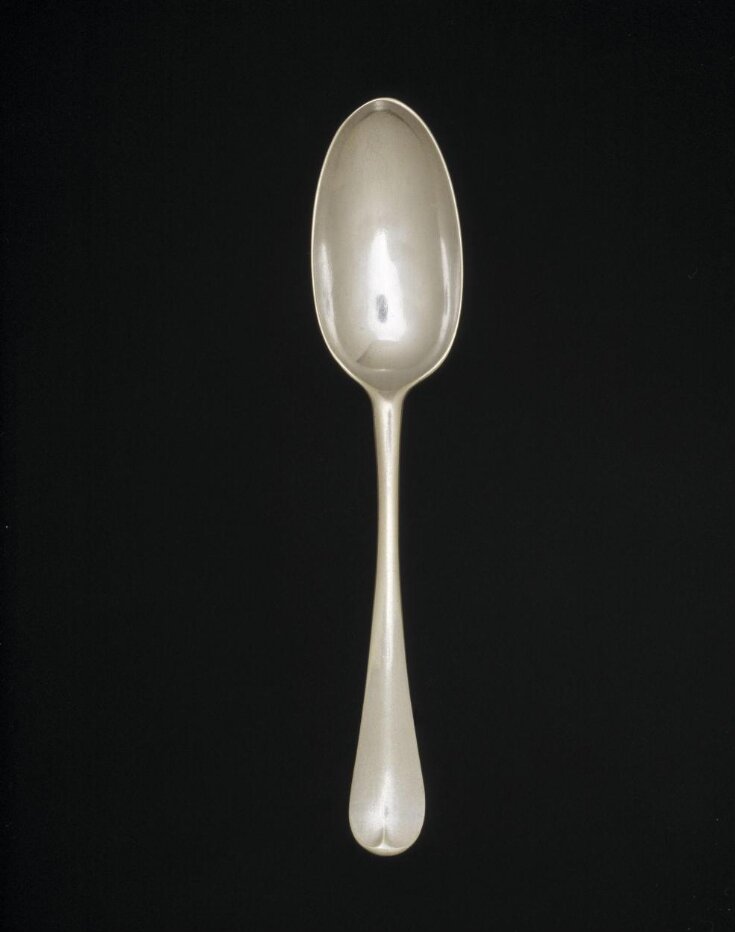
Teaspoon
ca. 1750 (made)
| Artist/Maker | |
| Place of origin |
Object Type
Tea was imported into Britain from the early 17th century, but became fashionable only after the Restoration of Charles II in 1660. Catherine of Braganza, Charles's Portuguese wife, had a particular passion for tea and did much to popularise it. Tea was originally drunk in the Chinese manner, weak and without milk, but by the early 18th century sugar and milk were added and small spoons became necessary.
Trading
Spoons were made by specialist goldsmiths, but often supplied as part of a tea service. For example, a set made by Paul de Lamerie (1688-1751) in 1735 includes 12 tea spoons, a pair of sugar nippers, a strainer spoon, three canisters for black tea, green tea and sugar, and a cream jug. Very few full sets of matching spoons made before the 1740s are known today.
Social Usage
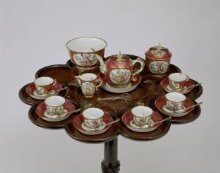
Tea spoons were part of the ritual of the tea table. They could be used to signal to the hostess when the guest had drunk his fill. In 1782 the Prince of Broglie reported that 'I partook of the most excellent tea and I should be even now still drinking it, I believe, if the Ambassador had not charitably notified me at the twelfth cup that I must put my spoon across it when I wished to finish with this sort of warm water'.
Tea was imported into Britain from the early 17th century, but became fashionable only after the Restoration of Charles II in 1660. Catherine of Braganza, Charles's Portuguese wife, had a particular passion for tea and did much to popularise it. Tea was originally drunk in the Chinese manner, weak and without milk, but by the early 18th century sugar and milk were added and small spoons became necessary.
Trading
Spoons were made by specialist goldsmiths, but often supplied as part of a tea service. For example, a set made by Paul de Lamerie (1688-1751) in 1735 includes 12 tea spoons, a pair of sugar nippers, a strainer spoon, three canisters for black tea, green tea and sugar, and a cream jug. Very few full sets of matching spoons made before the 1740s are known today.
Social Usage
Tea spoons were part of the ritual of the tea table. They could be used to signal to the hostess when the guest had drunk his fill. In 1782 the Prince of Broglie reported that 'I partook of the most excellent tea and I should be even now still drinking it, I believe, if the Ambassador had not charitably notified me at the twelfth cup that I must put my spoon across it when I wished to finish with this sort of warm water'.
Object details
| Categories | |
| Object type | |
| Materials and techniques | Silver |
| Brief description | Cutlery and flatware |
| Dimensions |
|
| Gallery label | British Galleries:
TEASPOONS Spoon-making was a specialist branch of goldsmithing. The design of spoons for specific uses, such as these silver teaspoons, began in the late 17th century. Until about 1750, tables were laid with the reverse of the spoon uppermost, so that decoration on the back would be prominently displayed.(27/03/2003) |
| Credit line | Given by J. H. Fitzhenry |
| Object history | Possibly made in London by John Gale (active from 1721) |
| Summary | Object Type Tea was imported into Britain from the early 17th century, but became fashionable only after the Restoration of Charles II in 1660. Catherine of Braganza, Charles's Portuguese wife, had a particular passion for tea and did much to popularise it. Tea was originally drunk in the Chinese manner, weak and without milk, but by the early 18th century sugar and milk were added and small spoons became necessary. Trading Spoons were made by specialist goldsmiths, but often supplied as part of a tea service. For example, a set made by Paul de Lamerie (1688-1751) in 1735 includes 12 tea spoons, a pair of sugar nippers, a strainer spoon, three canisters for black tea, green tea and sugar, and a cream jug. Very few full sets of matching spoons made before the 1740s are known today. Social Usage Tea spoons were part of the ritual of the tea table. They could be used to signal to the hostess when the guest had drunk his fill. In 1782 the Prince of Broglie reported that 'I partook of the most excellent tea and I should be even now still drinking it, I believe, if the Ambassador had not charitably notified me at the twelfth cup that I must put my spoon across it when I wished to finish with this sort of warm water'. |
| Collection | |
| Accession number | 1118-1902 |
About this object record
Explore the Collections contains over a million catalogue records, and over half a million images. It is a working database that includes information compiled over the life of the museum. Some of our records may contain offensive and discriminatory language, or reflect outdated ideas, practice and analysis. We are committed to addressing these issues, and to review and update our records accordingly.
You can write to us to suggest improvements to the record.
Suggest feedback
You can write to us to suggest improvements to the record.
Suggest feedback
| Record created | March 27, 2003 |
| Record URL |
Download as: JSONIIIF Manifest
