
Matthew Boulton
Portrait Medallion
1814 (made)
1814 (made)
| Artist/Maker | |
| Place of origin |
Object Type
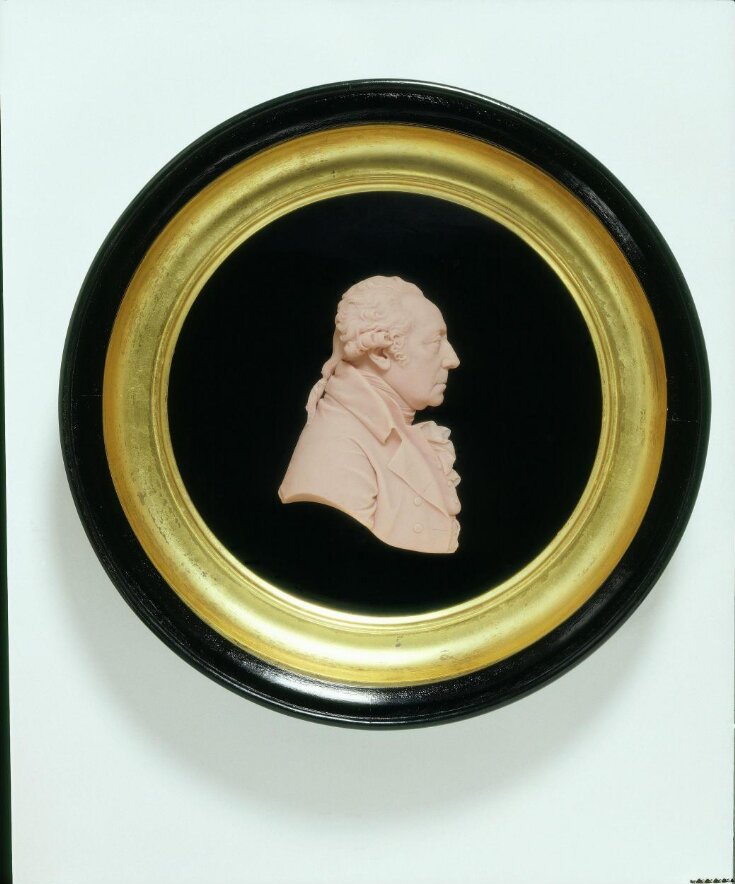
This wax portrait would have been relatively cheap to make, and it could then be reproduced for the friends and family of the subject. The portrait of Boulton is posthumous; the artist, Rouw stated in a letter to the subject's son, M.R. Boulton, 'If any friend should wish to have a copy of your father's portrait the price will be fourteen guineas, as it has taken me more time than I expected it would when I gave you the amount.' A bill accompanying the letter mentions a portrait of the late M. Boulton 25 gns., a copy of the same 10 gns. Graham Pollard writing in the 'Numismatic Chronicle' (1970) commented: 'As 10 guineas was Rouw's standard price, the sum of 25 guineas must refer to the large-scale wax. The example in the Victoria and Albert Museum is signed and dated 1814. It is therefore one of the copies mentioned by Rouw, priced at fourteen guineas.'
People
Peter Rouw (1771-1852) was a successful wax modeller, who specialised in portrait waxes. He was also appointed modeller of gems and cameos to His Royal Highness the Prince Regent.
Matthew Boulton was a Birmingham industrialist whose ormolu and metalwork were renowned, and were exported abroad, especially to Russia. He was a friend and rival of Wedgwood in the field of luxury commodities.
Materials & Making
Wax portraits and figure groups were popular in Britain during the 18th and early 19th centuries. The malleability of the material meant that it could be modelled very naturalistically. As casts could easily be taken, and wax was relatively cheap, reproductions could be made and sold at low prices. Sometimes colour was added; pink colour of this portrait was favoured by Rouw and other portrait modellers. Some wax pieces were naturalistically coloured, and adorned with textiles or other additions, such as glass jewels, increasing the realism of the pieces.
This wax portrait would have been relatively cheap to make, and it could then be reproduced for the friends and family of the subject. The portrait of Boulton is posthumous; the artist, Rouw stated in a letter to the subject's son, M.R. Boulton, 'If any friend should wish to have a copy of your father's portrait the price will be fourteen guineas, as it has taken me more time than I expected it would when I gave you the amount.' A bill accompanying the letter mentions a portrait of the late M. Boulton 25 gns., a copy of the same 10 gns. Graham Pollard writing in the 'Numismatic Chronicle' (1970) commented: 'As 10 guineas was Rouw's standard price, the sum of 25 guineas must refer to the large-scale wax. The example in the Victoria and Albert Museum is signed and dated 1814. It is therefore one of the copies mentioned by Rouw, priced at fourteen guineas.'
People
Peter Rouw (1771-1852) was a successful wax modeller, who specialised in portrait waxes. He was also appointed modeller of gems and cameos to His Royal Highness the Prince Regent.
Matthew Boulton was a Birmingham industrialist whose ormolu and metalwork were renowned, and were exported abroad, especially to Russia. He was a friend and rival of Wedgwood in the field of luxury commodities.
Materials & Making
Wax portraits and figure groups were popular in Britain during the 18th and early 19th centuries. The malleability of the material meant that it could be modelled very naturalistically. As casts could easily be taken, and wax was relatively cheap, reproductions could be made and sold at low prices. Sometimes colour was added; pink colour of this portrait was favoured by Rouw and other portrait modellers. Some wax pieces were naturalistically coloured, and adorned with textiles or other additions, such as glass jewels, increasing the realism of the pieces.
Object details
| Categories | |
| Object type | |
| Title | Matthew Boulton (generic title) |
| Materials and techniques | Wax, tinted. |
| Brief description | Medallion, wax relief, portrait of Matthew Boulton, by Peter Rouw, England, 1814 |
| Physical description | Portait relief of Matthew Boulton, framed. |
| Dimensions |
|
| Marks and inscriptions | 'P. Rouw sculptor London 1814'
|
| Gallery label | British Galleries:
Boulton's Soho factory attracted informed visitors from all over the world. In Britain, his intellectual circle included a discussion group formed around 1764 and known as the Lunar Society. Members included the ceramic manufacturer Josiah Wedgwood, the chemist Joseph Priestly, the President of the Royal Society, Sir Joseph Banks an the astronomer Sir William Herschel.(27/03/2003) |
| Credit line | Given by Charles Vine |
| Object history | Modelled in London, after Boulton's death, by Peter Rouw the younger (born, 1770, died, 1852). Given by Charles Vine, Esc. in 1871. |
| Summary | Object Type This wax portrait would have been relatively cheap to make, and it could then be reproduced for the friends and family of the subject. The portrait of Boulton is posthumous; the artist, Rouw stated in a letter to the subject's son, M.R. Boulton, 'If any friend should wish to have a copy of your father's portrait the price will be fourteen guineas, as it has taken me more time than I expected it would when I gave you the amount.' A bill accompanying the letter mentions a portrait of the late M. Boulton 25 gns., a copy of the same 10 gns. Graham Pollard writing in the 'Numismatic Chronicle' (1970) commented: 'As 10 guineas was Rouw's standard price, the sum of 25 guineas must refer to the large-scale wax. The example in the Victoria and Albert Museum is signed and dated 1814. It is therefore one of the copies mentioned by Rouw, priced at fourteen guineas.' People Peter Rouw (1771-1852) was a successful wax modeller, who specialised in portrait waxes. He was also appointed modeller of gems and cameos to His Royal Highness the Prince Regent. Matthew Boulton was a Birmingham industrialist whose ormolu and metalwork were renowned, and were exported abroad, especially to Russia. He was a friend and rival of Wedgwood in the field of luxury commodities. Materials & Making Wax portraits and figure groups were popular in Britain during the 18th and early 19th centuries. The malleability of the material meant that it could be modelled very naturalistically. As casts could easily be taken, and wax was relatively cheap, reproductions could be made and sold at low prices. Sometimes colour was added; pink colour of this portrait was favoured by Rouw and other portrait modellers. Some wax pieces were naturalistically coloured, and adorned with textiles or other additions, such as glass jewels, increasing the realism of the pieces. |
| Bibliographic references |
|
| Collection | |
| Accession number | 1058-1871 |
About this object record
Explore the Collections contains over a million catalogue records, and over half a million images. It is a working database that includes information compiled over the life of the museum. Some of our records may contain offensive and discriminatory language, or reflect outdated ideas, practice and analysis. We are committed to addressing these issues, and to review and update our records accordingly.
You can write to us to suggest improvements to the record.
Suggest feedback
You can write to us to suggest improvements to the record.
Suggest feedback
| Record created | March 27, 2003 |
| Record URL |
Download as: JSONIIIF Manifest
