'Prometheus' Vase
Vase
1867 (made)
1867 (made)
| Artist/Maker | |
| Place of origin |
Object Type
This substantial vase and cover were made specifically for an international exhibition to demonstrate the technical and artistic superiority of their makers, Minton & Co. of Stoke-on-Trent. Objects of this size were acquired by public collections such as this Museum or by the most ambitious collectors with the grandest houses in which to display them.
Historical Association
This vase is one of two made for the Paris Exhibition of 1867, each painted with a different scene. This was the first showing of the model, and both examples were bought for the Museum. Still further variations were exhibited at the Paris Exhibition of 1878, where it was described as 'one of the noblest pieces ever produced'.
People
The modeller of this vase was Victor Simyan (sometimes spelt Simian), a French sculptor who moved to Britain in about 1860. He founded his own workshop and designed for the pottery industry. His compatriot Léon Arnoux (1816-1902) had been art director at Minton's since 1849. The painter, Thomas Allen, was a local artist. As an apprentice at Minton's he studied at the Stoke-on-Trent School of Design from 1849. In 1852 he became one of the first students to be awarded a National Art Training Scholarship to the School of Design at Somerset House (the forerunner of the South Kensington Museum, later the V&A). He stayed with Minton's until 1875, when he left to join Wedgwood as chief designer.
This substantial vase and cover were made specifically for an international exhibition to demonstrate the technical and artistic superiority of their makers, Minton & Co. of Stoke-on-Trent. Objects of this size were acquired by public collections such as this Museum or by the most ambitious collectors with the grandest houses in which to display them.
Historical Association
This vase is one of two made for the Paris Exhibition of 1867, each painted with a different scene. This was the first showing of the model, and both examples were bought for the Museum. Still further variations were exhibited at the Paris Exhibition of 1878, where it was described as 'one of the noblest pieces ever produced'.
People
The modeller of this vase was Victor Simyan (sometimes spelt Simian), a French sculptor who moved to Britain in about 1860. He founded his own workshop and designed for the pottery industry. His compatriot Léon Arnoux (1816-1902) had been art director at Minton's since 1849. The painter, Thomas Allen, was a local artist. As an apprentice at Minton's he studied at the Stoke-on-Trent School of Design from 1849. In 1852 he became one of the first students to be awarded a National Art Training Scholarship to the School of Design at Somerset House (the forerunner of the South Kensington Museum, later the V&A). He stayed with Minton's until 1875, when he left to join Wedgwood as chief designer.
Object details
| Categories | |
| Object type | |
| Parts | This object consists of 2 parts.
|
| Title | 'Prometheus' Vase (manufacturer's title) |
| Materials and techniques | Earthenware, painted in enamels and majolica glazes |
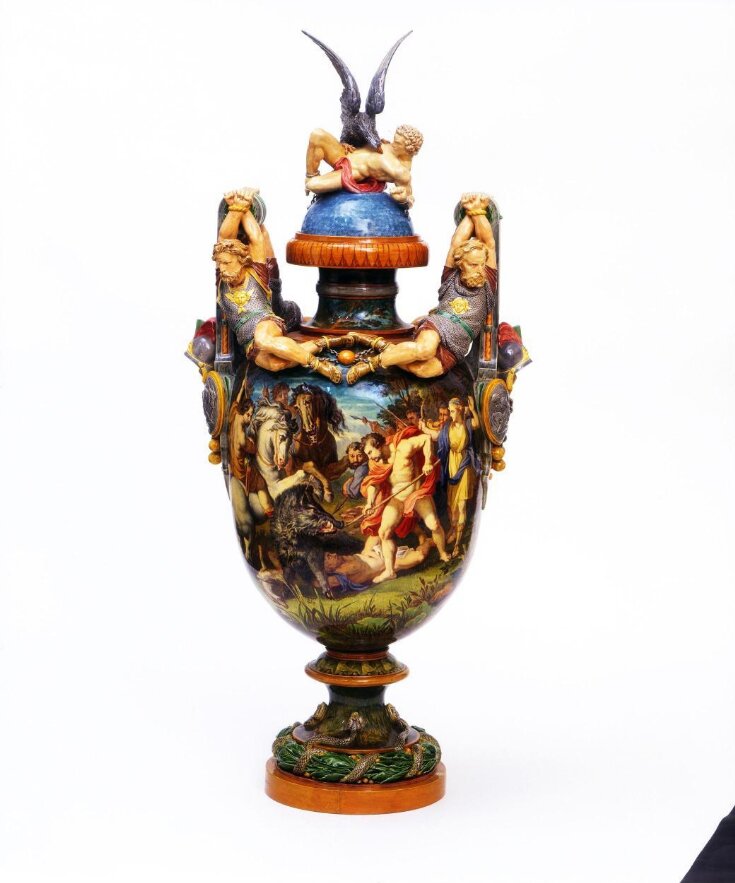
| Brief description | 'Prometheus' or 'Captive' vase, earthenware with coloured glazes, modelled by Victor Simyan, painted in enamels by Thomas Allen at the Minton Factory, England, 1867 |
| Physical description | Vase and cover, earthenware, painted, with coloured glazes. |
| Dimensions |
|
| Gallery label | British Galleries:
The painted decoration of this vase imitates maiolica (tin-glazed earthenware) and draws on a mixture of design sources from Italy, France and Flanders (now Belgium). The body of the base is painted with scenes of a boar hunt, based on prints by the artist Peter Paul Rubens (1577-1640). The captive warriors, who include the mythical figure of Prometheus on the lid, are based on 16th-century Italian models from Florence. The snakes are in the style of the 16th-century French ceramicist, Bernard Palissy (1510-1590).(27/03/2003) |
| Object history | Designed and modelled by Victor Etienne Simyan (born in Saint-Gangoux-le-Royal, France, 1826, died in 1886); painted by Thomas Allen (born in Stoke-on-Trent, Staffordshire 1831, died in 1915); made by Minton & Co., Stoke-on-Trent, Staffordshire Shown at the Paris International Exhibition of 1867 Exhibited by Minton at the Paris Exhibition of 1867. The painter Thomas Allen, worked for Minton from 1854 to 1875 and subsequently for the firm of Wedgwood. It is decorated in imitation of maiolica though the base is decorated with snakes in the manner of the 16th century French ceramicist, Bernard Palissy. The scenes on the bowl of the vase are taken from prints after works by the Rubens, The Calydonaian Boar Hunt, of which the original painting is now lost, and a second Boar Hunt, now in Marseilles. This vase and its companion took their name however from the cover, where an eagle feeds on the liver of Prometheus, a punishment of Zeus for stealing fire from the gods and bringing it back to earth. The vase is thus a typical 19th century virtuoso piece in its command of technique and visual scenes. |
| Subjects depicted | |
| Summary | Object Type This substantial vase and cover were made specifically for an international exhibition to demonstrate the technical and artistic superiority of their makers, Minton & Co. of Stoke-on-Trent. Objects of this size were acquired by public collections such as this Museum or by the most ambitious collectors with the grandest houses in which to display them. Historical Association This vase is one of two made for the Paris Exhibition of 1867, each painted with a different scene. This was the first showing of the model, and both examples were bought for the Museum. Still further variations were exhibited at the Paris Exhibition of 1878, where it was described as 'one of the noblest pieces ever produced'. People The modeller of this vase was Victor Simyan (sometimes spelt Simian), a French sculptor who moved to Britain in about 1860. He founded his own workshop and designed for the pottery industry. His compatriot Léon Arnoux (1816-1902) had been art director at Minton's since 1849. The painter, Thomas Allen, was a local artist. As an apprentice at Minton's he studied at the Stoke-on-Trent School of Design from 1849. In 1852 he became one of the first students to be awarded a National Art Training Scholarship to the School of Design at Somerset House (the forerunner of the South Kensington Museum, later the V&A). He stayed with Minton's until 1875, when he left to join Wedgwood as chief designer. |
| Bibliographic reference | Baker, Malcolm, and Brenda Richardson (eds.), A Grand Design: The Art of the Victoria and Albert Museum, London: V&A Publications, 1999.
|
| Collection | |
| Accession number | 1047:1, 2-1871 |
About this object record
Explore the Collections contains over a million catalogue records, and over half a million images. It is a working database that includes information compiled over the life of the museum. Some of our records may contain offensive and discriminatory language, or reflect outdated ideas, practice and analysis. We are committed to addressing these issues, and to review and update our records accordingly.
You can write to us to suggest improvements to the record.
Suggest feedback
You can write to us to suggest improvements to the record.
Suggest feedback
| Record created | March 27, 2003 |
| Record URL |
Download as: JSONIIIF Manifest
