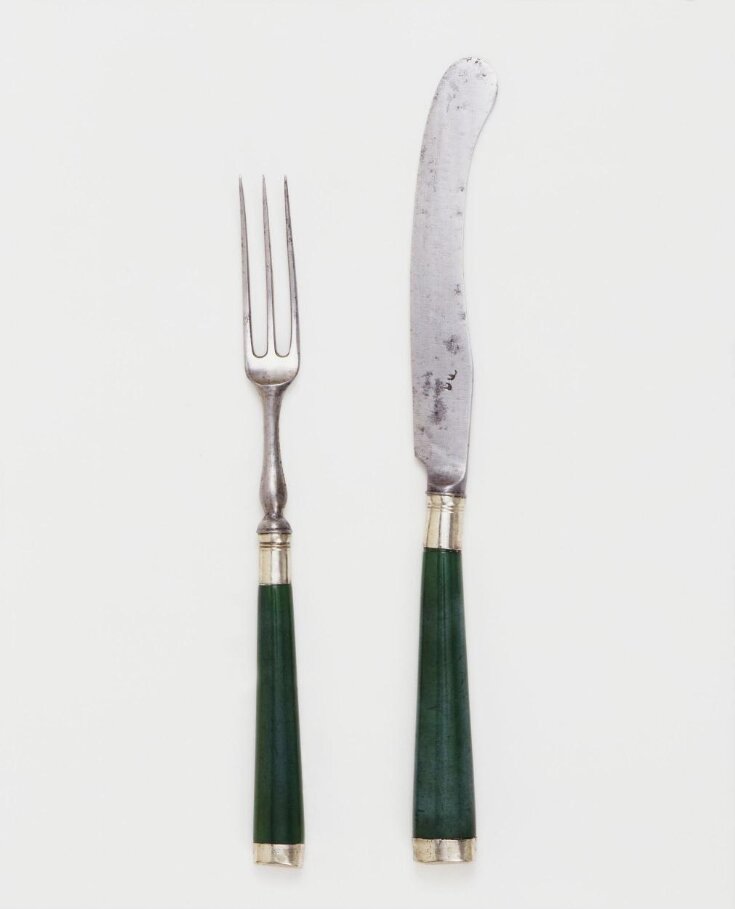

Knife and Fork
ca. 1800 (made)
| Artist/Maker | |
| Place of origin |
Object Type
Until the 17th century, it was the custom for guests to bring their personal cutlery, but by the 18th century knives and forks were provided in matching sets by the host. The basic form of knives and forks had also become standardised by this date.
Design
By the mid-18th century, table knives and forks were usually made in sets and decorated to match the rest of the cutlery. By the end of the 18th century the standard pistol-shaped haft (handle) gave way to straighter, flat-ended hafts. Forks generally had smaller hafts. The knife blade is usually of sabre, or scimitar, shape. The steel blades and shanks have a 'tang' or rod at the base that fits into the hollow handle, which is then packed with resin. The junction between haft and blade is fitted with a small metal collar, or 'ferrule'.
Materials & Making
A wide range of materials have been employed as hafts since the early 17th century. Ivory and bone remained popular into the 19th century, when it became fashionable to stain them a characteristic green.
Until the 17th century, it was the custom for guests to bring their personal cutlery, but by the 18th century knives and forks were provided in matching sets by the host. The basic form of knives and forks had also become standardised by this date.
Design
By the mid-18th century, table knives and forks were usually made in sets and decorated to match the rest of the cutlery. By the end of the 18th century the standard pistol-shaped haft (handle) gave way to straighter, flat-ended hafts. Forks generally had smaller hafts. The knife blade is usually of sabre, or scimitar, shape. The steel blades and shanks have a 'tang' or rod at the base that fits into the hollow handle, which is then packed with resin. The junction between haft and blade is fitted with a small metal collar, or 'ferrule'.
Materials & Making
A wide range of materials have been employed as hafts since the early 17th century. Ivory and bone remained popular into the 19th century, when it became fashionable to stain them a characteristic green.
Object details
| Categories | |
| Object type | |
| Parts | This object consists of 2 parts.
|
| Materials and techniques | Green-stained bone, with steel blade and tines |
| Brief description | Knife and fork with bone handles |
| Gallery label | British Galleries:
Ivory and bone have been popular materials for cutlery hafts (handles) since the Roman period. They were sometimes elaborately carved, but in the 18th century designs became simpler. Unadorned hafts, stained green by vegetable dye, were among the most popular.(27/03/2003) |
| Credit line | Given by J. H. Fitzhenry |
| Object history | Made in England by an unidentified maker |
| Summary | Object Type Until the 17th century, it was the custom for guests to bring their personal cutlery, but by the 18th century knives and forks were provided in matching sets by the host. The basic form of knives and forks had also become standardised by this date. Design By the mid-18th century, table knives and forks were usually made in sets and decorated to match the rest of the cutlery. By the end of the 18th century the standard pistol-shaped haft (handle) gave way to straighter, flat-ended hafts. Forks generally had smaller hafts. The knife blade is usually of sabre, or scimitar, shape. The steel blades and shanks have a 'tang' or rod at the base that fits into the hollow handle, which is then packed with resin. The junction between haft and blade is fitted with a small metal collar, or 'ferrule'. Materials & Making A wide range of materials have been employed as hafts since the early 17th century. Ivory and bone remained popular into the 19th century, when it became fashionable to stain them a characteristic green. |
| Collection | |
| Accession number | 1017&A-1902 |
About this object record
Explore the Collections contains over a million catalogue records, and over half a million images. It is a working database that includes information compiled over the life of the museum. Some of our records may contain offensive and discriminatory language, or reflect outdated ideas, practice and analysis. We are committed to addressing these issues, and to review and update our records accordingly.
You can write to us to suggest improvements to the record.
Suggest feedback
You can write to us to suggest improvements to the record.
Suggest feedback
| Record created | March 27, 2003 |
| Record URL |
Download as: JSONIIIF Manifest
