
Table
ca. 1880 (made)
| Artist/Maker | |
| Place of origin |
Object Type
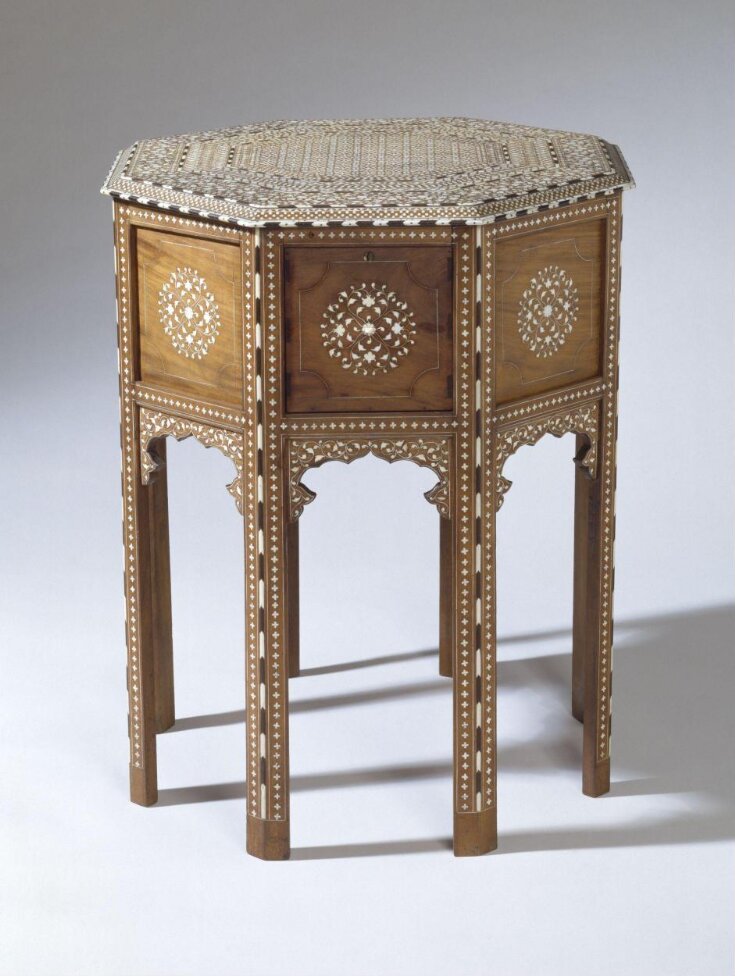
Although Turkish in inspiration, octagonal tables of this form were made in several parts of late 19th-century British India. They were produced principally in response to the growing fashion in Europe for Middle Eastern and Islamic furnishings and decorative accessories. This table is of a standard type made in large numbers in Hoshiarpur, a town in the Punjab known for its workmanship in ivory and ebony inlay.
Trading
Although this table was purchased in the Punjab by Caspar Purdon Clarke (1846-1911), others like it were available at retail outlets throughout India and in Europe and America. They were exported in vast quantities by Hoshiarpur furniture dealers. In London they were advertised by Liberty & Co., which features identical examples in a catalogue of 1896.
Ownership & Use
Tables of this form were used a central decorative feature for interiors conceived in an Islamic style. These were much in vogue in the 1880s and 1890s, particularly for men's smoking rooms. Typical features of these rooms included tented ceilings, tiles and turned lattice panels (mashrabiyya) mounted on the walls, richly cushioned banquettes, huqqas, low square or octagonal tables, Qu'ran stands and hanging lanterns.
Although Turkish in inspiration, octagonal tables of this form were made in several parts of late 19th-century British India. They were produced principally in response to the growing fashion in Europe for Middle Eastern and Islamic furnishings and decorative accessories. This table is of a standard type made in large numbers in Hoshiarpur, a town in the Punjab known for its workmanship in ivory and ebony inlay.
Trading
Although this table was purchased in the Punjab by Caspar Purdon Clarke (1846-1911), others like it were available at retail outlets throughout India and in Europe and America. They were exported in vast quantities by Hoshiarpur furniture dealers. In London they were advertised by Liberty & Co., which features identical examples in a catalogue of 1896.
Ownership & Use
Tables of this form were used a central decorative feature for interiors conceived in an Islamic style. These were much in vogue in the 1880s and 1890s, particularly for men's smoking rooms. Typical features of these rooms included tented ceilings, tiles and turned lattice panels (mashrabiyya) mounted on the walls, richly cushioned banquettes, huqqas, low square or octagonal tables, Qu'ran stands and hanging lanterns.
Object details
| Categories | |
| Object type | |
| Materials and techniques | Shisham wood is from the deciduous tree of the the sub-Himalayan tract. It is a durable wood, which does not warp or split and is one of the most esteemed woods used for furniture making in the north of India along with deodar (Himalayan cedar). While Rosewood and sal are more commonly found furniture and wares of the south, inlaid and wood carving from Saharanpur, Farakhabad, Lucknow, Chiniot, Hoshiapur and Jallandar would be based on shisham wood. |
| Brief description | Octagonal shisham table inlaid with ivory, Punjab, 1881. |
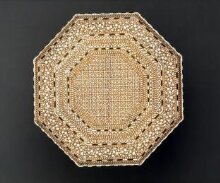
| Physical description | Octagonal eight legged small table made of shisham wood and inlaid with ivory and ebony |
| Dimensions |
|
| Gallery label | British Galleries:
India became Britain's most important colony and an active trading partner. Thousands of people in Britain had contact with India through travel, family connections and publications. Liberty & Co. supplied large numbers of Indian-style furnishings. The designs were usually adapted for European markets rather than following Indian designs exactly.(27/03/2003) |
| Object history | Made in Hoshiarpur, Punjab, India |
| Summary | Object Type Although Turkish in inspiration, octagonal tables of this form were made in several parts of late 19th-century British India. They were produced principally in response to the growing fashion in Europe for Middle Eastern and Islamic furnishings and decorative accessories. This table is of a standard type made in large numbers in Hoshiarpur, a town in the Punjab known for its workmanship in ivory and ebony inlay. Trading Although this table was purchased in the Punjab by Caspar Purdon Clarke (1846-1911), others like it were available at retail outlets throughout India and in Europe and America. They were exported in vast quantities by Hoshiarpur furniture dealers. In London they were advertised by Liberty & Co., which features identical examples in a catalogue of 1896. Ownership & Use Tables of this form were used a central decorative feature for interiors conceived in an Islamic style. These were much in vogue in the 1880s and 1890s, particularly for men's smoking rooms. Typical features of these rooms included tented ceilings, tiles and turned lattice panels (mashrabiyya) mounted on the walls, richly cushioned banquettes, huqqas, low square or octagonal tables, Qu'ran stands and hanging lanterns. |
| Bibliographic references |
|
| Collection | |
| Accession number | IS.2376-1883 |
About this object record
Explore the Collections contains over a million catalogue records, and over half a million images. It is a working database that includes information compiled over the life of the museum. Some of our records may contain offensive and discriminatory language, or reflect outdated ideas, practice and analysis. We are committed to addressing these issues, and to review and update our records accordingly.
You can write to us to suggest improvements to the record.
Suggest feedback
You can write to us to suggest improvements to the record.
Suggest feedback
| Record created | March 27, 2003 |
| Record URL |
Download as: JSONIIIF Manifest
