This object, or the text that describes it, is deemed offensive and discriminatory. We are committed to improving our records, and work is ongoing.
Morysse and Damashin renewed and increased, very profitable for Goldsmythes and Embroderars
Print
1548 (made)
1548 (made)
| Artist/Maker | |
| Place of origin |
Object Type
This print is an engraving, an image made by cutting lines into the surface of a flat piece of metal, inking the plate and then transferring the ink held in the lines onto a sheet of paper.
Subject Depicted
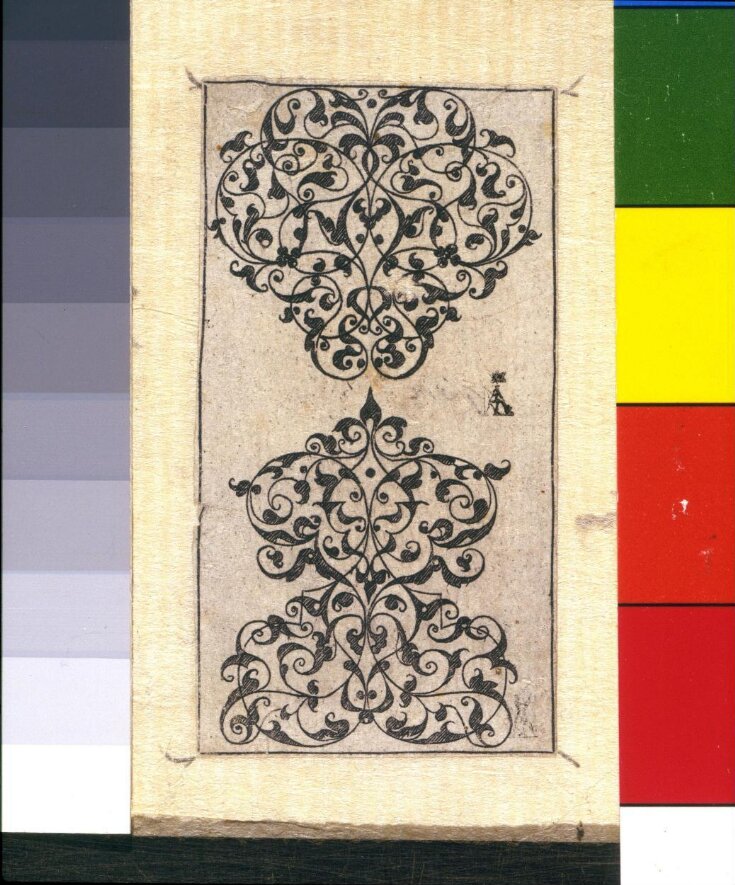
A modern transcription of the title of this set of prints might read 'Moresque and Damascene Patterns Suitable for Goldsmiths and Embroiderers'. Moresque was a term used in the later 16th century to describe a type of decoration for flat surfaces consisting of abstract, interlacing, formal, curling stem and leaf patterns, usually devoid of any human or animal presence.
Damascening is a metalworking technique developed in the Middle East, whereby gold, silver and copper is inlaid into base metal. The word is derived from the place name, Damascus, in Syria. The type of designs used for damascene work were often moresque in style; they were frequently also applied to other types of objects.
This print differs from the others in this set as the design cannot, like the others, be extended in any direction. Instead, it comprises two distinct elements; their shape suggests that either singly or together they could have been suitable for objects such as buckles or clasps.
Cultural Associations
The English word 'Moor' stems from the Latin word Mauri, which referred to the inhabitants of the Roman province of Mauretania. This included parts of the modern states of Algeria and Morocco, although not the modern Islamic Republic of Mauritania. The word 'Moor' usually refers to a Muslim of mixed Arab and Berber origin, from North Africa or southern Spain. The Moors occupied most of the Iberian peninsula in the early 8th century, but were pushed back to Granada by the Christian kingdoms of northern Spain by the mid-13th and were finally expelled in 1492. Until the 18th century a black person was commonly referred to in Britain as a 'moor' or 'blackamoor'; most famously, Othello was 'The Moor of Venice'.
This print is an engraving, an image made by cutting lines into the surface of a flat piece of metal, inking the plate and then transferring the ink held in the lines onto a sheet of paper.
Subject Depicted
A modern transcription of the title of this set of prints might read 'Moresque and Damascene Patterns Suitable for Goldsmiths and Embroiderers'. Moresque was a term used in the later 16th century to describe a type of decoration for flat surfaces consisting of abstract, interlacing, formal, curling stem and leaf patterns, usually devoid of any human or animal presence.
Damascening is a metalworking technique developed in the Middle East, whereby gold, silver and copper is inlaid into base metal. The word is derived from the place name, Damascus, in Syria. The type of designs used for damascene work were often moresque in style; they were frequently also applied to other types of objects.
This print differs from the others in this set as the design cannot, like the others, be extended in any direction. Instead, it comprises two distinct elements; their shape suggests that either singly or together they could have been suitable for objects such as buckles or clasps.
Cultural Associations
The English word 'Moor' stems from the Latin word Mauri, which referred to the inhabitants of the Roman province of Mauretania. This included parts of the modern states of Algeria and Morocco, although not the modern Islamic Republic of Mauritania. The word 'Moor' usually refers to a Muslim of mixed Arab and Berber origin, from North Africa or southern Spain. The Moors occupied most of the Iberian peninsula in the early 8th century, but were pushed back to Granada by the Christian kingdoms of northern Spain by the mid-13th and were finally expelled in 1492. Until the 18th century a black person was commonly referred to in Britain as a 'moor' or 'blackamoor'; most famously, Othello was 'The Moor of Venice'.
Object details
| Categories | |
| Object type | |
| Title | Morysse and Damashin renewed and increased, very profitable for Goldsmythes and Embroderars (series title) |
| Materials and techniques | Engraving, ink on paper |
| Brief description | Thomas Geminus. Plate from a suite of 29 designs for Moresque ornament entitled 'Morysse and Damashin renewed and increased, very profitable for Goldsmythes and Embroderars'. London, 1548. |
| Physical description | Plate 3. |
| Dimensions |
|
| Gallery label | British Galleries:
Moresque was an Islamic style of ornament, associated with the Moors of North Africa and Spain (from which they were expelled in 1492). It was one of several ways to explore intricate knot patterns. Early examples of Moresque appeared on book covers but it quickly spread to goldsmiths' work and textiles. Geminus was Flemish by birth but lived in London. He was surgeon to the Tudor monarchs, as well as being an engraver and instrument maker.(27/03/2003) |
| Object history | NB. While the term 'blackamoor' has been used in this record, it has since fallen from usage and is now considered offensive. The term is repeated in this record in its original historical context. Part of a group of objects previously in possession of Mr. R.S. Smith [South Kensington Museum employee?]. |
| Summary | Object Type This print is an engraving, an image made by cutting lines into the surface of a flat piece of metal, inking the plate and then transferring the ink held in the lines onto a sheet of paper. Subject Depicted A modern transcription of the title of this set of prints might read 'Moresque and Damascene Patterns Suitable for Goldsmiths and Embroiderers'. Moresque was a term used in the later 16th century to describe a type of decoration for flat surfaces consisting of abstract, interlacing, formal, curling stem and leaf patterns, usually devoid of any human or animal presence. Damascening is a metalworking technique developed in the Middle East, whereby gold, silver and copper is inlaid into base metal. The word is derived from the place name, Damascus, in Syria. The type of designs used for damascene work were often moresque in style; they were frequently also applied to other types of objects. This print differs from the others in this set as the design cannot, like the others, be extended in any direction. Instead, it comprises two distinct elements; their shape suggests that either singly or together they could have been suitable for objects such as buckles or clasps. Cultural Associations The English word 'Moor' stems from the Latin word Mauri, which referred to the inhabitants of the Roman province of Mauretania. This included parts of the modern states of Algeria and Morocco, although not the modern Islamic Republic of Mauritania. The word 'Moor' usually refers to a Muslim of mixed Arab and Berber origin, from North Africa or southern Spain. The Moors occupied most of the Iberian peninsula in the early 8th century, but were pushed back to Granada by the Christian kingdoms of northern Spain by the mid-13th and were finally expelled in 1492. Until the 18th century a black person was commonly referred to in Britain as a 'moor' or 'blackamoor'; most famously, Othello was 'The Moor of Venice'. |
| Bibliographic references |
|
| Collection | |
| Accession number | 19012 |
About this object record
Explore the Collections contains over a million catalogue records, and over half a million images. It is a working database that includes information compiled over the life of the museum. Some of our records may contain offensive and discriminatory language, or reflect outdated ideas, practice and analysis. We are committed to addressing these issues, and to review and update our records accordingly.
You can write to us to suggest improvements to the record.
Suggest feedback
You can write to us to suggest improvements to the record.
Suggest feedback
| Record created | March 27, 2003 |
| Record URL |
Download as: JSONIIIF Manifest
