
The Apotheosis of Henry VIII
Drawing
ca. 1546 (made)
ca. 1546 (made)
| Artist/Maker | |
| Place of origin |
Object Type
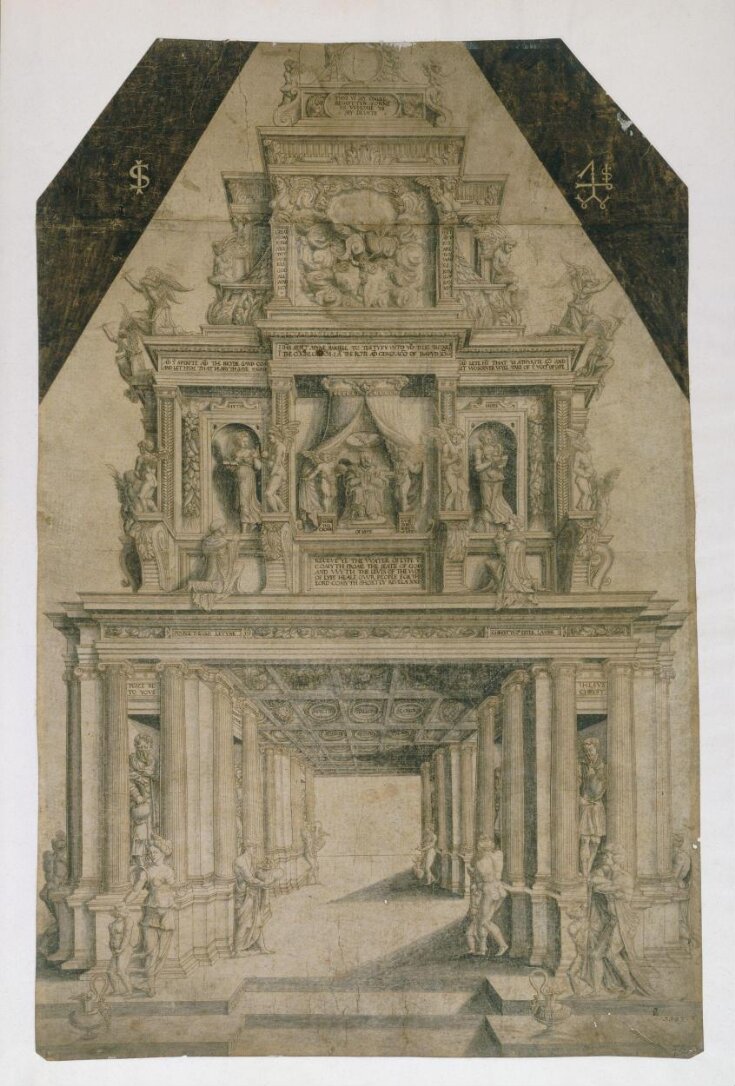
This highly finished drawing may have been a preparatory design for an engraving (an image made by cutting lines into the surface of a flat piece of metal, inking the plate and then transferring the ink held in the lines on to a sheet of paper), but this is not certain. Some think that it was a design for an arch for a triumphal procession, though there is little evidence for this. The meaning of the subject is uncertain, though it seems to be an allegory referring to Henry VIII (1509-1547) during the last years of his reign. It is clear, however, that the artist, Robert Pyte (died about 1552), was familiar with the classical-influenced work of the Italian architect and theorist Sebastiano Serlio (1475-about 1553 or 1555). The frieze of the second storey and the panelled attic storey above it are directly copied from folio 62v of Book IV of Serlio's treatise on architecture, which was first published in 1537.
Materials & Making
The design is drawn in pen and ink with wash on vellum, which is a fine parchment prepared from the skin of calf, kid or lamb. Vellum was commonly used in Britain at this time, although it was being surpassed by the use of paper. Made from wood pulp, paper was better for printing uses and cheaper than vellum.
People
The drawing is inscribed 'Robertus Pyte' and bears the monogram 'IS'. This is probably Robert Pyte, who was an engraver to the Royal Mint from the early 1540s. He was chief engraver from 1550 until his death in 1552.
This highly finished drawing may have been a preparatory design for an engraving (an image made by cutting lines into the surface of a flat piece of metal, inking the plate and then transferring the ink held in the lines on to a sheet of paper), but this is not certain. Some think that it was a design for an arch for a triumphal procession, though there is little evidence for this. The meaning of the subject is uncertain, though it seems to be an allegory referring to Henry VIII (1509-1547) during the last years of his reign. It is clear, however, that the artist, Robert Pyte (died about 1552), was familiar with the classical-influenced work of the Italian architect and theorist Sebastiano Serlio (1475-about 1553 or 1555). The frieze of the second storey and the panelled attic storey above it are directly copied from folio 62v of Book IV of Serlio's treatise on architecture, which was first published in 1537.
Materials & Making
The design is drawn in pen and ink with wash on vellum, which is a fine parchment prepared from the skin of calf, kid or lamb. Vellum was commonly used in Britain at this time, although it was being surpassed by the use of paper. Made from wood pulp, paper was better for printing uses and cheaper than vellum.
People
The drawing is inscribed 'Robertus Pyte' and bears the monogram 'IS'. This is probably Robert Pyte, who was an engraver to the Royal Mint from the early 1540s. He was chief engraver from 1550 until his death in 1552.
Object details
| Categories | |
| Object type | |
| Title | The Apotheosis of Henry VIII |
| Materials and techniques | Pen and ink and wash on vellum |
| Brief description | Henry VIII in the setting of a triumphal arch, representing the apotheosis of Henry VIII, design for an engraving, probably designed and drawn in England by Robert Pyte, ca. 1546 |
| Physical description | Pen and ink and wash drawing on vellum |
| Dimensions |
|
| Marks and inscriptions | 'Robertus Pyte' (Maker's identification; signed; ink) |
| Gallery label | British Galleries:
The exact purpose of this highly finished drawing is unknown. It may record a temporary arch erected at court or it may be preparation for an engraving. Its details were based on the latest Italian architectural books. Inscriptions celebrate the King at the end of his reign as the all-powerful commander of church and state.(27/03/2003) |
| Object history | Probably designed and drawn in England by Robert Pyte (died about 1552) |
| Subjects depicted | |
| Summary | Object Type This highly finished drawing may have been a preparatory design for an engraving (an image made by cutting lines into the surface of a flat piece of metal, inking the plate and then transferring the ink held in the lines on to a sheet of paper), but this is not certain. Some think that it was a design for an arch for a triumphal procession, though there is little evidence for this. The meaning of the subject is uncertain, though it seems to be an allegory referring to Henry VIII (1509-1547) during the last years of his reign. It is clear, however, that the artist, Robert Pyte (died about 1552), was familiar with the classical-influenced work of the Italian architect and theorist Sebastiano Serlio (1475-about 1553 or 1555). The frieze of the second storey and the panelled attic storey above it are directly copied from folio 62v of Book IV of Serlio's treatise on architecture, which was first published in 1537. Materials & Making The design is drawn in pen and ink with wash on vellum, which is a fine parchment prepared from the skin of calf, kid or lamb. Vellum was commonly used in Britain at this time, although it was being surpassed by the use of paper. Made from wood pulp, paper was better for printing uses and cheaper than vellum. People The drawing is inscribed 'Robertus Pyte' and bears the monogram 'IS'. This is probably Robert Pyte, who was an engraver to the Royal Mint from the early 1540s. He was chief engraver from 1550 until his death in 1552. |
| Bibliographic reference | pp. 151-3
Elizabeth Cleland and Adam Eaker,with contributions by Marjorie E. Wieseman and Sarah Bochicchio The Tudors: Art and Majesty in Renaissance England , Yale University Press, 2022. ISBN: 978-1588396921 |
| Collection | |
| Accession number | 3337 |
About this object record
Explore the Collections contains over a million catalogue records, and over half a million images. It is a working database that includes information compiled over the life of the museum. Some of our records may contain offensive and discriminatory language, or reflect outdated ideas, practice and analysis. We are committed to addressing these issues, and to review and update our records accordingly.
You can write to us to suggest improvements to the record.
Suggest feedback
You can write to us to suggest improvements to the record.
Suggest feedback
| Record created | March 27, 2003 |
| Record URL |
Download as: JSONIIIF Manifest
