
Border
1800-1875 (made)
| Artist/Maker | |
| Place of origin |
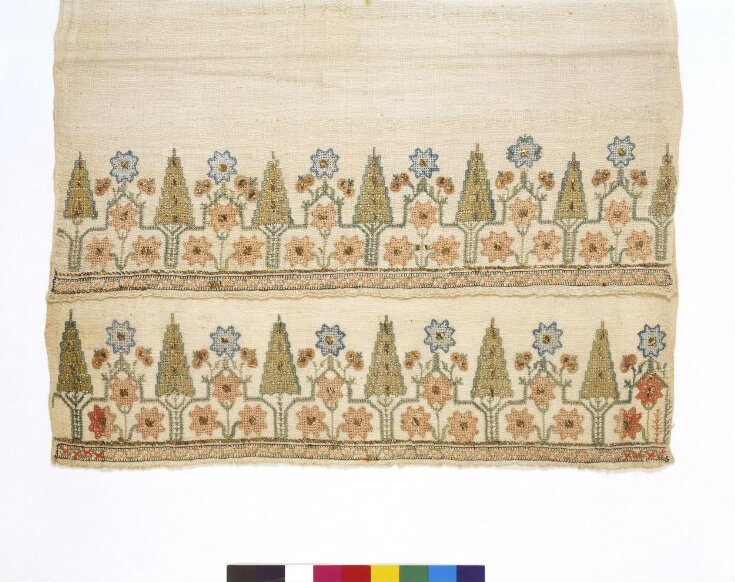
At the end of the 18th century embroidery designs began to develop into rigid and heavily stylised borders for towels and napkins. The colours of 18th and 19th century embroideries were originally very bright but many have faded to pleasing pastel shades; often great quantities of metal thread were used. Napkins were mainly used to clean fingers during meals, but were also used as decoration and as covers. Their designs were consistently inventive.
Object details
| Categories | |
| Object type | |
| Materials and techniques | Cotton, embroidered with silk in double running variations and combinations and in musabak, and with metal thread in slanted satin stitch |
| Brief description | towel or napkin border, embroidered, 1800s, Turkish |
| Physical description | Towel/Napkin Border, cotton embroidered with silk in double running variations and combinations and in musabak and with metal thread in slanted satin stitch. The colours are predominantly light shades of pink and blue. There are tall, stylized pointed trees between trilobed arches, each enclosing three pink flowerhead and topped by a blue one. |
| Dimensions |
|
| Style | |
| Subjects depicted | |
| Association | |
| Summary | At the end of the 18th century embroidery designs began to develop into rigid and heavily stylised borders for towels and napkins. The colours of 18th and 19th century embroideries were originally very bright but many have faded to pleasing pastel shades; often great quantities of metal thread were used. Napkins were mainly used to clean fingers during meals, but were also used as decoration and as covers. Their designs were consistently inventive. |
| Bibliographic reference | Illustrated in 'Ottoman Embroidery' by Marianne Ellis and Jennifer Wearden (V&A Publications, 2001); plate 144 |
| Collection | |
| Accession number | 681A-1877 |
About this object record
Explore the Collections contains over a million catalogue records, and over half a million images. It is a working database that includes information compiled over the life of the museum. Some of our records may contain offensive and discriminatory language, or reflect outdated ideas, practice and analysis. We are committed to addressing these issues, and to review and update our records accordingly.
You can write to us to suggest improvements to the record.
Suggest feedback
You can write to us to suggest improvements to the record.
Suggest feedback
| Record created | March 26, 2003 |
| Record URL |
Download as: JSONIIIF Manifest
