Les Femmes Savantes
Oil Painting
1845 (made)
1845 (made)
| Artist/Maker | |
| Place of origin |
Object Type
Oil paintings such as this with subjects taken from popular literature steadily replaced commissions for history paintings in the early 19th century. The public and most collectors of modern works started to prefer lighter and sometimes more sentimental themes.
Subjects Depicted
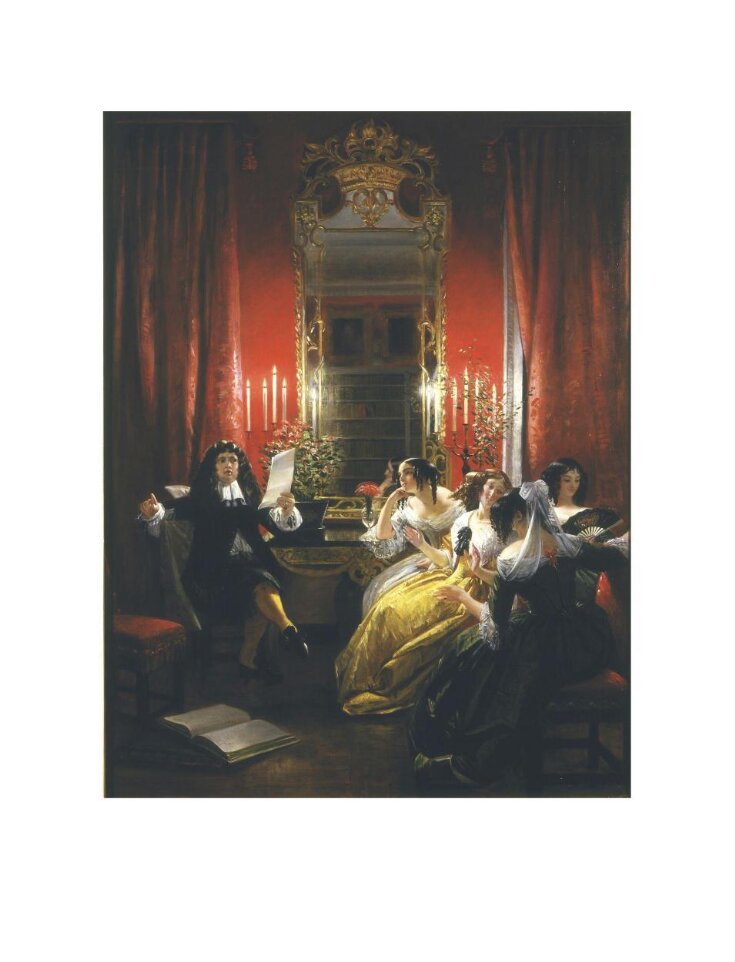
Leslie frequently used themes from humorous literature. Here he is illustrating a scene from a play by Molière, Les Femmes Savantes ('The Learned Ladies'), in which the conceited Trissotin reads a pretentious sonnet of his own composition to his admiring audience of literary ladies, the self-styled 'learned ladies' of the title. When this picture was exhibited at the Royal Academy in London in 1845, it was called A Scene from Molière and several lines from the play were quoted in the catalogue.
People
Although Leslie began his career as a history and portrait painter, he soon turned to literary themes. The collector John Sheepshanks (1787-1863) owned 17 paintings by Leslie with subjects taken from well-known authors such as Shakespeare, Chaucer and Molière.
Oil paintings such as this with subjects taken from popular literature steadily replaced commissions for history paintings in the early 19th century. The public and most collectors of modern works started to prefer lighter and sometimes more sentimental themes.
Subjects Depicted
Leslie frequently used themes from humorous literature. Here he is illustrating a scene from a play by Molière, Les Femmes Savantes ('The Learned Ladies'), in which the conceited Trissotin reads a pretentious sonnet of his own composition to his admiring audience of literary ladies, the self-styled 'learned ladies' of the title. When this picture was exhibited at the Royal Academy in London in 1845, it was called A Scene from Molière and several lines from the play were quoted in the catalogue.
People
Although Leslie began his career as a history and portrait painter, he soon turned to literary themes. The collector John Sheepshanks (1787-1863) owned 17 paintings by Leslie with subjects taken from well-known authors such as Shakespeare, Chaucer and Molière.
Object details
| Categories | |
| Object type | |
| Title | Les Femmes Savantes (popular title) |
| Materials and techniques | Oil on canvas, with carved wood and composition frame |
| Brief description | Oil painting by Charles Robert Leslie depicting a scene from a play by Molière, Les Femmes Savantes, namely Trissotin reading his sonnet (Act III, Scene 2). Great Britain, 1845. |
| Physical description | Oil painting depicting Trissotin reading his sonnet. |
| Dimensions |
|
| Styles | |
| Gallery label | British Galleries:
This shows a scene from a French play first performed in 1672. The frame was carved with motifs that came into fashion only in 1700. Mixing of historic styles was an accepted part of 19th century French Style.(27/03/2003) |
| Credit line | Given by John Sheepshanks, 1857 |
| Object history | Given by John Sheepshanks, 1857. Painted by Charles Robert Leslie RA (born in London, 1794, died there in 1859); frame maker unidentified. Leslie was one of many artists who frequently visited Petworth House during the early 19th century and was given a great deal of access to the house and collections. This is reflected in the works he produced, including the present work painted in the Petworth House interiors. The room depicted in this painting is what is known now as the Little Dining Room and the reflected view in the mirror, shows the White Library, which at the time was painted red. |
| Subject depicted | |
| Literary reference | Molière, <i>Les Femmes Savantes</i> |
| Summary | Object Type Oil paintings such as this with subjects taken from popular literature steadily replaced commissions for history paintings in the early 19th century. The public and most collectors of modern works started to prefer lighter and sometimes more sentimental themes. Subjects Depicted Leslie frequently used themes from humorous literature. Here he is illustrating a scene from a play by Molière, Les Femmes Savantes ('The Learned Ladies'), in which the conceited Trissotin reads a pretentious sonnet of his own composition to his admiring audience of literary ladies, the self-styled 'learned ladies' of the title. When this picture was exhibited at the Royal Academy in London in 1845, it was called A Scene from Molière and several lines from the play were quoted in the catalogue. People Although Leslie began his career as a history and portrait painter, he soon turned to literary themes. The collector John Sheepshanks (1787-1863) owned 17 paintings by Leslie with subjects taken from well-known authors such as Shakespeare, Chaucer and Molière. |
| Bibliographic reference | Catalogue of British Oil Paintings 1820-1860, Ronald Parkinson, Victoria and Albert Museum, London: HMSO, 1990, pp. 166-67 |
| Collection | |
| Accession number | FA.117[O] |
About this object record
Explore the Collections contains over a million catalogue records, and over half a million images. It is a working database that includes information compiled over the life of the museum. Some of our records may contain offensive and discriminatory language, or reflect outdated ideas, practice and analysis. We are committed to addressing these issues, and to review and update our records accordingly.
You can write to us to suggest improvements to the record.
Suggest feedback
You can write to us to suggest improvements to the record.
Suggest feedback
| Record created | March 25, 2003 |
| Record URL |
Download as: JSONIIIF Manifest
