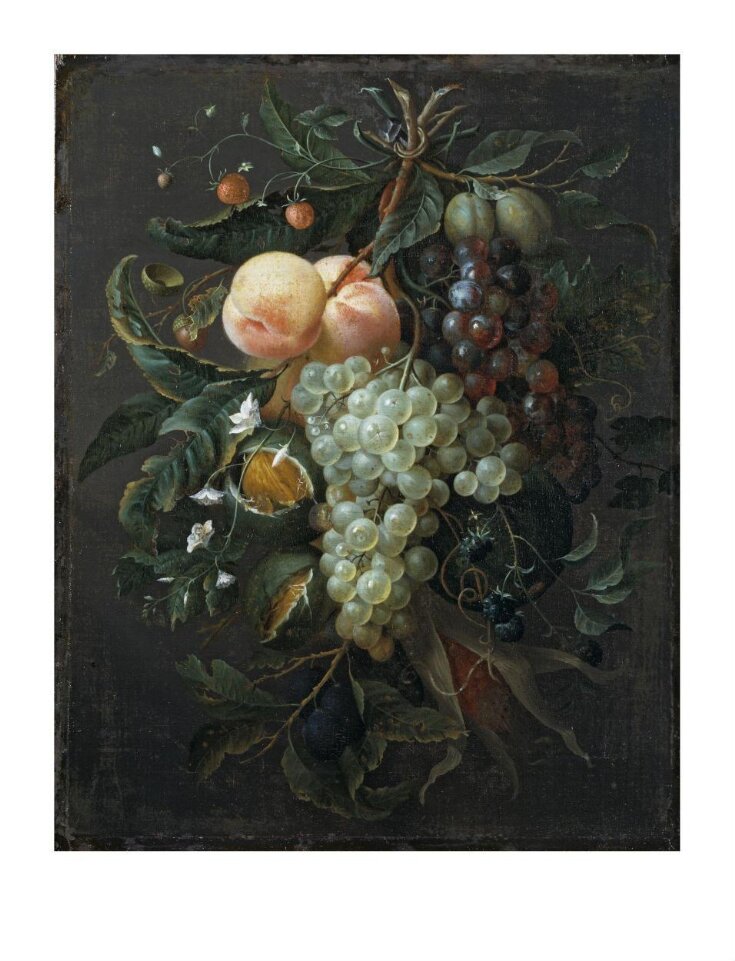
Festoon with Fruit, Corn, Nuts and Flowers
Oil Painting
mid 17th century (painted)
mid 17th century (painted)
| Artist/Maker | |
| Place of origin |
A festoon of fruit, flowers, vegetables and nuts hanging from a nail. Pieter Gallis (1633-1697) was a painter of the Northern-Netherlandish School, working in Amsterdam Enkhizen, Purmerend and Hoorn. He was primarily a painter of still lifes and landscapes and appears to have been inspired by the works of Jan and his son Cornelis de Heem. 501-1870 closely resembles two of Cornelis' festoons of the 1650s and 1660s now in private collections. These were inspired by works by his father such as Festoon with Fruit and Flowers ca. 1660, now in the Rijksmuseum, Amsterdam. In still-life paintings such as 501-1870, objects, especially fruit, which may appear to be no more than miscellaneous elements in fact conceal a system of Christian symbolism. Grapes symbolize the Eucharistic wine and hence the Redeemer’s blood, a concept expressed by Augustine, ‘Jesus is the grape of the Promised Land, the bunch that has been put under the wine-press’. The black bunch of grapes at right and a white in the centre probably allude to John’s account of the wounding of Christ on the cross ‘and at once there was a flow of blood and water’ (19:34). Ears of corn, as visible in the lower right, in association with grapes, stand for the bread of the Eucharist while the walnut as seen at the lower left, was also elaborated by Augustine; the outer green case was the flesh of Christ, the shell the wood of his cross, the kernel his divine nature. Peaches are similarly associated with the Trinity due to their three constituent parts (skin, flesh, stone) and with Truth. Strawberries are associated with the Incarnation while green plums evoke the charity and humility of Christ and purple plums are associated with His Passion and death. Jasmine flowers (?) are an attribute of the Virgin symbolising Grace and Divine Love.
Object details
| Category | |
| Object type | |
| Title | Festoon with Fruit, Corn, Nuts and Flowers (generic title) |
| Materials and techniques | Oil on canvas |
| Brief description | Oil painting, 'Festoon with Fruit, Corn, Nuts and Flowers', Pieter Gallis, mid 17th century |
| Physical description | A festoon of fruit, flowers, vegetables and nuts hanging from a nail |
| Dimensions |
|
| Style | |
| Credit line | Bequeathed by John M. Parsons |
| Object history | Bequeathed by John M. Parsons, 1870 Historical significance: This painting has been attributed, based on photographs only, to Pieter Gallis by Dr. Fred Meijer (verbal communication) in February 2010. Gallis (1633-1697) was a painter of the Northern-Netherlandish School, working in Amsterdam Enkhizen, Purmerend and Hoorn. He was primarily a painter of still lifes and landscapes and appears to have been inspired by the works of Jan and his son Cornelis de Heem. 501-1870 closely resembles two of Cornelis' festoons of the 1650s and 1660s now in private collections. These were inspired by works by his father such as Festoon with Fruit and Flowers ca. 1660, now in the Rijksmuseum, Amsterdam. In still-life paintings such as 501-1870, objects, especially fruit, which may appear to be no more than miscellaneous elements in fact conceal a system of Christian symbolism. Grapes symbolize the Eucharistic wine and hence the Redeemer’s blood, a concept expressed by Augustine, ‘Jesus is the grape of the Promised Land, the bunch that has been put under the wine-press’. The black bunch of grapes at right and a white in the centre probably allude to John’s account of the wounding of Christ on the cross ‘and at once there was a flow of blood and water’ (19:34). Ears of corn, as visible in the lower right, in association with grapes, stand for the bread of the Eucharist while the walnut as seen at the lower left, was also elaborated by Augustine; the outer green case was the flesh of Christ, the shell the wood of his cross, the kernel his divine nature. Peaches are similarly associated with the Trinity due to their three constituent parts (skin, flesh, stone) and with Truth. Strawberries are associated with the Incarnation while green plums evoke the charity and humility of Christ and purple plums are associated with His Passion and death. Jasmine flowers (?) are an attribute of the Virgin symbolising Grace and Divine Love. |
| Historical context | The term 'still life' conventionally refers to works depicting an arrangement of diverse inanimate objects including fruits, flowers, shellfish, vessels and artefacts. The term derives from the Dutch 'stilleven', which became current from about 1650 as a collective name for this type of subject matter. Still-life reached the height of its popularity in Western Europe, especially in the Netherlands, during the 17th century although still-life subjects already existed in pre-Classical, times. As a genre, this style originates in the early 15th century in Flanders with Hugo van der Goes (ca.1440-1482), Hans Memling (ca.1435-1494) and Gerard David (ca.1460-1523) who included refined still-life details charged with symbolic meaning in their compositions in the same manner as illuminators from Ghent or Bruges did in their works for decorative purpose. In the Low Countries, the first types of still life to emerge were flower paintings and banquet tables by artists like Floris van Schooten (c.1585-after 1655). Soon, different traditions of still life with food items developed in Flanders and in the Netherlands where they became especially popular commodities in the new bourgeois art market. Dutch painters played a major role the development of this genre, inventing distinctive variations on the theme over the course of the century while Flemish artist Frans Snyders' established a taste for banquet pieces. These works were developed further in Antwerp by the Dutchman Jan Davidsz. de Heem (1606-1684) who created opulent baroque confections of fruit, flowers, and precious vessels that became a standardized decorative type throughout Europe. Scholarly opinion had long been divided over how all of these images should be understood. The exotic fruits and valuable objects often depicted testify to the prosperous increase in wealth in cities such as Amsterdam and Haarlem but may also function as memento mori, or vanitas, that is, reminders of human mortality and invitations to meditate upon the passage of time. |
| Production | Originally called Cuyp (1893), then 'style of van Huysum' and then 'Dutch School' by Kaufmann (1973). Fred Meijer of the Rijksbureau voor Kunsthistorische Documentatie (RKD) has recently suggested that the work was painted by Pieter Gallis. |
| Subjects depicted | |
| Summary | A festoon of fruit, flowers, vegetables and nuts hanging from a nail. Pieter Gallis (1633-1697) was a painter of the Northern-Netherlandish School, working in Amsterdam Enkhizen, Purmerend and Hoorn. He was primarily a painter of still lifes and landscapes and appears to have been inspired by the works of Jan and his son Cornelis de Heem. 501-1870 closely resembles two of Cornelis' festoons of the 1650s and 1660s now in private collections. These were inspired by works by his father such as Festoon with Fruit and Flowers ca. 1660, now in the Rijksmuseum, Amsterdam. In still-life paintings such as 501-1870, objects, especially fruit, which may appear to be no more than miscellaneous elements in fact conceal a system of Christian symbolism. Grapes symbolize the Eucharistic wine and hence the Redeemer’s blood, a concept expressed by Augustine, ‘Jesus is the grape of the Promised Land, the bunch that has been put under the wine-press’. The black bunch of grapes at right and a white in the centre probably allude to John’s account of the wounding of Christ on the cross ‘and at once there was a flow of blood and water’ (19:34). Ears of corn, as visible in the lower right, in association with grapes, stand for the bread of the Eucharist while the walnut as seen at the lower left, was also elaborated by Augustine; the outer green case was the flesh of Christ, the shell the wood of his cross, the kernel his divine nature. Peaches are similarly associated with the Trinity due to their three constituent parts (skin, flesh, stone) and with Truth. Strawberries are associated with the Incarnation while green plums evoke the charity and humility of Christ and purple plums are associated with His Passion and death. Jasmine flowers (?) are an attribute of the Virgin symbolising Grace and Divine Love. |
| Associated object | 4835-1857 (Object) |
| Bibliographic references |
|
| Collection | |
| Accession number | 501-1870 |
About this object record
Explore the Collections contains over a million catalogue records, and over half a million images. It is a working database that includes information compiled over the life of the museum. Some of our records may contain offensive and discriminatory language, or reflect outdated ideas, practice and analysis. We are committed to addressing these issues, and to review and update our records accordingly.
You can write to us to suggest improvements to the record.
Suggest feedback
You can write to us to suggest improvements to the record.
Suggest feedback
| Record created | March 25, 2003 |
| Record URL |
Download as: JSONIIIF Manifest
