
A Fountain with Classical ruins
Oil Painting
mid 18th century (painted)
mid 18th century (painted)
| Artist/Maker | |
| Place of origin |
Giovanni Paolo Pannini (1691-1765) was born in Piacenza where Giuseppe Natali (1661-1722) and Andrea Galluzzi (1716-1743) as well as the stage designer Francesco Galli-Bibiena (1659-1739), who taught him the art of painting illusionistic architecture. In 1711 he moved to Rome where he worked under Benedetto Luti (1666-1724) and then Andrea Locatelli (1695-1741). He entered in the Congregazione dei Virtuosi al Pantheon, and had a rapid success. By 1719 he was nominated to the Accademia di S Luca, where he taught perspective drawing. Panini ran an important workshop which included his son Francesco (b. 1738) and the Frenchman Hubert Robert (1733-1808). His work also influence such artists as Giovanni Battista Piranesi (1720-1778) and Giovanni Antonio Canaletto (1697-1768). He died in Rome in 1765.
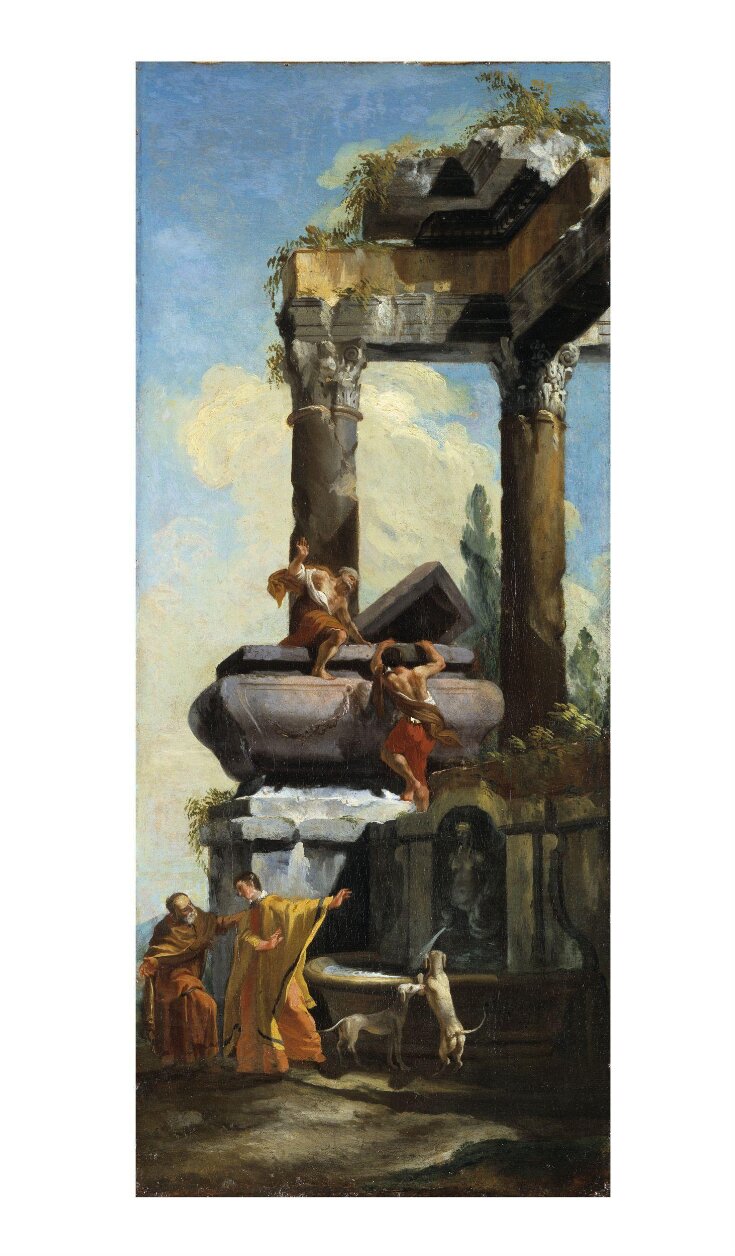
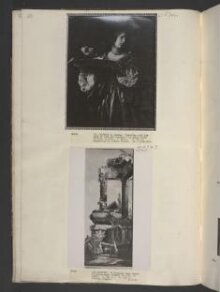
This painting was probably made by a follower of Panini who became famous for his vedute and capricci paintings. This picture of an unclear subject matter shows idealised classical ruins with a fountain and four male figures. Two men are opening up a sarcophagus while two other stand at the bottom of the monument. This kind of pictures was sought after by collectors and patrons during the 18th century and became extremely popular during the era of the Grand Tour of Europe, stimulated by the need of recording topographical settings.
This painting was probably made by a follower of Panini who became famous for his vedute and capricci paintings. This picture of an unclear subject matter shows idealised classical ruins with a fountain and four male figures. Two men are opening up a sarcophagus while two other stand at the bottom of the monument. This kind of pictures was sought after by collectors and patrons during the 18th century and became extremely popular during the era of the Grand Tour of Europe, stimulated by the need of recording topographical settings.
Object details
| Category | |
| Object type | |
| Parts | This object consists of 3 parts.
|
| Title | A Fountain with Classical ruins (generic title) |
| Materials and techniques | Oil on canvas |
| Brief description | Oil painting, 'A Fountain with Classical Ruins', follower of Giovanni Paolo Panini, mid 18th century |
| Physical description | In a vertical composition, classical ruins set in a sunny landscape with a fountain and a sarcophagus, tow dogs and four male figures, two of which are climbing onto the monument. |
| Dimensions |
|
| Style | |
| Credit line | Bequeathed by John Forster |
| Object history | Bequeathed by John Forster, 1876 Extract from Parkinson, Ronald, Catalogue of British Oil Paintings 1820-1860. Victoria & Albert Museum, HMSO, London, 1990. p.xix John Forster (1812-1876) was born in Newcastle, the son of a cattle dealer. Educated at Newcastle Grammar School and University College London, he was a student in the Inner Temple 1828 and qualified as a barrister 1843. Began his career as a journalist as dramatic critic of the True Sun 1832; he later edited the Foreign Quarterly Review (1842-3), the Daily News (1846) and most famously the Examiner (1847-55). He was the author of numerous works, notably the Life and Adventures of Oliver Goldsmith (1848) and the Life of Charles Dickens (1872-4). He bequeathed his extensive collection of books, pamphlets, manuscripts, prints, drawings, watercolours and oil paintings to the V&A. See also South Kensington Museum Art Handbooks. The Dyce and Forster Collections. With Engravings and Facsimiles. Published for the Committee of Council on Education by Chapman and Hall, Limited, 193, Piccadilly, London. 1880. Chapter V. Biographical Sketch of Mr. Forster. pp.53-73, including 'Portrait of Mr. Forster' illustrated opposite p.53. Historical significance: Following in the footsteps of Gaspar van Wittel (1652/53-1736), Giovanni Ghisolfi (ca. 1623-1683) and Salvator Rosa (1615-1673), Panini devoted himself to the painting of vedute and capricci, for which he was best known. The 'capriccio', a somewhat derivation of the 'veduta', i.e. a landscape or town view that is largely topographical in conception, enabled the painter to develop further his imagination as he included in a realistic setting fantastic elements and had therefore to combine them together in an elaborate composition. This painting bears similar characteristics with Panini's manner such as the luminous albeit cool palette enlivened with reddish brown and orange hues, the vertical composition as well as the small figures interacting with the architecture. However it was most likely executed by a follower whose brushwork betrays some weakness in the details and a loose, freer manner. The subject matter is unclear although the two men by the fountain look like patricians, whereas the two others, poorly dressed, are opening up a sarcophagus. The theme of grave thieves (called 'tombaroli' in Italian) is quite common in this type of imagery and can be found in the works of other capricci painter such as the Venetian Francesco Guardi (1712-1793). This picture is a good example of the kind of pictures that were particularly sought after during the 18th century: an idealised representation of Roman classical ruins in the Italian countryside with little regard for historic or geographic accuracy. |
| Historical context | A 'capriccio' is a painted, drawn or engraved composition that combines imaginary and realistic architectural features in a picturesque setting, often dotted with small figures, and mostly displayed as wall schemes for interior decoration. It emerges as a genre during the early 18th-century Rococo period, and became extremely popular during the era of the Grand Tour of Europe, stimulated by the need of recording topographical settings. The Italian landscape, which abounded with classical ruins, was especially favoured for this new genre painting. It particularly developed in Venice with such artists as Marco Ricci (1676-1730) and his uncle Sebastiano Ricci (1659-1734), together with Canaletto (1697-1768), Giambattista Pittoni (1687-1767) and Giovanni Battista Piazzetta (1682-1754), and in Rome where Giovanni Paolo Panini (ca. 1692-1765) was the most representative of the 'capriccio' painters. The genre declined during the early part of the next century, gradually transformed and was eventually absorbed by the Romanticism. |
| Subjects depicted | |
| Summary | Giovanni Paolo Pannini (1691-1765) was born in Piacenza where Giuseppe Natali (1661-1722) and Andrea Galluzzi (1716-1743) as well as the stage designer Francesco Galli-Bibiena (1659-1739), who taught him the art of painting illusionistic architecture. In 1711 he moved to Rome where he worked under Benedetto Luti (1666-1724) and then Andrea Locatelli (1695-1741). He entered in the Congregazione dei Virtuosi al Pantheon, and had a rapid success. By 1719 he was nominated to the Accademia di S Luca, where he taught perspective drawing. Panini ran an important workshop which included his son Francesco (b. 1738) and the Frenchman Hubert Robert (1733-1808). His work also influence such artists as Giovanni Battista Piranesi (1720-1778) and Giovanni Antonio Canaletto (1697-1768). He died in Rome in 1765. This painting was probably made by a follower of Panini who became famous for his vedute and capricci paintings. This picture of an unclear subject matter shows idealised classical ruins with a fountain and four male figures. Two men are opening up a sarcophagus while two other stand at the bottom of the monument. This kind of pictures was sought after by collectors and patrons during the 18th century and became extremely popular during the era of the Grand Tour of Europe, stimulated by the need of recording topographical settings. |
| Bibliographic references |
|
| Collection | |
| Accession number | F.31 |
About this object record
Explore the Collections contains over a million catalogue records, and over half a million images. It is a working database that includes information compiled over the life of the museum. Some of our records may contain offensive and discriminatory language, or reflect outdated ideas, practice and analysis. We are committed to addressing these issues, and to review and update our records accordingly.
You can write to us to suggest improvements to the record.
Suggest feedback
You can write to us to suggest improvements to the record.
Suggest feedback
| Record created | March 25, 2003 |
| Record URL |
Download as: JSONIIIF Manifest
