Flowers in a glass vase
Oil Painting
ca. 1686-1743 (painted)
ca. 1686-1743 (painted)
| Artist/Maker |
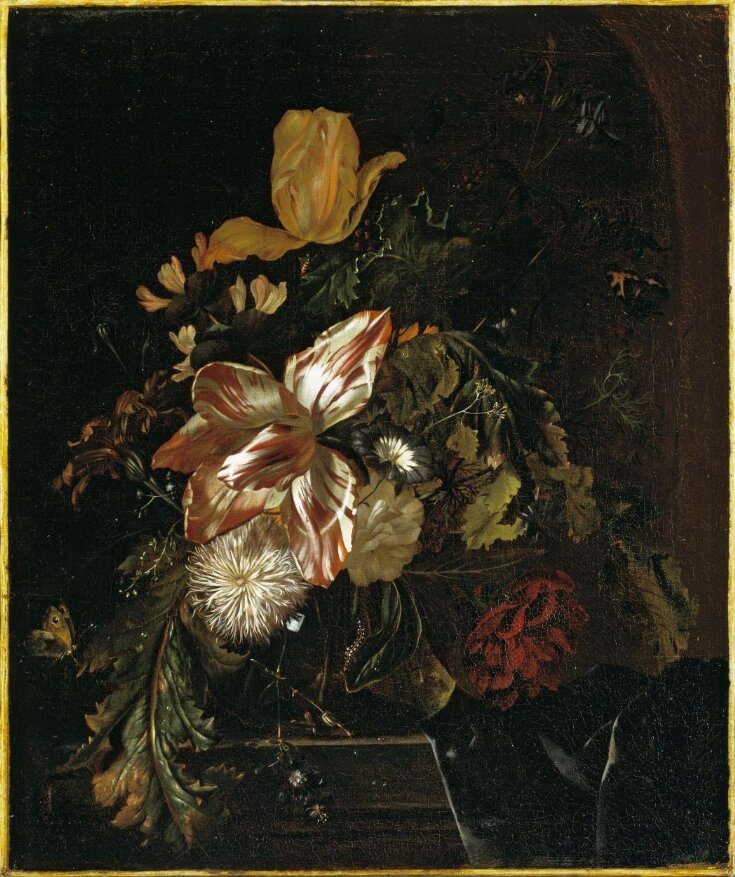
A bouquet of flowers in a glass vase set in a stone niche with insects. Fred Meijer has recently (February, 2010) reattributed the work to C.B. Voet (oral communication) based on photographs only. Carel Borchaert Voet (1671-1743) is a little known still-life painter born in Zwolle (Northern Holland) who worked principally in The Hague and Dordrecht. His principal patron, by whom he was engaged from circa 1689 and whom he accompanied to England on numerous occasions, was Hans Willem Bentinck, later Earl of Portland. There is a fruit still-life by Voet in the Musée des Beaux-Arts de Quimper and have been several on the art market in London and New York.
Object details
| Category | |
| Object type | |
| Title | Flowers in a glass vase (generic title) |
| Materials and techniques | Oil on canvas |
| Brief description | Oil painting, Carel Borchaert Voet, 'Flowers in a Dutch Vase', Dutch school, 17th century |
| Physical description | A bouquet of flowers in a glass vase set in a stone niche with insects |
| Dimensions |
|
| Style | |
| Object history | Purchased, 1859 |
| Historical context | Previously attributed to Rachel Ruysch, Fred Meijer (RKD) has (February, 2010) reattributed the work to C.B. Voet (oral communication) based on photographs only. Carel Borchaert Voet (1671-1743) is a little known still-life painter born in Zwolle (Northern Holland) who worked principally in The Hague and Dordrecht. His principal patron, by whom he was engaged from circa 1689 and whom he accompanied to England on numerous occasions, was Hans Willem Bentinck, later Earl of Portland. There is a fruit still-life by Voet in the Musée des Beaux-Arts de Quimper (inv.nr. 873-1-195) and have been several on the art market in London (ie. Sotheby's 1995-12-06) and New York (ie. Christie's, 1988-06-02). The term ‘still life’ conventionally refers to works depicting an arrangement of diverse inanimate objects including fruits, flowers, shellfish, vessels and artefacts. The term derives from the Dutch 'stilleven', which became current from about 1650 as a collective name for this type of subject matter. Still-life reached the height of its popularity in Western Europe, especially in the Netherlands, during the 17th century although still-life subjects already existed in pre-Classical, times. Dutch painters played a major role the development of this genre, inventing distinctive variations on the theme over the course of the century while Flemish artist Frans Snyders' established a taste for banquet pieces. These works were developed further in Antwerp by the Dutchman Jan Davidsz. de Heem (1606-1684) who created opulent baroque confections of fruit, flowers, and precious vessels that became a standardized decorative type throughout Europe. Scholarly opinion had long been divided over how all of these images should be understood. The exotic fruits and valuable objects often depicted testify to the prosperous increase in wealth in cities such as Amsterdam and Haarlem but may also function as memento mori, or vanitas, that is, reminders of human mortality and invitations to meditate upon the passage of time. |
| Production | This work was attributed to Rachel Ruysch in the 1893 catalogue and again in the 1973 Catalouge 'for want of a more convincing alternative.' Fred Meijer has recently (February 2010) reattributed the work to C.B. Voet (oral communication) based on photographs only. |
| Subjects depicted | |
| Summary | A bouquet of flowers in a glass vase set in a stone niche with insects. Fred Meijer has recently (February, 2010) reattributed the work to C.B. Voet (oral communication) based on photographs only. Carel Borchaert Voet (1671-1743) is a little known still-life painter born in Zwolle (Northern Holland) who worked principally in The Hague and Dordrecht. His principal patron, by whom he was engaged from circa 1689 and whom he accompanied to England on numerous occasions, was Hans Willem Bentinck, later Earl of Portland. There is a fruit still-life by Voet in the Musée des Beaux-Arts de Quimper and have been several on the art market in London and New York. |
| Associated object | 4836-1857 (Object) |
| Bibliographic reference | Kauffmann, C.M. Catalogue of Foreign Paintings, I. Before 1800. London: Victoria and Albert Museum, 1973, p. 253-255, cat. no. 316. |
| Collection | |
| Accession number | 4729-1859 |
About this object record
Explore the Collections contains over a million catalogue records, and over half a million images. It is a working database that includes information compiled over the life of the museum. Some of our records may contain offensive and discriminatory language, or reflect outdated ideas, practice and analysis. We are committed to addressing these issues, and to review and update our records accordingly.
You can write to us to suggest improvements to the record.
Suggest feedback
You can write to us to suggest improvements to the record.
Suggest feedback
| Record created | March 25, 2003 |
| Record URL |
Download as: JSONIIIF Manifest
