Panel
14th century-16th century (made)
| Artist/Maker | |
| Place of origin |
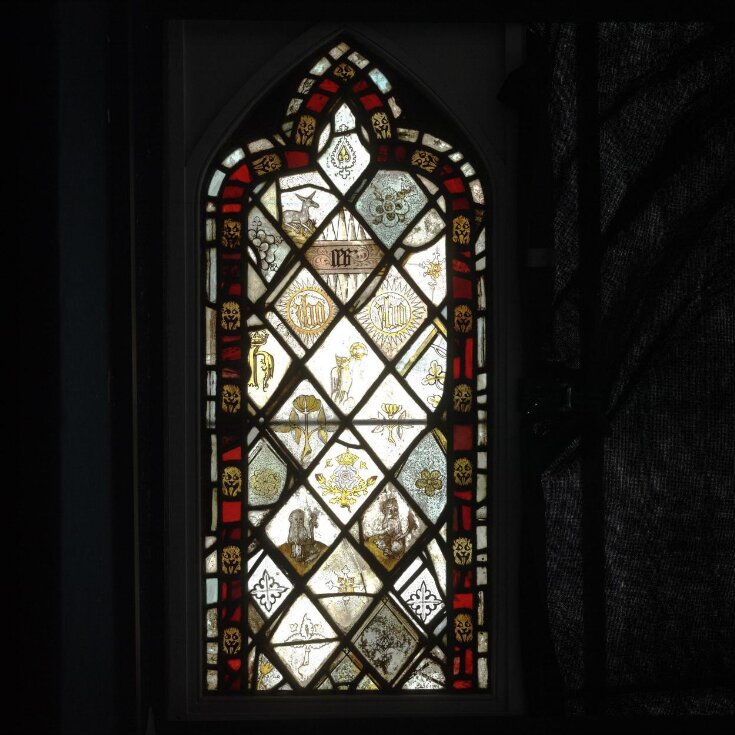
This window is known as a composite window, which means that it is not in its original form. Instead, it has been composed of various fragments of glass, the original setting of which is unknown.
In the 15th and 16th centuries it became commonplace to set panels of coloured glass against a background of plain glass quarries (often diamond-shaped panes, as used in lattice windows). Panels with armorial glass (coats of arms) were particularly popular. Such windows were found in both ecclesiastical and domestic settings.
The plain glass quarries were decorated with a wide variety of motifs painted in brown and yellow silver. Certain plants and flowers, such as hawthorn and honeysuckle, appear repeatedly. Devices, badges, emblems and mottoes specific to particular patrons were also introduced. Here we see a quarry painted with a white hart, which could be the badge of Richard II of England, who reigned from 1377 to 1399.
This panel has been made up with a mixture of quarries that clearly come from different windows. They are all contained within a border of red glass set with lion masks, which dates from the 14th century. Some of the quarries bear spirited animal portraits, such as the pair of lions near the bottom and the bird feeding its chick in the centre of the panel. We also see the ubiquitous flowers, rosettes and flowering buds.
In the 15th and 16th centuries it became commonplace to set panels of coloured glass against a background of plain glass quarries (often diamond-shaped panes, as used in lattice windows). Panels with armorial glass (coats of arms) were particularly popular. Such windows were found in both ecclesiastical and domestic settings.
The plain glass quarries were decorated with a wide variety of motifs painted in brown and yellow silver. Certain plants and flowers, such as hawthorn and honeysuckle, appear repeatedly. Devices, badges, emblems and mottoes specific to particular patrons were also introduced. Here we see a quarry painted with a white hart, which could be the badge of Richard II of England, who reigned from 1377 to 1399.
This panel has been made up with a mixture of quarries that clearly come from different windows. They are all contained within a border of red glass set with lion masks, which dates from the 14th century. Some of the quarries bear spirited animal portraits, such as the pair of lions near the bottom and the bird feeding its chick in the centre of the panel. We also see the ubiquitous flowers, rosettes and flowering buds.
Object details
| Categories | |
| Object type | |
| Materials and techniques | Stained glass |
| Brief description | Composite panel of armorial devices, English, 14th-16th century. |
| Physical description | Panel, stained glass, composed mainly of armorial devices. The white hart, emblem of Richard II, a crowned Tudor rose with the initials E.R. of Edward VI, the crowned H. of Henry VII, the initials IHC in soleil, a lion and a spray of honeysuckle, a bird holding a mirror. |
| Dimensions |
|
| Gallery label | COMPOSITE PANEL OF QUARRIES
This panel has been made up with a mixture of quarries undoubtedly from different windows, all contained within a 14th-century border of ruby glass set with lion masks. Included amongst the designs are the sacred monogram within the sun, a crowned h (for Henry VII, 1485-1509) and a crowned Tudor rose with the initials ER (for Edward VI, 1547-53).
England, of various dates between about 1300 and 1550
Museum no. 930-1900; Bequest of Henry Vaughan((PW) 2003) |
| Credit line | Bequeathed by Mr Henry Vaughan |
| Historical context | This window is known as a composite window. This means that it is not in its original form but rather it has been composed of various fragments of glass, the original setting of which is unknown. |
| Subjects depicted | |
| Summary | This window is known as a composite window, which means that it is not in its original form. Instead, it has been composed of various fragments of glass, the original setting of which is unknown. In the 15th and 16th centuries it became commonplace to set panels of coloured glass against a background of plain glass quarries (often diamond-shaped panes, as used in lattice windows). Panels with armorial glass (coats of arms) were particularly popular. Such windows were found in both ecclesiastical and domestic settings. The plain glass quarries were decorated with a wide variety of motifs painted in brown and yellow silver. Certain plants and flowers, such as hawthorn and honeysuckle, appear repeatedly. Devices, badges, emblems and mottoes specific to particular patrons were also introduced. Here we see a quarry painted with a white hart, which could be the badge of Richard II of England, who reigned from 1377 to 1399. This panel has been made up with a mixture of quarries that clearly come from different windows. They are all contained within a border of red glass set with lion masks, which dates from the 14th century. Some of the quarries bear spirited animal portraits, such as the pair of lions near the bottom and the bird feeding its chick in the centre of the panel. We also see the ubiquitous flowers, rosettes and flowering buds. |
| Bibliographic reference | Williamson, Paul. Medieval and Renaissance Stained Glass in the Victoria and Albert Museum. London, 2003. ISBN 1851774041 |
| Collection | |
| Accession number | 930-1900 |
About this object record
Explore the Collections contains over a million catalogue records, and over half a million images. It is a working database that includes information compiled over the life of the museum. Some of our records may contain offensive and discriminatory language, or reflect outdated ideas, practice and analysis. We are committed to addressing these issues, and to review and update our records accordingly.
You can write to us to suggest improvements to the record.
Suggest feedback
You can write to us to suggest improvements to the record.
Suggest feedback
| Record created | May 19, 1998 |
| Record URL |
Download as: JSONIIIF Manifest
