Pyxis
ca. 964 (made)
| Artist/Maker | |
| Place of origin |
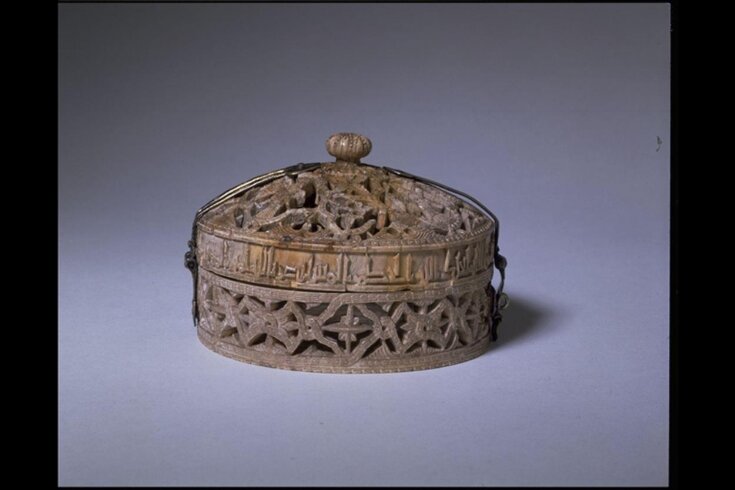
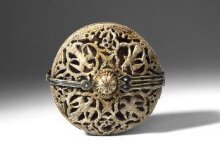
This small ivory box is a pyxis. This type of box has a cylindrical body and a domed lid. This example has carved openwork decoration of stylised plants and four eagles in a heraldic pose. Ivories of this kind were produced in Spain during the 10th and 11th centuries. At this time most of the country was under the rule of Muslim Arabs of the Umayyad dynasty.
According to the inscription around the lid, this example was made at the command of the Umayyad caliph al-Hakam II (ruled 961- 976). It is one of only two surviving objects known to have been made for him. The chief eunuch, Durri al-Saghir, who supervised the work, was also responsible for another object, known as the Zamora pyxis. Al-Hakam commissioned this second piece in 964 for his favourite wife, Subh. It was probably a gift to celebrate the birth of their son in the previous year. The inscriptions on the two ivories are very similar, suggesting they were commissioned as a pair. The pyxis in the V&A has unusual openwork carving on its lid. It was presumably designed to hold perfumed substances, and the scent would have wafted through the holes. The metal mounts for the hasp and the hinge were probably added at a later date. They are decorated with niello. This is a technique in which the decorator uses black inlay to fill the hollow design in a metal surface.
According to the inscription around the lid, this example was made at the command of the Umayyad caliph al-Hakam II (ruled 961- 976). It is one of only two surviving objects known to have been made for him. The chief eunuch, Durri al-Saghir, who supervised the work, was also responsible for another object, known as the Zamora pyxis. Al-Hakam commissioned this second piece in 964 for his favourite wife, Subh. It was probably a gift to celebrate the birth of their son in the previous year. The inscriptions on the two ivories are very similar, suggesting they were commissioned as a pair. The pyxis in the V&A has unusual openwork carving on its lid. It was presumably designed to hold perfumed substances, and the scent would have wafted through the holes. The metal mounts for the hasp and the hinge were probably added at a later date. They are decorated with niello. This is a technique in which the decorator uses black inlay to fill the hollow design in a metal surface.
Object details
| Categories | |
| Object type | |
| Materials and techniques | Carved ivory, with nielloed metal mounts |
| Brief description | Ivory container with openwork decoration, Spain (probably Córdoba), about 964. |
| Physical description | Ivory pyxis with carved openwork decoration on the top of the lid and the side of the base and an inscription carved in relief around the side of the lid. The openwork on the base takes the form of stylized vegetation, while on the lid it also includes four "heraldic" eagles. Metal mounts forming a hasp and a hinge, probably added at a later date, are decorated with niello. |
| Dimensions |
|
| Style | |
| Marks and inscriptions | (Inscription; decoration; Arabic; Arabic (style known as floriated Kufic); around the side of the lid; carved)
|
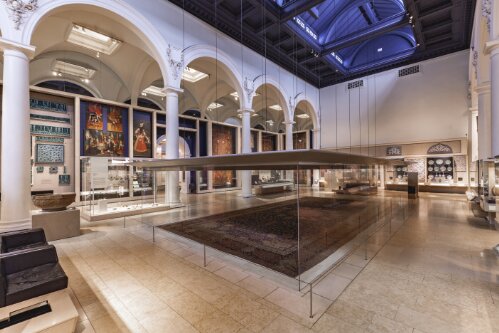
| Gallery label | Jameel Gallery
Openwork Container
Spain, probably Córdoba
About 964
The inscription around the lid begins with a prayer for Abd al-Rahman III's successor, the caliph al-Hakam II. A similar prayer appears on a casket made for al-Hakam's wife in 964. This container probably held a scented substance. The pierced lid and sides allowed the perfume to circulate.
Carved ivory with silver and niello mounts
Museum no. 217-1865(Jameel Gallery) |
| Object history | Made for the second Umayyad Caliph of Al-Andalus (Spain), al-Hakam II (961-976), son of 'Abd al-Rahman III. |
| Subject depicted | |
| Summary | This small ivory box is a pyxis. This type of box has a cylindrical body and a domed lid. This example has carved openwork decoration of stylised plants and four eagles in a heraldic pose. Ivories of this kind were produced in Spain during the 10th and 11th centuries. At this time most of the country was under the rule of Muslim Arabs of the Umayyad dynasty. According to the inscription around the lid, this example was made at the command of the Umayyad caliph al-Hakam II (ruled 961- 976). It is one of only two surviving objects known to have been made for him. The chief eunuch, Durri al-Saghir, who supervised the work, was also responsible for another object, known as the Zamora pyxis. Al-Hakam commissioned this second piece in 964 for his favourite wife, Subh. It was probably a gift to celebrate the birth of their son in the previous year. The inscriptions on the two ivories are very similar, suggesting they were commissioned as a pair. The pyxis in the V&A has unusual openwork carving on its lid. It was presumably designed to hold perfumed substances, and the scent would have wafted through the holes. The metal mounts for the hasp and the hinge were probably added at a later date. They are decorated with niello. This is a technique in which the decorator uses black inlay to fill the hollow design in a metal surface. |
| Bibliographic references |
|
| Collection | |
| Accession number | 217-1865 |
About this object record
Explore the Collections contains over a million catalogue records, and over half a million images. It is a working database that includes information compiled over the life of the museum. Some of our records may contain offensive and discriminatory language, or reflect outdated ideas, practice and analysis. We are committed to addressing these issues, and to review and update our records accordingly.
You can write to us to suggest improvements to the record.
Suggest feedback
You can write to us to suggest improvements to the record.
Suggest feedback
| Record created | March 11, 2003 |
| Record URL |
Download as: JSONIIIF Manifest
