Bowl
1050-1100 (made)
| Artist/Maker | |
| Place of origin |
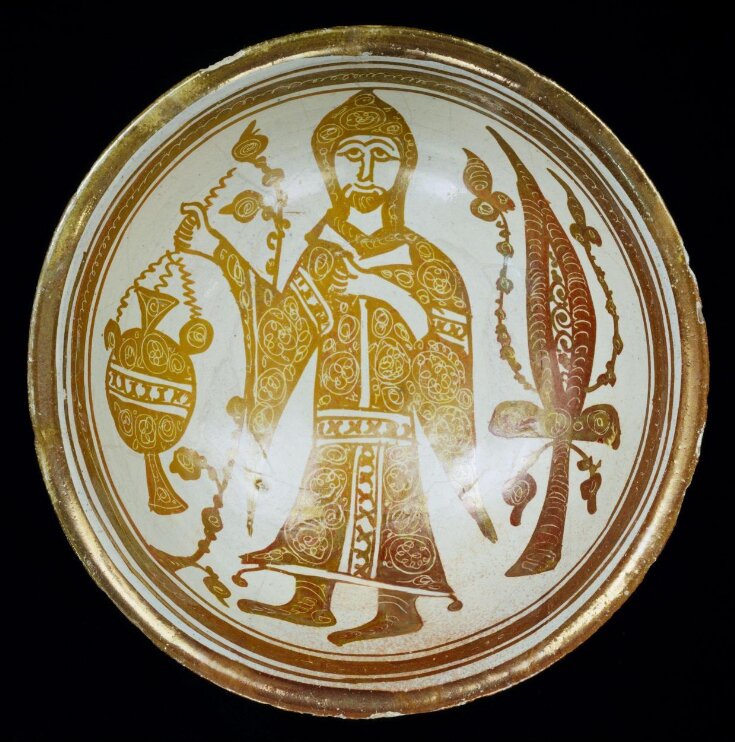
This Egyptian bowl has lustre decoration. It is one of the finest complete examples of the lustre-decorated pottery produced in Egypt under the Fatimid dynasty (ruled 969 -1171). Decorators had transferred the technique of painting in lustre over the glaze from glassware to pottery in Iraq at an earlier date. However, the quality of Egyptian wares of the Fatimid period is often much higher, as in this case.
The decoration on the interior of the bowl shows a hooded man carrying a lamp or censer suspended on chains. The space to his left is filled with a cypress tree. The man has traditionally been identified as a Coptic priest. (The Copts are Egyptian Christians who have lived under Muslim rule since the 7th century AD and still form a substantial minority of Egypt's population.)
The Arabic word Sa'd appears twice, back to front, on the outside of the bowl. It means 'happiness' but is also a common man's name. The same inscription appears on many other Egyptian lustre wares. It is not clear what it signifies. It may be a potter's signature, a workshop mark or the expression of a good wish by the maker for the future owner. Experts have dated this bowl to between 1050 and 1100. This is because a similar item was built into the facade of the church of San Sisto in Pisa, Italy, which was begun in 1070.
The decoration on the interior of the bowl shows a hooded man carrying a lamp or censer suspended on chains. The space to his left is filled with a cypress tree. The man has traditionally been identified as a Coptic priest. (The Copts are Egyptian Christians who have lived under Muslim rule since the 7th century AD and still form a substantial minority of Egypt's population.)
The Arabic word Sa'd appears twice, back to front, on the outside of the bowl. It means 'happiness' but is also a common man's name. The same inscription appears on many other Egyptian lustre wares. It is not clear what it signifies. It may be a potter's signature, a workshop mark or the expression of a good wish by the maker for the future owner. Experts have dated this bowl to between 1050 and 1100. This is because a similar item was built into the facade of the church of San Sisto in Pisa, Italy, which was begun in 1070.
Object details
| Categories | |
| Object type | |
| Materials and techniques | Fritware, with overglaze lustre decoration |
| Brief description | Lustre bowl with a priest, Egypt (probably Cairo), 1050-1100. |
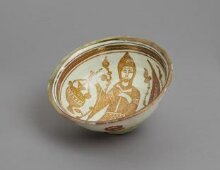
| Physical description | Bowl with a high cylindrical footring, convex sides and a slightly out-turned rim. It may be covered with a white slip under a transparent glaze, rather than a tin-opacified glaze. The decoration is painted in reddish-brown lustre, which varies slightly in tone across the bowl, probably as a result of uneven heat in the kiln. The lustre-painting is articulated by scratches through the pigment. Plain concentric bands around the rim frame the central figural decoration, which depicts a hooded man, probably a Coptic priest, carrying a large lamp or censer, while the space to his left is occupied by a cypress tree. The Arabic word Sa'd is written twice, back to front, on the exterior. |
| Dimensions |
|
| Style | |
| Marks and inscriptions | Sa'd (Arabic; wirtten twice on the exterior, back-to-front; lustre-painted)
|
| Gallery label |
|
| Credit line | Purchased with Art Fund support and the Byran Bequest |
| Production | said to have been found near Luxor |
| Subjects depicted | |
| Summary | This Egyptian bowl has lustre decoration. It is one of the finest complete examples of the lustre-decorated pottery produced in Egypt under the Fatimid dynasty (ruled 969 -1171). Decorators had transferred the technique of painting in lustre over the glaze from glassware to pottery in Iraq at an earlier date. However, the quality of Egyptian wares of the Fatimid period is often much higher, as in this case. The decoration on the interior of the bowl shows a hooded man carrying a lamp or censer suspended on chains. The space to his left is filled with a cypress tree. The man has traditionally been identified as a Coptic priest. (The Copts are Egyptian Christians who have lived under Muslim rule since the 7th century AD and still form a substantial minority of Egypt's population.) The Arabic word Sa'd appears twice, back to front, on the outside of the bowl. It means 'happiness' but is also a common man's name. The same inscription appears on many other Egyptian lustre wares. It is not clear what it signifies. It may be a potter's signature, a workshop mark or the expression of a good wish by the maker for the future owner. Experts have dated this bowl to between 1050 and 1100. This is because a similar item was built into the facade of the church of San Sisto in Pisa, Italy, which was begun in 1070. |
| Bibliographic references |
|
| Collection | |
| Accession number | C.49-1952 |
About this object record
Explore the Collections contains over a million catalogue records, and over half a million images. It is a working database that includes information compiled over the life of the museum. Some of our records may contain offensive and discriminatory language, or reflect outdated ideas, practice and analysis. We are committed to addressing these issues, and to review and update our records accordingly.
You can write to us to suggest improvements to the record.
Suggest feedback
You can write to us to suggest improvements to the record.
Suggest feedback
| Record created | March 11, 2003 |
| Record URL |
Download as: JSONIIIF Manifest
