Panel
15th century (made)
| Artist/Maker | |
| Place of origin |
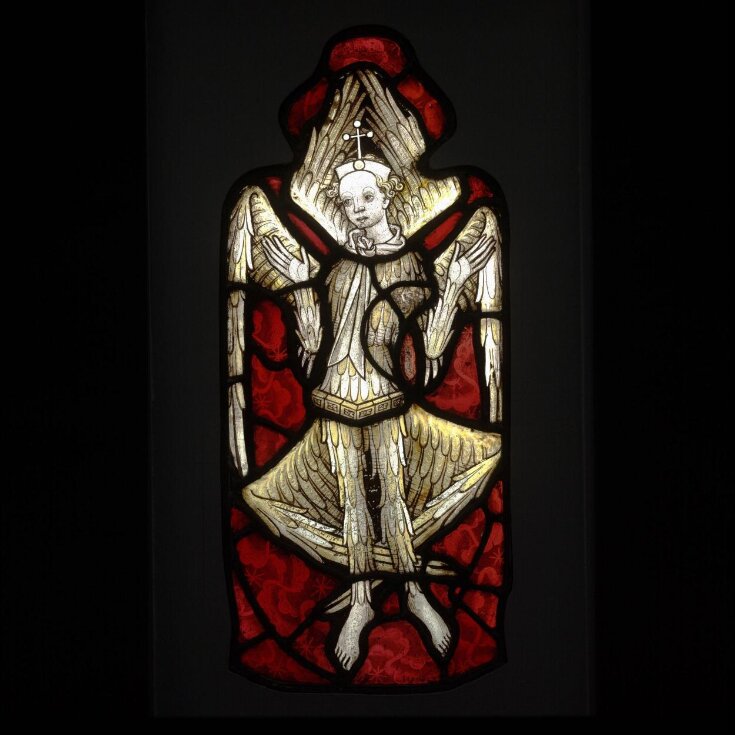
The irregular shape of this panel shows that it must have been located at the top of a window in a church. These are known as ‘tracery lights’.
Angels, celestial creatures, figure prominently in many of the world’s religions. Christianity inherited its devotion to angels from the Jewish faith from which it emerged. The angel in this panel has a set of six wings instead of two. This would identify him as a Seraph.
From early on, the great theologians of the Christian church devoted much effort to identifying and understanding the role of angels in God’s creation. About the year 500, one scholar wrote a treatise called ‘The Celestial Hierarchy’. He scoured the Old and New Testaments for information relating to angels. From this he compiled a list of different types of angels according to their functions. He claimed that there were nine orders of angels, divided into three hierarchies. Each order had a specific function, such as the Order of the Archangels, who act as messengers between God and mankind. The author of this treatise is known as the ‘Pseudo-St Denis’ or ‘Pseudo-Aeropagite’, because he was once thought to be the St Denis (or Dionysus) the Aeropagite who is mentioned in the New Testament Book of Acts.
Seraphim encircle the throne of the Godhead and protect the Ark of the Covenant. They belong to the first hierarchy of angels, together with the Cherubim and Thrones. In medieval art the Seraphim acquired six wings in reference to the vision of the Prophet Isaiah (6: 2–7): ‘I also saw the Lord sitting upon a throne, high and lifted up . . . Above it stood the seraphim: each one had six wings, with two he covered his face, and with two he covered his feet, and with two he flew. And one called to the other and said: Holy, Holy, Holy’.
Angels, celestial creatures, figure prominently in many of the world’s religions. Christianity inherited its devotion to angels from the Jewish faith from which it emerged. The angel in this panel has a set of six wings instead of two. This would identify him as a Seraph.
From early on, the great theologians of the Christian church devoted much effort to identifying and understanding the role of angels in God’s creation. About the year 500, one scholar wrote a treatise called ‘The Celestial Hierarchy’. He scoured the Old and New Testaments for information relating to angels. From this he compiled a list of different types of angels according to their functions. He claimed that there were nine orders of angels, divided into three hierarchies. Each order had a specific function, such as the Order of the Archangels, who act as messengers between God and mankind. The author of this treatise is known as the ‘Pseudo-St Denis’ or ‘Pseudo-Aeropagite’, because he was once thought to be the St Denis (or Dionysus) the Aeropagite who is mentioned in the New Testament Book of Acts.
Seraphim encircle the throne of the Godhead and protect the Ark of the Covenant. They belong to the first hierarchy of angels, together with the Cherubim and Thrones. In medieval art the Seraphim acquired six wings in reference to the vision of the Prophet Isaiah (6: 2–7): ‘I also saw the Lord sitting upon a throne, high and lifted up . . . Above it stood the seraphim: each one had six wings, with two he covered his face, and with two he covered his feet, and with two he flew. And one called to the other and said: Holy, Holy, Holy’.
Object details
| Categories | |
| Object type | |
| Materials and techniques | Stained glass |
| Brief description | Panel of clear and coloured glass with painted details and yellow (silver) stain. Depicting an angel. Made in England, c.1450 |
| Physical description | Panel, with a trefoil top, from a tracery window set in a larger panel. A feathered angel with 3 pairs of wings. Canopy and inscription modern. |
| Dimensions |
|
| Gallery label | TWO ANGELS
Angels were commonly found in English medieval tracery lights. They were often shown in large groups, holding scrolls with texts from the most popular hymns of praise, or in smaller numbers accompanying scenes from the Lives of Christ or the Virgin. The original location of these angels is not known.
England (possibly Gloucestershire), about 1450
Museum nos. C.346 and C.347-1937((PW) 2003) |
| Historical context | Because of its irregular shape, it is clear that this panel must have been located at the top of a window in a church. These are known as 'tracery lights'. The angel in this panel has a set of six wings instead of two. This would identify him as a Seraph. Angels, divine creatures, figure prominently in many of the world's religions. The Christian religion inherited its devotion to angels from the Jewish faith, out of which it emerged. From early on in the Christian church its great theologians devoted much effort to identifying and understanding the role of angels in God's creation. Around the year 500, a church scholar wrote a treatise called 'The Celestial Hierarchy'. The author of this treatise, known as 'Pseudo-St Denis' because formerly he was thought to be St Denis the Aeropagite who is mentioned in the New Testament Book of Acts, scoured the Old and New Testaments for information relating to angels. From this he compiled a list of different types of angels according to their functions. He claimed that there were nine Orders of angels divided into three hierarchies. Each Order had a specific function such as the Order of the Archangels who act as messengers between God and mankind. The first hierarchy of angels consists of Seraphim, Cherubim and Thrones. The Seraphim encircle the throne of the Godhead and protect the Ark of the Covenant. In medieval art the Seraphim acquired six wings in reference to the vision of the Prophet Isaiah (6:2-7): I also saw the Lord sitting upon a throne, high and lifted up...Above it stood the seraphim: each one had six wings, with two he covered his face, and with two he covered his feet, and with two he flew. And one called to the other and said: Holy, Holy, Holy… |
| Subject depicted | |
| Summary | The irregular shape of this panel shows that it must have been located at the top of a window in a church. These are known as ‘tracery lights’. Angels, celestial creatures, figure prominently in many of the world’s religions. Christianity inherited its devotion to angels from the Jewish faith from which it emerged. The angel in this panel has a set of six wings instead of two. This would identify him as a Seraph. From early on, the great theologians of the Christian church devoted much effort to identifying and understanding the role of angels in God’s creation. About the year 500, one scholar wrote a treatise called ‘The Celestial Hierarchy’. He scoured the Old and New Testaments for information relating to angels. From this he compiled a list of different types of angels according to their functions. He claimed that there were nine orders of angels, divided into three hierarchies. Each order had a specific function, such as the Order of the Archangels, who act as messengers between God and mankind. The author of this treatise is known as the ‘Pseudo-St Denis’ or ‘Pseudo-Aeropagite’, because he was once thought to be the St Denis (or Dionysus) the Aeropagite who is mentioned in the New Testament Book of Acts. Seraphim encircle the throne of the Godhead and protect the Ark of the Covenant. They belong to the first hierarchy of angels, together with the Cherubim and Thrones. In medieval art the Seraphim acquired six wings in reference to the vision of the Prophet Isaiah (6: 2–7): ‘I also saw the Lord sitting upon a throne, high and lifted up . . . Above it stood the seraphim: each one had six wings, with two he covered his face, and with two he covered his feet, and with two he flew. And one called to the other and said: Holy, Holy, Holy’. |
| Collection | |
| Accession number | C.346-1937 |
About this object record
Explore the Collections contains over a million catalogue records, and over half a million images. It is a working database that includes information compiled over the life of the museum. Some of our records may contain offensive and discriminatory language, or reflect outdated ideas, practice and analysis. We are committed to addressing these issues, and to review and update our records accordingly.
You can write to us to suggest improvements to the record.
Suggest feedback
You can write to us to suggest improvements to the record.
Suggest feedback
| Record created | May 5, 1998 |
| Record URL |
Download as: JSONIIIF Manifest
