Labours of the Months
Panel
ca. 1450-1475 (made)
ca. 1450-1475 (made)
| Artist/Maker | |
| Place of origin |
This roundel is one of six acquired by the museum in 1923 (Museum nos.C.123-128-1923). It was originally from a set of 12 roundels depicting the ‘Labours of the Months’. The museum purchased them from the sale of the contents of Cassiobury Park in Hertfordshire. They had probably been installed in the windows of the house when it was remodelled in the early years of the 19th century. We do not know where they were located before that date.
The depiction of the months and occupations associated with them appear early in the Medieval period on church facades and interiors. They also appear in illuminated manuscripts and start to become more common in stained glass in the 14th and, especially, the 15th centuries.
The occupations depicted in these ‘Labours of the Months’ are mostly agricultural and are thus intimately associated with the landed class and their agricultural labourers. They appear in both religious and secular settings.
‘Labours of the Months’ are found all throughout Europe and the occupations depicted are standard but do vary in accordance with the local climate. Harvesting, for instance, began earlier in the year in Southern Europe. Feasting and drinking scenes, mostly aristocratic in form, appear in either December or January in all European countries. These months are traditionally associated with major festivals in the Church year and the consumption of large quantities of meat. Much livestock was killed at this time of year to provide food over the winter months.
Some of the ‘Labours of the Months’ stained glass roundels believed to have been painted in England share the same imagery. This imagery must have come from a common source, most likely from a series of woodblock engravings which may have circulated between the glazing workshops.
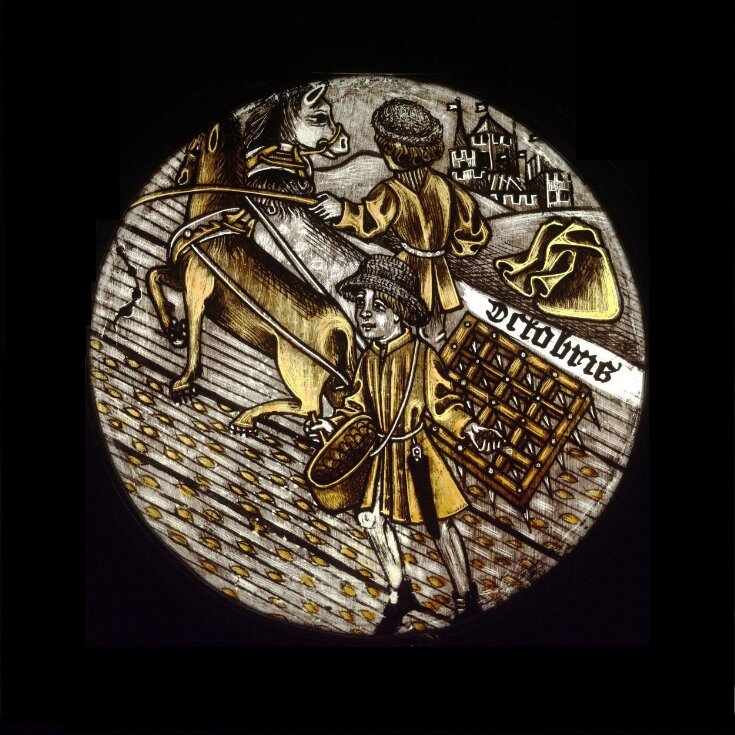
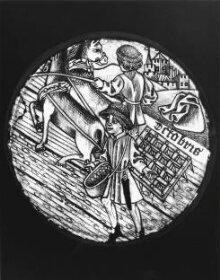
Diagonally across the centre of this roundel a farm labourer is leading a team of two horses. The horses are pulling a harrow across a field. Harrows were dragged across ploughed fields to break up the clumps of soil. Another farm labourer is in the foreground of the roundel spreading seed over the newly-harrowed field. The seed is probably wheat (‘winter wheat’) or rye. This was a common occupation in the autumn months and the letters on the scroll in the centre of the panel indicate that the activity is taking place in the month of October.
The paintwork on this roundel is very detailed and highly skilled, indicating the work of a prominent glass-painting workshop. The techniques employed include ‘stickwork’ which makes use of a stylus to scrape away areas of paint to produce highlights, as seen in the man’s hose and on the horse in the background. Smear shading and stipple-shading are used to create depth in the background and texture in the figures’ tunics and headwear.
The depiction of the months and occupations associated with them appear early in the Medieval period on church facades and interiors. They also appear in illuminated manuscripts and start to become more common in stained glass in the 14th and, especially, the 15th centuries.
The occupations depicted in these ‘Labours of the Months’ are mostly agricultural and are thus intimately associated with the landed class and their agricultural labourers. They appear in both religious and secular settings.
‘Labours of the Months’ are found all throughout Europe and the occupations depicted are standard but do vary in accordance with the local climate. Harvesting, for instance, began earlier in the year in Southern Europe. Feasting and drinking scenes, mostly aristocratic in form, appear in either December or January in all European countries. These months are traditionally associated with major festivals in the Church year and the consumption of large quantities of meat. Much livestock was killed at this time of year to provide food over the winter months.
Some of the ‘Labours of the Months’ stained glass roundels believed to have been painted in England share the same imagery. This imagery must have come from a common source, most likely from a series of woodblock engravings which may have circulated between the glazing workshops.
Diagonally across the centre of this roundel a farm labourer is leading a team of two horses. The horses are pulling a harrow across a field. Harrows were dragged across ploughed fields to break up the clumps of soil. Another farm labourer is in the foreground of the roundel spreading seed over the newly-harrowed field. The seed is probably wheat (‘winter wheat’) or rye. This was a common occupation in the autumn months and the letters on the scroll in the centre of the panel indicate that the activity is taking place in the month of October.
The paintwork on this roundel is very detailed and highly skilled, indicating the work of a prominent glass-painting workshop. The techniques employed include ‘stickwork’ which makes use of a stylus to scrape away areas of paint to produce highlights, as seen in the man’s hose and on the horse in the background. Smear shading and stipple-shading are used to create depth in the background and texture in the figures’ tunics and headwear.
Object details
| Categories | |
| Object type | |
| Titles |
|
| Materials and techniques | Clear glass with yellow (silver) stain and details painted in brown pigment. |
| Brief description | Roundel of clear glass with yellow (silver) stain and brown painted details. Depicting an agrigultural harrowing and sowing scene and illustrating the month of October from a series of the Labours of the Months. Made in England about 1450-75. |
| Physical description | Diagonally arranged across the centre of the roundel is the figure of a labourer, seen from the back, driving a team of two horses pulling a harrow. In the foreground another labourer is spreading seed from a basket which he carries across his shoulder. He is probably sowing winter wheat or rye. A sack lies in the background, partially filled with more seed. In the distant background is a fortified townscape. There is a diagonally-placed white scroll with the letters ‘Octobris’ painted in brown-black pigment. |
| Dimensions |
|
| Marks and inscriptions | Octobris
|
| Credit line | Given by Art Fund |
| Object history | These six roundels were purchased from Cassiobury Park, near Watford, Hertfordshire in 1923. |
| Historical context | This roundel is one of six acquired by the museum in 1923 (Museum nos.C.123-128-1923). It was originally from a set of 12 roundels depicting the 'Labours of the Months'. The museum purchased them from the sale of the contents of Cassiobury Park in Hertfordshire. They had probably been installed in the windows of the house when it was remodelled in the early years of the 19th century. We do not know where they were located before that date. The depiction of the months and occupations associated with them appear early in the Medieval period on church facades and interiors. They also appear in illuminated manuscripts and start to become more common in stained glass in the 14th and, especially, the 15th centuries. The occupations depicted in these 'Labours of the Months' are mostly agricultural and are thus intimately associated with the landed class and their agricultural labourers. They appear in both religious and secular settings. 'Labours of the Months' are found all throughout Europe and the occupations depicted are standard but do vary in accordance with the local climate. Harvesting, for instance, began earlier in the year in Southern Europe. Feasting and drinking scenes, mostly aristocratic in form, appear in either December or January in all European countries. These months are traditionally associated with major festivals in the Church year and the consumption of large quantities of meat. Much livestock was killed at this time of year to provide food over the winter months. Some of the 'Labours of the Months' stained glass roundels believed to have been painted in England share the same imagery. This imagery must have come from a common source, most likely from a series of woodblock engravings which may have circulated between the glazing workshops. Diagonally across the centre of this roundel a farm labourer is leading a team of two horses. The horses are pulling a harrow across a field. Harrows were dragged across ploughed fields to break up the clumps of soil. Another farm labourer is in the foreground of the roundel spreading seed over the newly-harrowed field. The seed is probably wheat ('winter wheat') or rye. This was a common occupation in the autumn months and the letters on the scroll in the centre of the panel indicate that the activity is taking place in the month of October. The paintwork on this roundel is very detailed and highly skilled, indicating the work of a prominent glass-painting workshop. The techniques employed include 'stickwork' which makes use of a stylus to scrape away areas of paint to produce highlights, as seen in the man's hose and on the horse in the background. Smear shading and stipple-shading are used to create depth in the background and texture in the figures' tunics and headwear. |
| Subjects depicted | |
| Summary | This roundel is one of six acquired by the museum in 1923 (Museum nos.C.123-128-1923). It was originally from a set of 12 roundels depicting the ‘Labours of the Months’. The museum purchased them from the sale of the contents of Cassiobury Park in Hertfordshire. They had probably been installed in the windows of the house when it was remodelled in the early years of the 19th century. We do not know where they were located before that date. The depiction of the months and occupations associated with them appear early in the Medieval period on church facades and interiors. They also appear in illuminated manuscripts and start to become more common in stained glass in the 14th and, especially, the 15th centuries. The occupations depicted in these ‘Labours of the Months’ are mostly agricultural and are thus intimately associated with the landed class and their agricultural labourers. They appear in both religious and secular settings. ‘Labours of the Months’ are found all throughout Europe and the occupations depicted are standard but do vary in accordance with the local climate. Harvesting, for instance, began earlier in the year in Southern Europe. Feasting and drinking scenes, mostly aristocratic in form, appear in either December or January in all European countries. These months are traditionally associated with major festivals in the Church year and the consumption of large quantities of meat. Much livestock was killed at this time of year to provide food over the winter months. Some of the ‘Labours of the Months’ stained glass roundels believed to have been painted in England share the same imagery. This imagery must have come from a common source, most likely from a series of woodblock engravings which may have circulated between the glazing workshops. Diagonally across the centre of this roundel a farm labourer is leading a team of two horses. The horses are pulling a harrow across a field. Harrows were dragged across ploughed fields to break up the clumps of soil. Another farm labourer is in the foreground of the roundel spreading seed over the newly-harrowed field. The seed is probably wheat (‘winter wheat’) or rye. This was a common occupation in the autumn months and the letters on the scroll in the centre of the panel indicate that the activity is taking place in the month of October. The paintwork on this roundel is very detailed and highly skilled, indicating the work of a prominent glass-painting workshop. The techniques employed include ‘stickwork’ which makes use of a stylus to scrape away areas of paint to produce highlights, as seen in the man’s hose and on the horse in the background. Smear shading and stipple-shading are used to create depth in the background and texture in the figures’ tunics and headwear. |
| Associated objects |
|
| Bibliographic references |
|
| Collection | |
| Accession number | C.127-1923 |
About this object record
Explore the Collections contains over a million catalogue records, and over half a million images. It is a working database that includes information compiled over the life of the museum. Some of our records may contain offensive and discriminatory language, or reflect outdated ideas, practice and analysis. We are committed to addressing these issues, and to review and update our records accordingly.
You can write to us to suggest improvements to the record.
Suggest feedback
You can write to us to suggest improvements to the record.
Suggest feedback
| Record created | May 5, 1998 |
| Record URL |
Download as: JSONIIIF Manifest
