Tea Chest
ca. 1745 (made)
| Artist/Maker | |
| Place of origin |
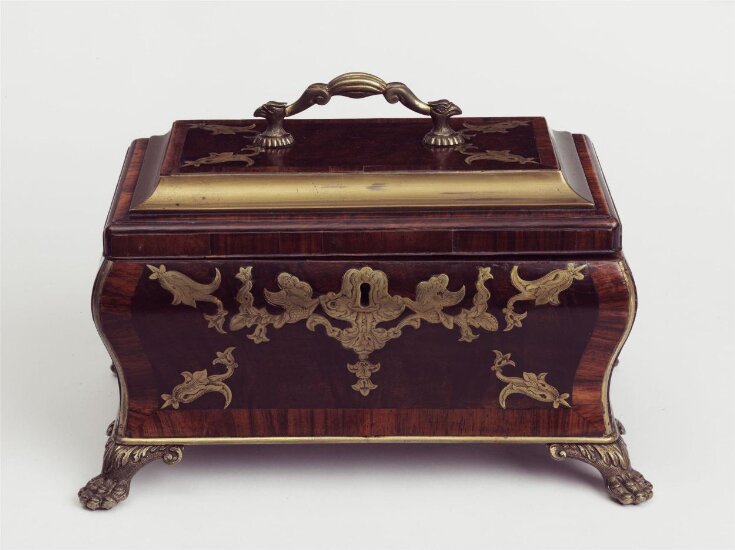
The elegant boxes that we now call tea caddies were known as tea chests in the 18th century. Until the second half of the century, tea remained a luxurious and expensive commodity. The fashionable design of tea chests reflected its value, while the locks fitted to the chests kept the tea secure. This tea chest is veneered in fine woods imported from islands in the Indian Ocean and the Caribbean. The maker also used engraved brass plaques to enliven the design. Only a few workshops in London used engraved brass plaques in this way at the time. The firm of Landall & Gordon published a trade card that illustrates a very similar tea chest, and they may have been the makers of this one.
Object details
| Category | |
| Object type | |
| Parts | This object consists of 2 parts.
|
| Materials and techniques | Veneered with mahog |
| Brief description | Tea chest of mahogany and oak, veneered in mahogany, tulipwood and with plaques of engraved brass, with gilt-brass mounts. British. Possibly made by Landall & Gordon, ca. 1745 |
| Physical description | Tea chest of bombé (swelling), sarcophagus form with a hinged lid, the carcase of mahogany and oak, veneered with mahogany, tulipwood and engraved brass plaques. and set with brass and gilt-brass mounts; key of steel . |
| Dimensions |
|
| Gallery label |
|
| Object history | Purchased from H. Blairman & Sons Ltd, (Nominal File: Blairman, H. & Sons, MA/1/B1600), 15 June 1965 from the Antique Dealers' Fair. A note in Peter Thornton's hand makes the case for its acquisition 'because it is brass-inlaid and must be an example of the oeuvre of John Channon, about whom Mr Hayward has been writing in the 'Bulletin'. It will be mentioned in the follow-up article Mr. Hayward is now composing.' |
| Historical context | Furniture of mahogany and occasionally of padouk, inlaid with brass plaques, was a relatively short-lived phenomenon during the 18th century in England. The earliest pieces appear to date from the 1730s and by the middle of the century, the fashion had faded. The technique is associated with the London cabinet-maker John Channon (1711-1779), who signed two monumental bookcases for Powderham Castle, Devon, in 1740 (V&A museum no. W.1&A-1987) but was practised by several other makers. It was associated with the movement between Germany and London of young German cabinet-makers to work in Britain, particularly Abraham Roentgen (1711-1793 ) and Johann Friedrich (Frederick) Hintz ( ca. 1711-1772 ). It is still unclear whether they learned this technique in London, or brought the idea of it with them but Abraham Roentgen at least, made furniture with this technique after his return to Germany. The application of the technique varied from simple brass stringing to the inlay of complex, pierced motifs, and sometimes large plaques that were engraved like printing plates, the lines highlighted with dark mastic. These motifs sometimes followed published engravings. In the late 1740s, the London firm of Landall & Gordon published a trade card illustrating a very similar tea chest to this one and it is attributed to them on that account. |
| Production | Attributed to Landall & Gordon by reason of its similarity to the design of a tea chest illustrated on their trade card, published ca. 1745. A copy is in the British Museum |
| Summary | The elegant boxes that we now call tea caddies were known as tea chests in the 18th century. Until the second half of the century, tea remained a luxurious and expensive commodity. The fashionable design of tea chests reflected its value, while the locks fitted to the chests kept the tea secure. This tea chest is veneered in fine woods imported from islands in the Indian Ocean and the Caribbean. The maker also used engraved brass plaques to enliven the design. Only a few workshops in London used engraved brass plaques in this way at the time. The firm of Landall & Gordon published a trade card that illustrates a very similar tea chest, and they may have been the makers of this one. |
| Bibliographic references |
|
| Collection | |
| Accession number | W.11:1 to 2-1965 |
About this object record
Explore the Collections contains over a million catalogue records, and over half a million images. It is a working database that includes information compiled over the life of the museum. Some of our records may contain offensive and discriminatory language, or reflect outdated ideas, practice and analysis. We are committed to addressing these issues, and to review and update our records accordingly.
You can write to us to suggest improvements to the record.
Suggest feedback
You can write to us to suggest improvements to the record.
Suggest feedback
| Record created | March 5, 2003 |
| Record URL |
Download as: JSONIIIF Manifest
