
Stool
1600-1620 (made)
| Artist/Maker | |
| Place of origin |
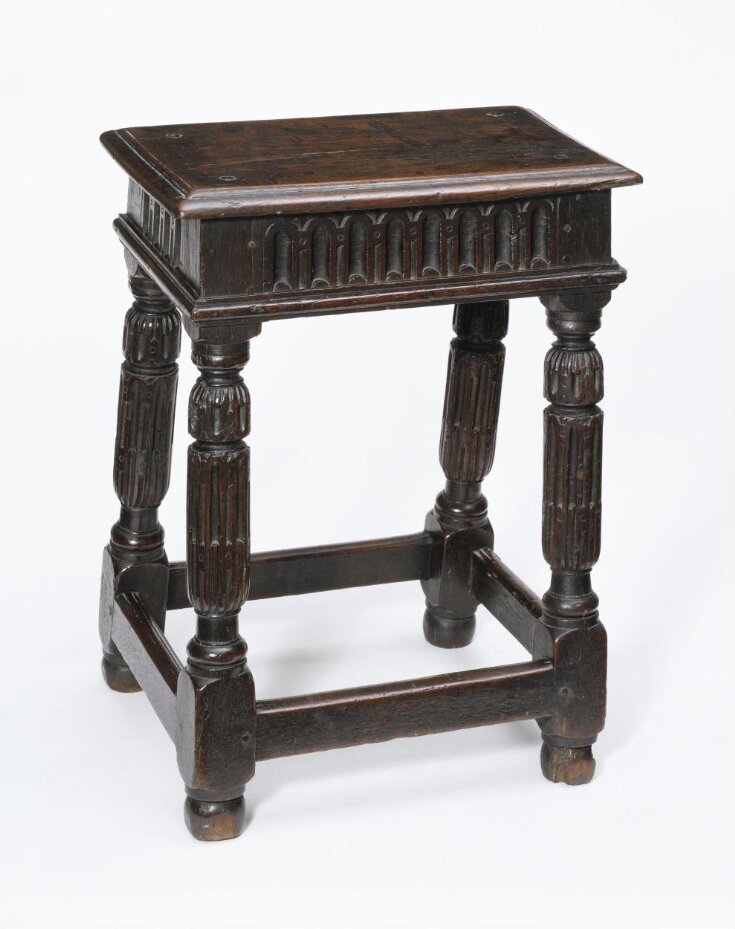
Stools of this kind were called ‘joint’ or ‘joined’ stools, because they are made using mortise and tenon joints. This was a technique used by joiners to link the parts of furniture using a tenon, or pared-down end, which slotted into a mortise, or rectangular hole. It would then be locked in place with wooden pegs. Stools were the most common form of seating. More expensive stools, especially those made for bedchambers, were covered with upholstery which might match the bed hangings.
This example has a wooden seat and is well-made. The legs were shaped by turning on a pole-lathe, after which further decoration was carved. This kind of stool was in general use but would have been particularly useful with ‘draw’ tables, which became popular around 1600. These had extra leaves that could be 'drawn' or pulled out, to increase the size of the table.
On loan to Lamport Hall.
This example has a wooden seat and is well-made. The legs were shaped by turning on a pole-lathe, after which further decoration was carved. This kind of stool was in general use but would have been particularly useful with ‘draw’ tables, which became popular around 1600. These had extra leaves that could be 'drawn' or pulled out, to increase the size of the table.
On loan to Lamport Hall.
Object details
| Categories | |
| Object type | |
| Materials and techniques | Oak, joined, with turned and carved decoration |
| Brief description | English 1580-1620 |
| Physical description | Oak joint stool or small table, the sawn rails (double-pegged) with fluting and a convex moulding (probably added) along the lower edge. The legs of reeded baluster form, joined at the bottom by plain, single-pegged stretchers. The top consists of a single board, pegged at the corners down into the frame using large, early pegs. This stool is noticeably larger than many similar surviving stools. Condition One corner of the seat missing. |
| Dimensions |
|
| Style | |
| Object history | Bought for £30 from J.H. Gillingham, Harrington Road, SW7 See RP 56/3300 and 37/2847 |
| Summary | Stools of this kind were called ‘joint’ or ‘joined’ stools, because they are made using mortise and tenon joints. This was a technique used by joiners to link the parts of furniture using a tenon, or pared-down end, which slotted into a mortise, or rectangular hole. It would then be locked in place with wooden pegs. Stools were the most common form of seating. More expensive stools, especially those made for bedchambers, were covered with upholstery which might match the bed hangings. This example has a wooden seat and is well-made. The legs were shaped by turning on a pole-lathe, after which further decoration was carved. This kind of stool was in general use but would have been particularly useful with ‘draw’ tables, which became popular around 1600. These had extra leaves that could be 'drawn' or pulled out, to increase the size of the table. On loan to Lamport Hall. |
| Bibliographic reference | For the stool type and leg form compare:
P. Macquoid, History of English Furniture, vol.I 1904 fig.121, and
P.Macquoid and R. Edwards, Dictionary of English Furniture, vol.III 1927, p.162, fig.8 |
| Collection | |
| Accession number | W.34-1937 |
About this object record
Explore the Collections contains over a million catalogue records, and over half a million images. It is a working database that includes information compiled over the life of the museum. Some of our records may contain offensive and discriminatory language, or reflect outdated ideas, practice and analysis. We are committed to addressing these issues, and to review and update our records accordingly.
You can write to us to suggest improvements to the record.
Suggest feedback
You can write to us to suggest improvements to the record.
Suggest feedback
| Record created | March 4, 2003 |
| Record URL |
Download as: JSONIIIF Manifest
