
Peek, Frean & Co's Biscuits London
Poster
ca. 1891 (printed)
ca. 1891 (printed)
| Artist/Maker | |
| Place of origin |
Object Type
During the 1880s and early 1890s a number of leading manufacturers were using fine art as a source for their advertising campaigns. Biscuit manufacturers often decorated their smaller gift tins with images after such painters as Landseer, Walter Goodall and Gainsborough, as well as drawing on well-known art works in their designs for advertising posters. It is likely that posters such as this example were actually framed like paintings and hung inside the grocers' shops.
People
Thomas B. Kennington (1856-1916) was a well-known portrait and genre painter. He regularly exhibited at the Royal Academy between 1880 and 1916. He particularly admired the contemporary French school of painting, a fact reflected in his interest in depicting the urban poor as well as in producing portraits and other works documenting the lives of the affluent. He also painted a number of images of children.
Design & Designing
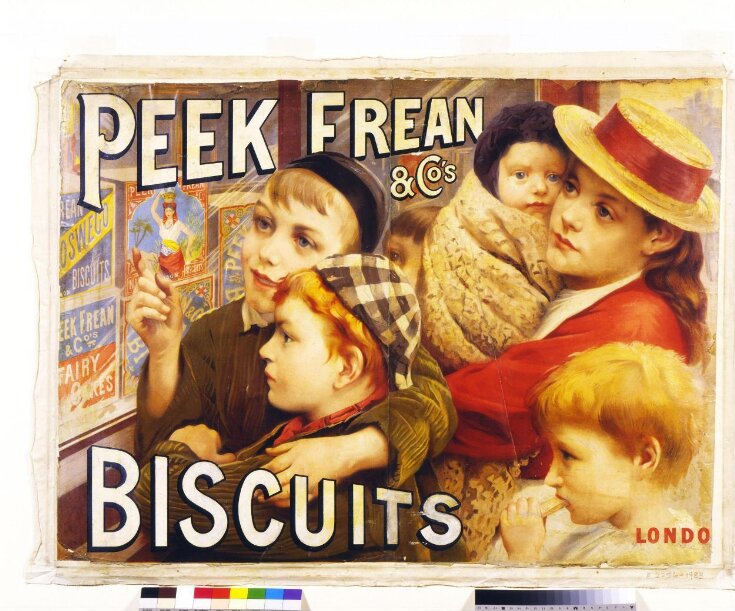
This poster was derived from Kennington's painting The Toy Shop, of 1891. It is an adaptation of the main section of the painting, which actually showed the figures three-quarter length, looking at a toy shop window in a busy street. Besides the addition of lettering, the key details that were changed were: the replacement of the child sucking its thumb with a child eating a biscuit, the extension of the shop window, and the replacement of the toys with biscuit tins.
Subjects Depicted
Peek Freans was started by James Peek and George Hender Freans, who opened their first factory in Dockhead, London, in 1857. By 1861 they were exporting biscuits to Argentina, Australia, Egypt and India. At this time most biscuits were supplied to retailers in large tins and then sold loose. The labels were therefore for display in the shop, identifying the types of biscuit.
During the 1880s and early 1890s a number of leading manufacturers were using fine art as a source for their advertising campaigns. Biscuit manufacturers often decorated their smaller gift tins with images after such painters as Landseer, Walter Goodall and Gainsborough, as well as drawing on well-known art works in their designs for advertising posters. It is likely that posters such as this example were actually framed like paintings and hung inside the grocers' shops.
People
Thomas B. Kennington (1856-1916) was a well-known portrait and genre painter. He regularly exhibited at the Royal Academy between 1880 and 1916. He particularly admired the contemporary French school of painting, a fact reflected in his interest in depicting the urban poor as well as in producing portraits and other works documenting the lives of the affluent. He also painted a number of images of children.
Design & Designing
This poster was derived from Kennington's painting The Toy Shop, of 1891. It is an adaptation of the main section of the painting, which actually showed the figures three-quarter length, looking at a toy shop window in a busy street. Besides the addition of lettering, the key details that were changed were: the replacement of the child sucking its thumb with a child eating a biscuit, the extension of the shop window, and the replacement of the toys with biscuit tins.
Subjects Depicted
Peek Freans was started by James Peek and George Hender Freans, who opened their first factory in Dockhead, London, in 1857. By 1861 they were exporting biscuits to Argentina, Australia, Egypt and India. At this time most biscuits were supplied to retailers in large tins and then sold loose. The labels were therefore for display in the shop, identifying the types of biscuit.
Object details
| Categories | |
| Object type | |
| Title | Peek, Frean & Co's Biscuits London (assigned by artist) |
| Materials and techniques | Colour lithograph on paper |
| Brief description | Poster by Thomas Benjamin Kennington advertising Peek Frean & Co. Biscuits. Great Britain, ca. 1891. |
| Physical description | Poster depicting children looking at biscuits in shop window |
| Dimensions |
|
| Gallery label | British Galleries:
Biscuit manufacturers were among the first to introduce packaging and branding to distinguish their products in the grocery shops. This poster was adapted from Thomas Kennington's painting `The Toy Shop', exhibited at The Royal Academy in 1891. Tins of biscuits, covered with labels, have replaced the toys in the window.(27/03/2003) |
| Credit line | Given by M. J. Franklin |
| Object history | After a painting by Thomas Benjamin Kennington (born in Grimbsy, East Lincolnshire, 1856, died in 1916); issued by Peek Frean & Co., London |
| Subject depicted | |
| Summary | Object Type During the 1880s and early 1890s a number of leading manufacturers were using fine art as a source for their advertising campaigns. Biscuit manufacturers often decorated their smaller gift tins with images after such painters as Landseer, Walter Goodall and Gainsborough, as well as drawing on well-known art works in their designs for advertising posters. It is likely that posters such as this example were actually framed like paintings and hung inside the grocers' shops. People Thomas B. Kennington (1856-1916) was a well-known portrait and genre painter. He regularly exhibited at the Royal Academy between 1880 and 1916. He particularly admired the contemporary French school of painting, a fact reflected in his interest in depicting the urban poor as well as in producing portraits and other works documenting the lives of the affluent. He also painted a number of images of children. Design & Designing This poster was derived from Kennington's painting The Toy Shop, of 1891. It is an adaptation of the main section of the painting, which actually showed the figures three-quarter length, looking at a toy shop window in a busy street. Besides the addition of lettering, the key details that were changed were: the replacement of the child sucking its thumb with a child eating a biscuit, the extension of the shop window, and the replacement of the toys with biscuit tins. Subjects Depicted Peek Freans was started by James Peek and George Hender Freans, who opened their first factory in Dockhead, London, in 1857. By 1861 they were exporting biscuits to Argentina, Australia, Egypt and India. At this time most biscuits were supplied to retailers in large tins and then sold loose. The labels were therefore for display in the shop, identifying the types of biscuit. |
| Collection | |
| Accession number | E.2256-1983 |
About this object record
Explore the Collections contains over a million catalogue records, and over half a million images. It is a working database that includes information compiled over the life of the museum. Some of our records may contain offensive and discriminatory language, or reflect outdated ideas, practice and analysis. We are committed to addressing these issues, and to review and update our records accordingly.
You can write to us to suggest improvements to the record.
Suggest feedback
You can write to us to suggest improvements to the record.
Suggest feedback
| Record created | March 3, 2003 |
| Record URL |
Download as: JSONIIIF Manifest
