
Evening Dress
1932-1934 (designed)
| Artist/Maker | |
| Place of origin |
Madeleine Vionnet was born in 1875 in Aubervilliers, France. Apprenticed to a seamstress at an early age, she worked in the Paris suburbs in her late teens before joining Kate Reilly, a London dressmaker, in about 1897. She returned to Paris, working with David Bechoff, Callot Soeurs and Douçet, before opening her own fashion house in 1912. Her work was interrupted by the First World War of 1914-1918, but she reopened in 1918, moving to 50 avenue Matignon. She retired in 1939.
Vionnet is celebrated as master of the bias-cut dress, which moulds the body without restriction and flows with its movement. She was at the forefront of the neo-classical style and her label depicts a classical image of a woman poised on a column raising the straps of her tunic above her head. From 1924 her embroidery designs were inspired by Greek vases and Egyptian frescoes. Her bias-cut garments appear simple, but the cut and construction are complex and immaculately executed. During the 1930s she largely abandoned her famous bias-cut dresses in favour of classical-style draping and folding.
Vionnet is celebrated as master of the bias-cut dress, which moulds the body without restriction and flows with its movement. She was at the forefront of the neo-classical style and her label depicts a classical image of a woman poised on a column raising the straps of her tunic above her head. From 1924 her embroidery designs were inspired by Greek vases and Egyptian frescoes. Her bias-cut garments appear simple, but the cut and construction are complex and immaculately executed. During the 1930s she largely abandoned her famous bias-cut dresses in favour of classical-style draping and folding.
Delve deeper
Discover more about this object

Object details
| Categories | |
| Object type | |
| Parts | This object consists of 2 parts.
|
| Materials and techniques | Satin, with paste clasps and an inter-lining of grosgrain, machine stitched, hand hemmed and hand whipped |
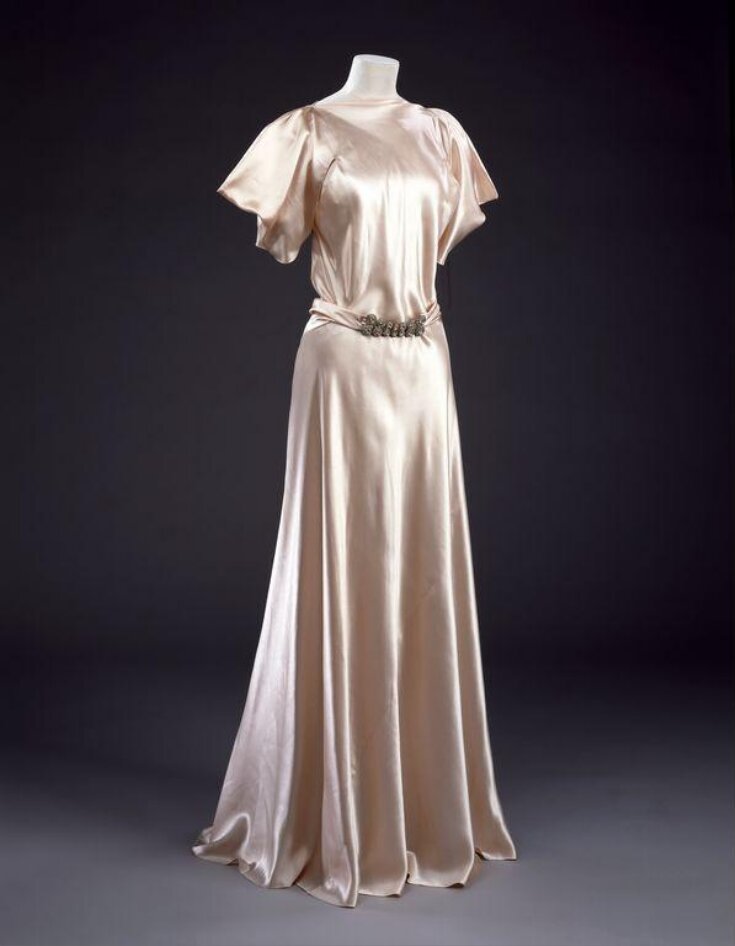
| Brief description | Satin evening dress and petticoat, designed and made by Madeleine Vionnet, Paris, 1932-1934. |
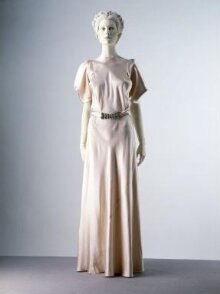
| Physical description | Long flared evening dress of pale flesh pink satin. It has short box shaped sleeves, which are skillfully cut in one with the front piece of the dress. They are peaked at the shoulders and are cut away around the under arms. They are taken across the back and fasten with a hook and loop at the top of the spine. The dress is almost backless, supported by two thin shoulder straps, concealed by the sleeves. The back piece is cut to form waist level half belts at the side seams, which are taken round to the front and fastened with two elaborate paste clasps. The front neck is high and of soft cowl type. The dress has an inter-lining of cream grosgrain. The main seams are machine stitched, but hemming and finishing is by hand and the raw edges are hand whipped. |
| Dimensions |
|
| Credit line | Given by Miss Amy Bird on behalf of Lady Dovercourt |
| Summary | Madeleine Vionnet was born in 1875 in Aubervilliers, France. Apprenticed to a seamstress at an early age, she worked in the Paris suburbs in her late teens before joining Kate Reilly, a London dressmaker, in about 1897. She returned to Paris, working with David Bechoff, Callot Soeurs and Douçet, before opening her own fashion house in 1912. Her work was interrupted by the First World War of 1914-1918, but she reopened in 1918, moving to 50 avenue Matignon. She retired in 1939. Vionnet is celebrated as master of the bias-cut dress, which moulds the body without restriction and flows with its movement. She was at the forefront of the neo-classical style and her label depicts a classical image of a woman poised on a column raising the straps of her tunic above her head. From 1924 her embroidery designs were inspired by Greek vases and Egyptian frescoes. Her bias-cut garments appear simple, but the cut and construction are complex and immaculately executed. During the 1930s she largely abandoned her famous bias-cut dresses in favour of classical-style draping and folding. |
| Collection | |
| Accession number | T.203&A-1973 |
About this object record
Explore the Collections contains over a million catalogue records, and over half a million images. It is a working database that includes information compiled over the life of the museum. Some of our records may contain offensive and discriminatory language, or reflect outdated ideas, practice and analysis. We are committed to addressing these issues, and to review and update our records accordingly.
You can write to us to suggest improvements to the record.
Suggest feedback
You can write to us to suggest improvements to the record.
Suggest feedback
| Record created | February 25, 2003 |
| Record URL |
Download as: JSON
