
Evening Dress
1957 (made)
| Artist/Maker | |
| Place of origin |
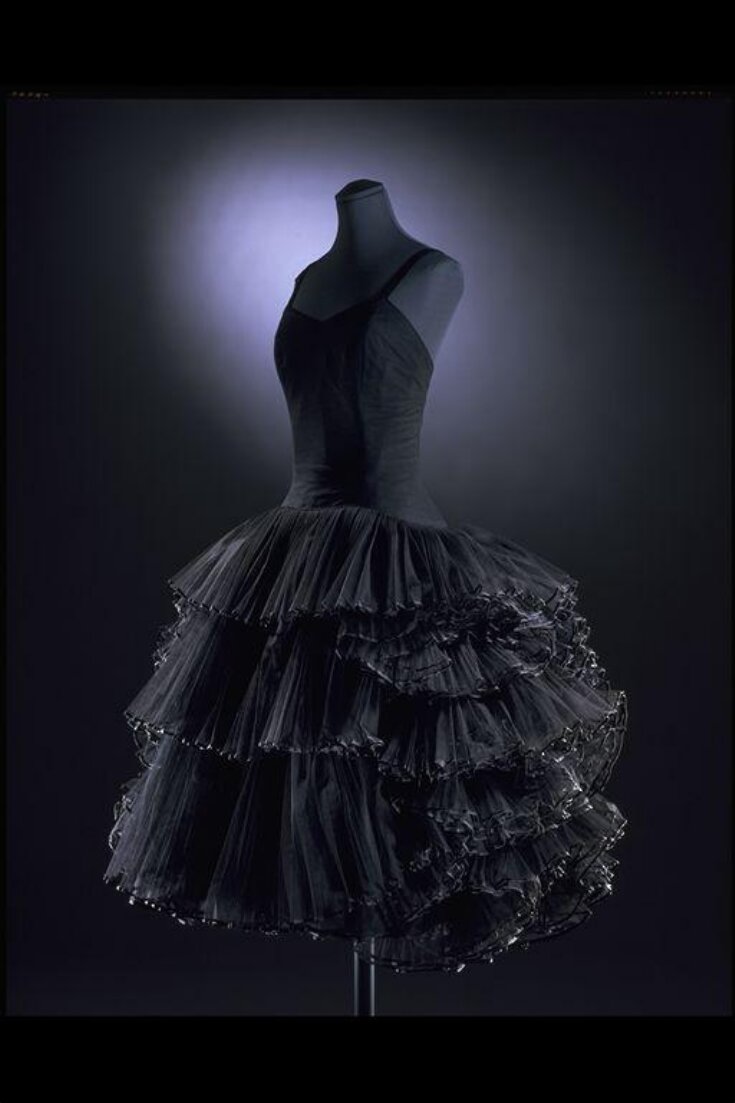
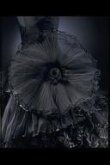
This evening dress has a low necked and adorned bodice which drops to the hip level at the sides and is tightly fitted to the body by curved seams and long darts. It is of tulle stretched over taffeta and mounted on a firmly boned foundation. Springing from the lowered waist is a frou-frou skirt of accordion-pleated triple flounces in frail tulle edged with shining satin ribbon. At the sides additional fullness is achived by tiers of enormous rosettes of pleated tulle interleaved with supporting ruches of nylon crin.
Pierre Balmain (1914-1982) opened his salon in 1945. Having studied architecture he worked on the structure of garments, defining the body with simple, modern lines. This cocktail dress, designed for the increasing elegant youth of the late 1950s is inspired by ballet and Spanish flamenco dress. It epitomises Balmain's harmonious balance between extravagance and elegance.
Pierre Balmain (1914-1982) opened his salon in 1945. Having studied architecture he worked on the structure of garments, defining the body with simple, modern lines. This cocktail dress, designed for the increasing elegant youth of the late 1950s is inspired by ballet and Spanish flamenco dress. It epitomises Balmain's harmonious balance between extravagance and elegance.
Delve deeper
Discover more about this object

Object details
| Categories | |
| Object type | |
| Materials and techniques | Tulle stretched over taffeta, mounted on boned foundation, frail tulle edged with satin ribbon, and lined with net stiffened with nylon and plastic mesh |
| Brief description | Tulle on tafetta evening dress, designed by Pierre Balmain, Paris, 1957. |
| Physical description | Short evening dress of tulle stretched over taffeta and mounted on a firmly boned foundation. It has a low necked and adorned bodice, which drops to the hip level at the sides and is tightly fitted to the body by curved seams and long darts. Springing from the lowered waist is a frou-frou skirt of accordion-pleated triple flounces in frail tulle edged with shining satin ribbon. At the sides additional fullness is achieved by tiers of enormous rosettes of pleated tulle interleaved with supporting ruches of nylon. The dress is lined with many layers of net, stiffened with nylon and plastic mesh. |
| Dimensions |
|
| Gallery label |
|
| Credit line | Given by Lady Elizabeth von Hofmannsthal |
| Object history | This dress has been displayed in the following V&A exhibitions: 1972: Fashion an Anthology by Cecil Beaton 1984: The Little Black Dress 1999: Black in Fashion 2007: The Golden Age of Couture: Paris and London 1947-1957 |
| Association | |
| Summary | This evening dress has a low necked and adorned bodice which drops to the hip level at the sides and is tightly fitted to the body by curved seams and long darts. It is of tulle stretched over taffeta and mounted on a firmly boned foundation. Springing from the lowered waist is a frou-frou skirt of accordion-pleated triple flounces in frail tulle edged with shining satin ribbon. At the sides additional fullness is achived by tiers of enormous rosettes of pleated tulle interleaved with supporting ruches of nylon crin. Pierre Balmain (1914-1982) opened his salon in 1945. Having studied architecture he worked on the structure of garments, defining the body with simple, modern lines. This cocktail dress, designed for the increasing elegant youth of the late 1950s is inspired by ballet and Spanish flamenco dress. It epitomises Balmain's harmonious balance between extravagance and elegance. |
| Bibliographic references |
|
| Collection | |
| Accession number | T.51-1974 |
About this object record
Explore the Collections contains over a million catalogue records, and over half a million images. It is a working database that includes information compiled over the life of the museum. Some of our records may contain offensive and discriminatory language, or reflect outdated ideas, practice and analysis. We are committed to addressing these issues, and to review and update our records accordingly.
You can write to us to suggest improvements to the record.
Suggest feedback
You can write to us to suggest improvements to the record.
Suggest feedback
| Record created | February 24, 2003 |
| Record URL |
Download as: JSON
