Bottle
975 to 1050 (made)
| Artist/Maker | |
| Place of origin |
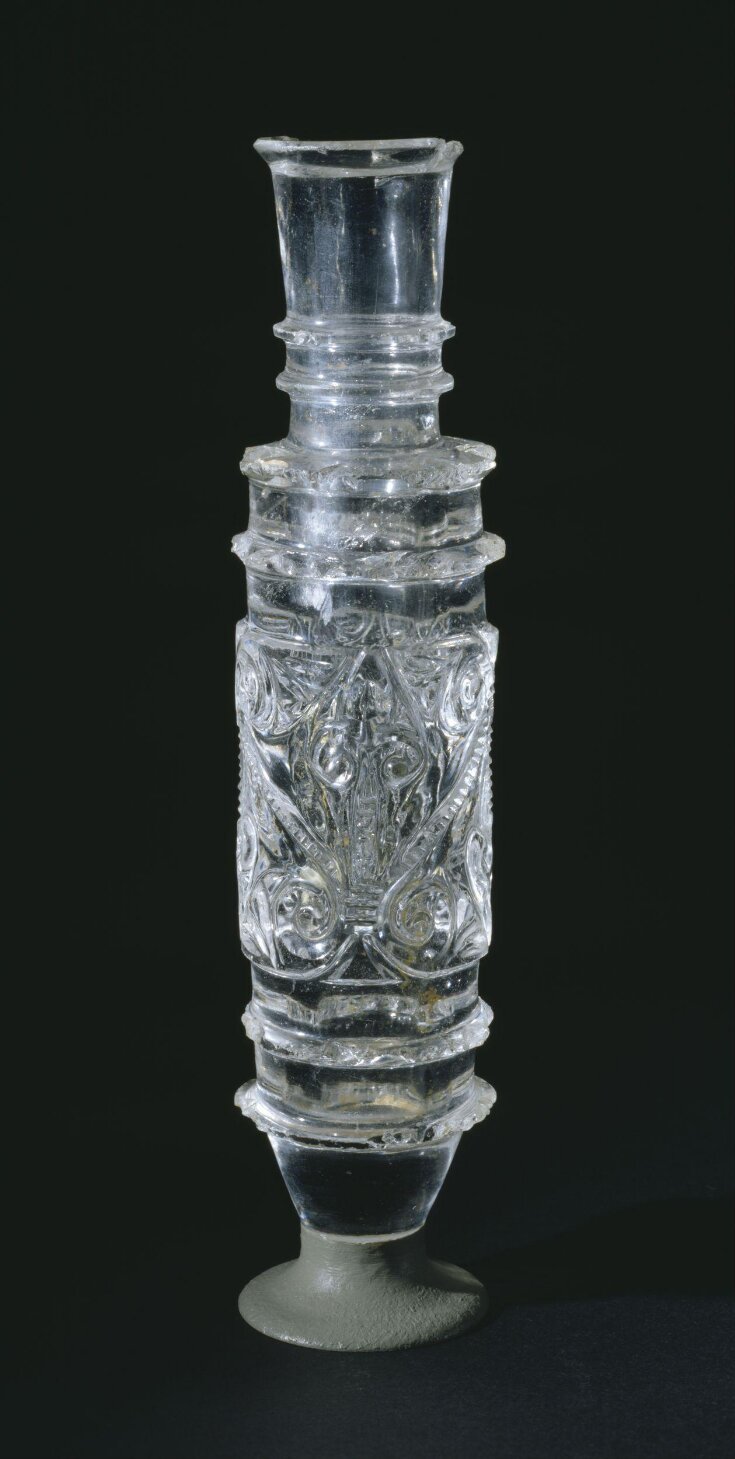
High-quality rock crystal vessels were made for the rulers of Cairo during the Fatimid period (969–1171). This is confirmed by inscriptions on several of them, which name specific rulers. Great skill was required to hollow out the raw rock crystal without breaking it and to carve the delicate, often very shallow, decoration. These vessels were therefore probably prestigious items that the ruler would have displayed in his own treasury of prized possessions.
Small rock crystals like this bottle could not have held much, but their contents must have been very precious indeed to deserve such containers. They were most probably used for storing perfumes, which were among the most luxurious items of any Islamic court. They often survive in cathedral treasuries, where they were rededicated after being captured from their original Islamic settings.
Small rock crystals like this bottle could not have held much, but their contents must have been very precious indeed to deserve such containers. They were most probably used for storing perfumes, which were among the most luxurious items of any Islamic court. They often survive in cathedral treasuries, where they were rededicated after being captured from their original Islamic settings.
Object details
| Categories | |
| Object type | |
| Materials and techniques | Rock crystal |
| Brief description | Rock crystal bottle, Egypt (probably Cairo), 975-1050. |
| Physical description | This bottle is tubular in shape, narrowing at the neck and foot. A broad band of palmette scrolls fills the centre, and above and below it are plain mouldings, at the shoulder and foot. The mouth is chipped half-way round, and the missing foot has been replaced by a base of metal covered by ceramic. Looking through the mouth hole, one can see at the base the mark of the drill which was used to hollow out the central hole. |
| Dimensions |
|
| Style | |
| Gallery label | Jameel Gallery
Rock Crystal Containers
Egypt, probably Cairo
975-1050
Many rock crystal objects were small containers for precious substances such as perfumes. Some are cylindrical. Others have a flattened, egg-shaped form, which would have been completed by mounts of other costly materials, now missing. The stylised plant designs were inspired by earlier work done in Iraq under the Abbasid dynasty, probably at Basra.
Carved rock crystal
Museum nos. A.45-1928, Purchased with the assistance of Messrs Henry Oppenheimer, Oscar Raphael and John Hugh Smith; 1163-1864(Jameel Gallery) |
| Credit line | Purchased with the assistance of Messrs Henry Oppenheimer, Oscar Raphael and John Hugh Smith |
| Object history | Formerly in the collection of Sir Hercules Read. Bought with A.46-1928 for £450,at Sotheby's sale, 7 November 1928 (Lot 413). Purchased with the help of contributions from Messrs. Henry Oppenheim, Oscar Raphael and John Hugh Smith. Case numbering changed from 1 to 48 to be consistent with Ceramics Dept 30/4/97 |
| Summary | High-quality rock crystal vessels were made for the rulers of Cairo during the Fatimid period (969–1171). This is confirmed by inscriptions on several of them, which name specific rulers. Great skill was required to hollow out the raw rock crystal without breaking it and to carve the delicate, often very shallow, decoration. These vessels were therefore probably prestigious items that the ruler would have displayed in his own treasury of prized possessions. Small rock crystals like this bottle could not have held much, but their contents must have been very precious indeed to deserve such containers. They were most probably used for storing perfumes, which were among the most luxurious items of any Islamic court. They often survive in cathedral treasuries, where they were rededicated after being captured from their original Islamic settings. |
| Bibliographic references |
|
| Collection | |
| Accession number | A.45-1928 |
About this object record
Explore the Collections contains over a million catalogue records, and over half a million images. It is a working database that includes information compiled over the life of the museum. Some of our records may contain offensive and discriminatory language, or reflect outdated ideas, practice and analysis. We are committed to addressing these issues, and to review and update our records accordingly.
You can write to us to suggest improvements to the record.
Suggest feedback
You can write to us to suggest improvements to the record.
Suggest feedback
| Record created | February 24, 2003 |
| Record URL |
Download as: JSONIIIF Manifest
