
Panel
late 19th century (made)
| Artist/Maker | |
| Place of origin |
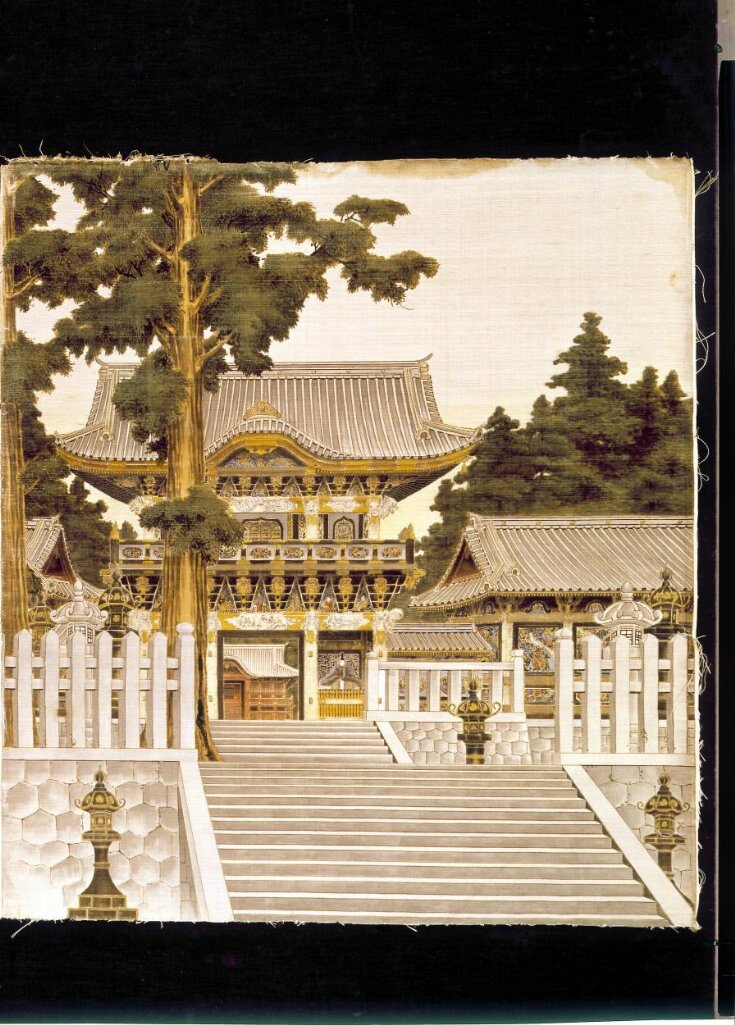
In the Meiji period (1868-1912), elaborate velvet pictures such as this panel were made in Japan for both the export and domestic markets. They were produced by first painting an image onto woven but uncut velvet. Some areas were then cut, producing tufted pile, but most areas were left as horizontal ridges. This velvet picture is of the Yomei-mon gate of the Tôshôgû shrine at Nikkô. The shrine is dedicated to Tokugawa Ieyasu (1542-1616), the first Tokugawa shôgun, and is one of the most popular tourist attractions in Japan.
Object details
| Categories | |
| Object type | |
| Materials and techniques | Painted, ribbed and cut velvet |
| Brief description | Velvet picture panel, Japan, late 19th century |
| Physical description | Cut and painted velvet picture panel of the Yomei-mon gate of the Tôshôgû shrine at Nikkô. The family crest (mon) of the Tokugawa clan appears on the pedestal lamps flanking the main staircase, which dominates the foreground of the picture. Immediately behind is the main gate of the shrine. The velvet pile is reserved for the principal elements of the buildings and for the pine trees; detail features have been subsequently painted in, either on the pile or the ribbed ground. |
| Dimensions |
|
| Summary | In the Meiji period (1868-1912), elaborate velvet pictures such as this panel were made in Japan for both the export and domestic markets. They were produced by first painting an image onto woven but uncut velvet. Some areas were then cut, producing tufted pile, but most areas were left as horizontal ridges. This velvet picture is of the Yomei-mon gate of the Tôshôgû shrine at Nikkô. The shrine is dedicated to Tokugawa Ieyasu (1542-1616), the first Tokugawa shôgun, and is one of the most popular tourist attractions in Japan. |
| Collection | |
| Accession number | T.104-1971 |
About this object record
Explore the Collections contains over a million catalogue records, and over half a million images. It is a working database that includes information compiled over the life of the museum. Some of our records may contain offensive and discriminatory language, or reflect outdated ideas, practice and analysis. We are committed to addressing these issues, and to review and update our records accordingly.
You can write to us to suggest improvements to the record.
Suggest feedback
You can write to us to suggest improvements to the record.
Suggest feedback
| Record created | February 24, 2003 |
| Record URL |
Download as: JSONIIIF Manifest
