An Unknown Woman
Portrait Miniature
ca. 1615 (painted)
ca. 1615 (painted)
| Artist/Maker | |
| Place of origin |
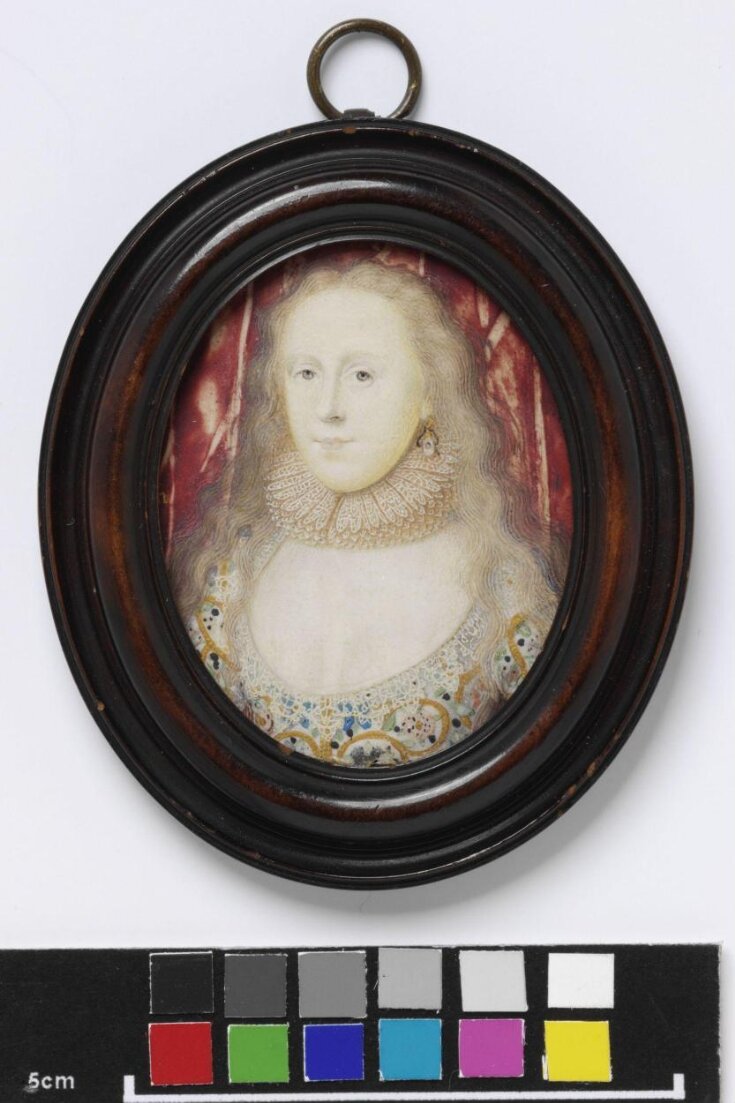
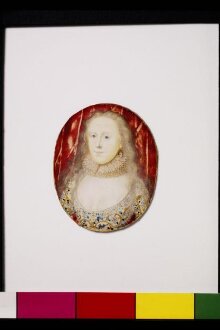
This modest work is an important early miniature portrait by John Hoskins, who originally trained as an oil painter. This work is datable to about 1615 and shows the still dominant influence of Nicholas Hilliard (1547-1619). The red curtain background is typical for this time, a development of the flat blue background of Elizabethan (later 16th-century) miniatures. Red paint is laid in flat, but the artist then used a wet brush to lift the red paint in strokes, giving the effect of folds in a curtain. Hoskins has also painted the woman's pearl earring using Hilliard's jewelling technique. This involved laying on a raised blob of white lead paint with some shadowing to one side. This was then crowned with a rounded touch of real silver that was burnished with, to quote Hilliard, ‘a pretty little tooth of some ferret or stoat or other wild little beast’. This brought the silver to a sparkling highlight, while actual gold is used to paint the pearl’s gold setting. Silver tarnishes with age, and so this pearl now appears black. Twenty years later Hoskins was painting pearls and gold in a more painterly fashion, using white and yellow paint rather than actual gold or silver. This change was influenced by Charles I's court painter, Anthony van Dyck, who arrived in London from Antwerp in 1632.
Object details
| Categories | |
| Object type | |
| Title | An Unknown Woman (generic title) |
| Materials and techniques | Watercolour on vellum put down on pasteboard |
| Brief description | Portrait miniature of an unknown woman, watercolour on vellum, painted by John Hoskins, ca.1615. |
| Physical description | Portrait, head and shoulders, to front, of a woman with long loose hair, wearing a ruff and a low cut embroidered jacket; in her left ear she wears a pearl earring. Features delicately stippled in grey with some yellow hatching in the shadows, on a pale thick carnation ground; the hair in long wiry strokes over a pale opaque yellow wash; the dress and white ruff in pale brown embossed with white and with touches of metallic gold and silver; background a crimson curtain flooded wet-in - wet; a gold marginal strip; on vellum put down on pasteboard. Frame: A relatively modern oval complex bolection moulding of fruitwood, stained dark brown; a Simple brown hanger stapled to the back. |
| Dimensions |
|
| Styles | |
| Marks and inscriptions | 'IH' (Signed in gold, centre left) |
| Credit line | Purchased with funds from the R. H. Stephenson Bequest |
| Object history | Provenance: H E Backer, from whom purchased with funds from the R H Stephenson Bequest, August 1942. |
| Subjects depicted | |
| Summary | This modest work is an important early miniature portrait by John Hoskins, who originally trained as an oil painter. This work is datable to about 1615 and shows the still dominant influence of Nicholas Hilliard (1547-1619). The red curtain background is typical for this time, a development of the flat blue background of Elizabethan (later 16th-century) miniatures. Red paint is laid in flat, but the artist then used a wet brush to lift the red paint in strokes, giving the effect of folds in a curtain. Hoskins has also painted the woman's pearl earring using Hilliard's jewelling technique. This involved laying on a raised blob of white lead paint with some shadowing to one side. This was then crowned with a rounded touch of real silver that was burnished with, to quote Hilliard, ‘a pretty little tooth of some ferret or stoat or other wild little beast’. This brought the silver to a sparkling highlight, while actual gold is used to paint the pearl’s gold setting. Silver tarnishes with age, and so this pearl now appears black. Twenty years later Hoskins was painting pearls and gold in a more painterly fashion, using white and yellow paint rather than actual gold or silver. This change was influenced by Charles I's court painter, Anthony van Dyck, who arrived in London from Antwerp in 1632. |
| Bibliographic references |
|
| Collection | |
| Accession number | P.6-1942 |
About this object record
Explore the Collections contains over a million catalogue records, and over half a million images. It is a working database that includes information compiled over the life of the museum. Some of our records may contain offensive and discriminatory language, or reflect outdated ideas, practice and analysis. We are committed to addressing these issues, and to review and update our records accordingly.
You can write to us to suggest improvements to the record.
Suggest feedback
You can write to us to suggest improvements to the record.
Suggest feedback
| Record created | February 24, 2003 |
| Record URL |
Download as: JSONIIIF Manifest
