
An Unknown Woman, aged 26
Portrait Miniature
1593 (made)
1593 (made)
| Artist/Maker | |
| Place of origin |
Object Type
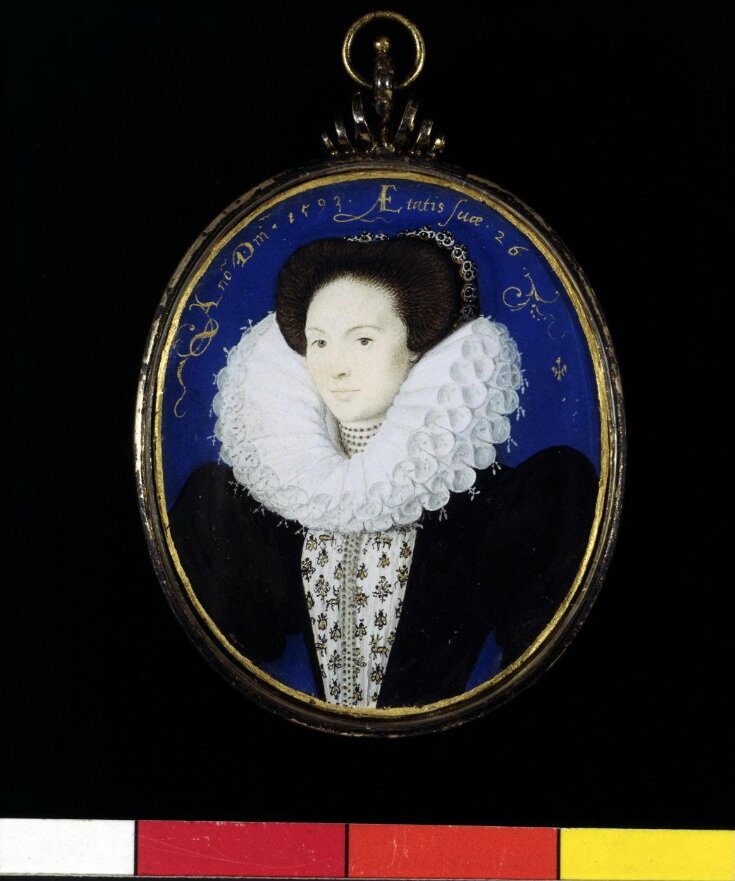
The medium and techniques of miniature painting, or limning as it was traditionally called, developed from the art of illustrating sacred books (also called limning). Nicholas Hilliard first trained as a goldsmith and introduced to this watercolour art innovative techniques for painting gold and jewels. In this miniature we see his characteristic curling and scrolling calligraphy, painted in real gold and then burnished.
Place
Nicholas Hilliard set up business in Gutter Lane in the City of London. In his treatise on limning Hilliard noted that limners should choose an area away from other trades, a 'place where neither dust, smoke, noise nor stench may offend' and some colours would suffer in the 'sulphurous air of seacoal and the gilding of goldsmiths'. Also 'the place where you work' should be lit from the north-east by one window, 'great and fair', with no walls or trees blocking the light. The late Medieval buildings of London would have made it hard to find such a workplace.
People
This sitter was once called Mistress Holland, Maid of Honour to Queen Elizabeth, because of a later inscription on the miniature's back. There is no real proof that she is Mistress Holland, but her magnificent costume, embroidered with tiny bees and deer, does not rule against her being a lady of the court.
The medium and techniques of miniature painting, or limning as it was traditionally called, developed from the art of illustrating sacred books (also called limning). Nicholas Hilliard first trained as a goldsmith and introduced to this watercolour art innovative techniques for painting gold and jewels. In this miniature we see his characteristic curling and scrolling calligraphy, painted in real gold and then burnished.
Place
Nicholas Hilliard set up business in Gutter Lane in the City of London. In his treatise on limning Hilliard noted that limners should choose an area away from other trades, a 'place where neither dust, smoke, noise nor stench may offend' and some colours would suffer in the 'sulphurous air of seacoal and the gilding of goldsmiths'. Also 'the place where you work' should be lit from the north-east by one window, 'great and fair', with no walls or trees blocking the light. The late Medieval buildings of London would have made it hard to find such a workplace.
People
This sitter was once called Mistress Holland, Maid of Honour to Queen Elizabeth, because of a later inscription on the miniature's back. There is no real proof that she is Mistress Holland, but her magnificent costume, embroidered with tiny bees and deer, does not rule against her being a lady of the court.
Delve deeper
Discover more about this object

Object details
| Categories | |
| Object type | |
| Title | An Unknown Woman, aged 26 (generic title) |
| Materials and techniques | Watercolour on vellum stuck onto a playing card |
| Brief description | Portrait of a woman, previously thought to be Mrs Holland, watercolour on vellum, painted by Nicholas Hilliard, 1593. |
| Physical description | Portrait miniature of a woman, half-length, turned slightly to left and looking to front. Oval with inscriptions in gold above the head. There are five spades printed on the reverse of the backing sheet. |
| Dimensions |
|
| Content description | Portrait of a woman, half-length, oval; the sitter is wearing a black dress with a white stomacher embroidered with bees and deer, and wearing a large ruff with white textile ties. |
| Styles | |
| Marks and inscriptions |
|
| Gallery label | British Galleries:
Nicholas Hilliard and Miniature Painting Nicholas Hilliard trained as a goldsmith and developed painting techniques that exploited this training. He used metallic pigments to mimic the jewellery on the opulent clothes that were fashionable. Hilliard created the image of Elizabeth and her courtiers that we know today, but he never won a salaried position at court. He had to set up shop in the City of London. From there he painted anyone who could afford his services. The woman in this miniature has chosen a conventional pose for her portrait. Hilliard has carefully painted her magnificent dress decorated with tiny embroidered bees and deer.(27/03/2003) |
| Credit line | Bequeathed by George Salting |
| Object history | - Previously thought to be a portrait of Mrs Holland because of a nineteenth-century inscription on the reverse. - In 2003 it was suggested that this miniature of an unknown woman was a portrait of Emilia Bassano [Amelia or Emilia Bassano], married to Alphonso Lanier. Emilia Bassano was claimed to be 'a prime contender for the role of [Shakespeare's] Dark Lady... The discovery was stumbled upon by the actor and playwright Tony Haygarth while researching his latest play, Dark Meaning Mouse, which examines the relationship between Shakespeare and his Dark Lady and her influence on his work.' (reported by Simon Tait, 'The Independent', 7 Dec 2003). Another miniature by Nicholas Hilliard in the V&A’s collection (museum no. P.8-1945) has also been suggested as a portrait of Amelia or Emilia Lanier (born Bassano). Provenance: In the collection of Samuel Addington in 1865 when lent to the South Kensington Exhibition as 'Mrs Holland', sold in his sale as Lady Elizabeth Russell, Christie’s 26th April 1883 (lot 87); bought Wareham; J. Lumsden Propert Collection; purchased by Salting at the dissolution of that collection in 1897 by the Fine Art Society; bequeathed by Salting 1910. |
| Subjects depicted | |
| Summary | Object Type The medium and techniques of miniature painting, or limning as it was traditionally called, developed from the art of illustrating sacred books (also called limning). Nicholas Hilliard first trained as a goldsmith and introduced to this watercolour art innovative techniques for painting gold and jewels. In this miniature we see his characteristic curling and scrolling calligraphy, painted in real gold and then burnished. Place Nicholas Hilliard set up business in Gutter Lane in the City of London. In his treatise on limning Hilliard noted that limners should choose an area away from other trades, a 'place where neither dust, smoke, noise nor stench may offend' and some colours would suffer in the 'sulphurous air of seacoal and the gilding of goldsmiths'. Also 'the place where you work' should be lit from the north-east by one window, 'great and fair', with no walls or trees blocking the light. The late Medieval buildings of London would have made it hard to find such a workplace. People This sitter was once called Mistress Holland, Maid of Honour to Queen Elizabeth, because of a later inscription on the miniature's back. There is no real proof that she is Mistress Holland, but her magnificent costume, embroidered with tiny bees and deer, does not rule against her being a lady of the court. |
| Bibliographic reference | Strong, Roy. Artists of the Tudor Court: the Portrait Miniature Rediscovered 1520-1620.. London: The Victoria and Albert Museum, 1983. Cat. 95, p. 81.
Carl Winter, Elizabethan Miniatures, 1943, pl. 11 (a). V&A, 1947 (60).
Erna Auerbach, Hilliard, 1961, p. 133, pl. 202, 305 (102). |
| Collection | |
| Accession number | P.134-1910 |
About this object record
Explore the Collections contains over a million catalogue records, and over half a million images. It is a working database that includes information compiled over the life of the museum. Some of our records may contain offensive and discriminatory language, or reflect outdated ideas, practice and analysis. We are committed to addressing these issues, and to review and update our records accordingly.
You can write to us to suggest improvements to the record.
Suggest feedback
You can write to us to suggest improvements to the record.
Suggest feedback
| Record created | February 21, 2003 |
| Record URL |
Download as: JSONIIIF Manifest
