

Maxim's
Cocktail Dress
1947 (made)
1947 (made)
| Artist/Maker | |
| Place of origin |
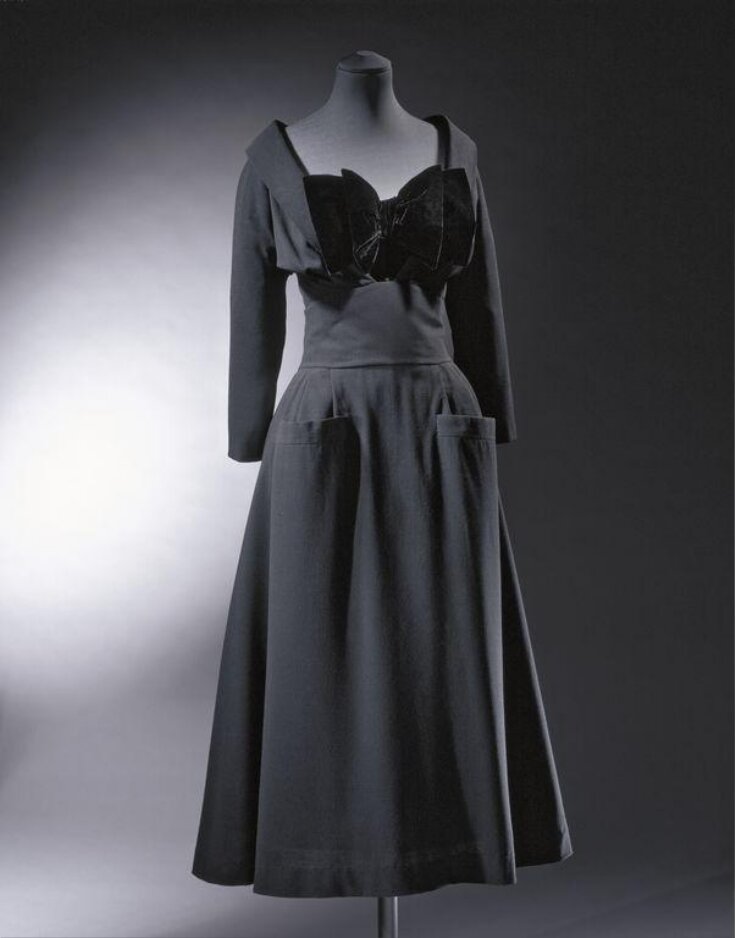
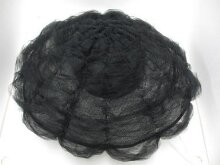
The spring 1947 collection of Christian Dior (1905-1957) caused a sensation and was christened 'The New Look' by Carmel Snow of Harper's Bazaar. Dior offered the glamour and romance of full skirts and nipped-in waists to women who were tired of utilitarian clothes with boxy silhouettes, mannish square shoulders and practical short skirts. This intricately cut afternoon dress of black wool, named 'Maxim's', was worn with a black tulle cartwheel hat, long black gloves and simple black court shoes. To emphasise the bust, a large silk velvet bow was set into the low, square neckline and the waist was compressed by a cummerbund-style lower bodice. A heavy ribbed silk petticoat supports and defines the skirt. The dress fastens with a zip down the back .
Object details
| Categories | |
| Object type | |
| Parts | This object consists of 3 parts.
|
| Titles |
|
| Materials and techniques | Silk velvet and wool, ribbed silk, lined with silk and boned, gathered and ruched tulle, and paste |
| Brief description | Maxim's cocktail ensemble by Christian Dior, wool and silk velvet (dress), tulle (hat), silk velvet and rhinestones (choker), Paris, France, corolle line, haute couture spring/summer 1947 |
| Physical description | Cocktail outfit consisting of a black woollen and velvet dress with attached corded silk waist petticoat, tulle hat and velvet chocker. |
| Dimensions |
|
| Style | |
| Production type | Haute couture |
| Gallery label |
|
| Credit line | Given by Mrs David Bruce |
| Object history | Worn and given by Evangeline Bruce (1914-1995). Mrs Bruce was the wife of the Honourable David Bruce, US ambassador to France from 1949 to 1952. In the notebook of the Dior Archive, the dress is referred to as a 'Restaurant Dress'. |
| Historical context | THE NEW LOOK panel text from The Golden Age of Couture: Paris and London 1947-1957 "Dior launched his new house on 12 February 1947 and became an overnight sensation. His voluptuous collection was the antithesis of lean, boxy wartime fashions. Instead, feminine designs featured rounded shoulders, a womanly bust and a hand-span waist above enormous skirts. It was christened on the spot by Carmel Snow, editor of American Harper’s Bazaar, as the ‘New Look’. The amount of fabric required to create a New Look garment – typically 15 metres in a woollen day dress, 25 metres in a short taffeta evening gown – caused outrage, for rationing was still in place. The collection was shown in secret to Princess Margaret at the French Embassy in London. But despite attempts by the Board of Trade to suppress it, the New Look was unstoppable." “Evangeline (Bruce) performed her job with such panache and aplomb that she became the country’s standard bearer as far as diplomacy went. … She had become the State Department’s last word on good taste” writes C. David Heymann in The Georgetown Ladies’ Social Club: Power, Passion, and Politics in the Nation's Capital (Atria Books: 2004) |
| Association | |
| Summary | The spring 1947 collection of Christian Dior (1905-1957) caused a sensation and was christened 'The New Look' by Carmel Snow of Harper's Bazaar. Dior offered the glamour and romance of full skirts and nipped-in waists to women who were tired of utilitarian clothes with boxy silhouettes, mannish square shoulders and practical short skirts. This intricately cut afternoon dress of black wool, named 'Maxim's', was worn with a black tulle cartwheel hat, long black gloves and simple black court shoes. To emphasise the bust, a large silk velvet bow was set into the low, square neckline and the waist was compressed by a cummerbund-style lower bodice. A heavy ribbed silk petticoat supports and defines the skirt. The dress fastens with a zip down the back . |
| Bibliographic references |
|
| Collection | |
| Accession number | T.116 to B-1974 |
About this object record
Explore the Collections contains over a million catalogue records, and over half a million images. It is a working database that includes information compiled over the life of the museum. Some of our records may contain offensive and discriminatory language, or reflect outdated ideas, practice and analysis. We are committed to addressing these issues, and to review and update our records accordingly.
You can write to us to suggest improvements to the record.
Suggest feedback
You can write to us to suggest improvements to the record.
Suggest feedback
| Record created | February 19, 2003 |
| Record URL |
Download as: JSON
