Panel
1840 (made)
| Artist/Maker | |
| Place of origin |
We know little of the stained-glass work of C.E. Gwilt. But it must have been favourably received, because he submitted designs for a competition to create windows for the House of Lords. These designs were for a large window depicting eight Norman kings. In 1844 they were exhibited at the Bazaar, St James’s Street, London.
This window was formerly located in a house in Niton in the Isle of Wight.
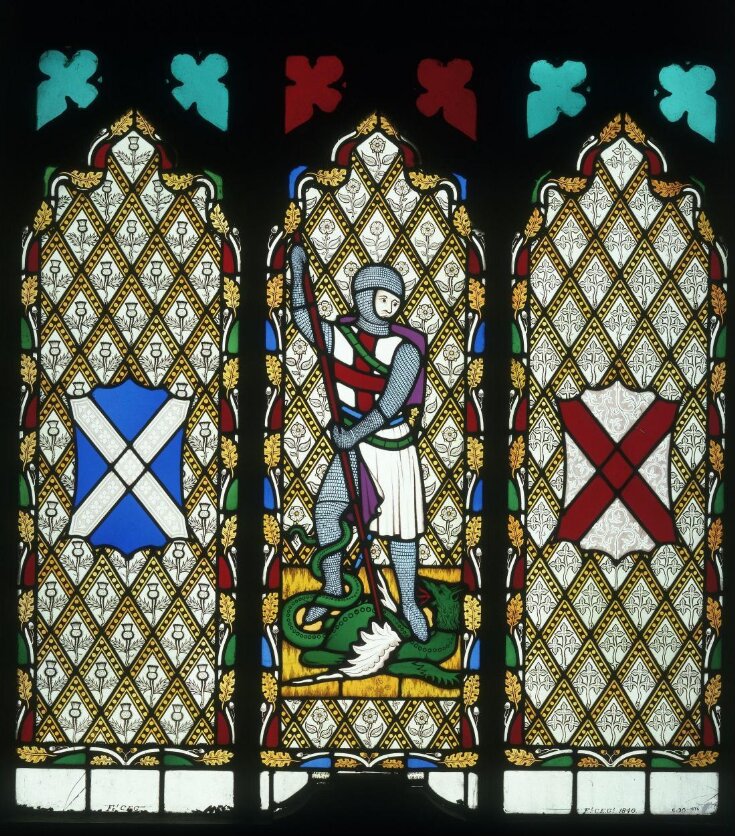
Gwilt was one of several stained-glass artists in the first half of the 1800s who experimented with the use of coloured glass in their compositions, in a return to earlier traditions. In this window Gwilt combines coloured and stained glass in a setting of clear quarries (diamond-shaped panes as used in lattice windows). Heraldry had been a popular addition to windows since the Middle Ages. Here we see arms representing the patron saints of Scotland and Ireland, Andrew and Patrick. St George represents England.
This window was formerly located in a house in Niton in the Isle of Wight.
Gwilt was one of several stained-glass artists in the first half of the 1800s who experimented with the use of coloured glass in their compositions, in a return to earlier traditions. In this window Gwilt combines coloured and stained glass in a setting of clear quarries (diamond-shaped panes as used in lattice windows). Heraldry had been a popular addition to windows since the Middle Ages. Here we see arms representing the patron saints of Scotland and Ireland, Andrew and Patrick. St George represents England.
Object details
| Categories | |
| Object type | |
| Materials and techniques | Stained and painted glass |
| Brief description | Clear and coloured glass window with painted details and yellow (silver) stain depicting St. George and the Dragon. Made by C.Edmund Gwilt in England, 1840. |
| Physical description | Three panels, trefoil-headed, with tracery lights above. The central panel depicts St George slaying the dragon - he wears chain mail and a white surcoat decorated with the arms of England - against a background of quarries with tudor roses. The left hand panel is decorated with a shield of the saltire cross of St Andrew or Scotland on a background of quarries decorated with thistles while the right hand panel has a similar shield with a saltire cross of red on white (St Patrick or Ireland) on a background of quarries with shamrocks. |
| Dimensions |
|
| Production type | Unique |
| Marks and inscriptions | 'designed executed by C. E. Guilt, 1840' [centre; & and lower right:] 'Fet C.E.G.t' [and lower left:] 'Fet C.E.G.' (Makers's mark; painted; Guilt; 1840) |
| Gallery label | SAINT GEORGE AND THE DRAGON
In the flanking lights of the window are the Saltires of St Andrew (left) and St Patrick (right), for Scotland and Ireland respectively. Formerly in a house at Niton, Isle of Wight.
England, signed and dated 1840; by C. Edwin Gwilt
Museum no. C.315-1976((PW) 2003) |
| Object history | The window was purchased in an antiques shop on the Isle of Wight in the 1930s by the vendor's father. No previous history is known. |
| Production | Formerly in a house at Niton, Isle of Wight |
| Subject depicted | |
| Summary | We know little of the stained-glass work of C.E. Gwilt. But it must have been favourably received, because he submitted designs for a competition to create windows for the House of Lords. These designs were for a large window depicting eight Norman kings. In 1844 they were exhibited at the Bazaar, St James’s Street, London. This window was formerly located in a house in Niton in the Isle of Wight. Gwilt was one of several stained-glass artists in the first half of the 1800s who experimented with the use of coloured glass in their compositions, in a return to earlier traditions. In this window Gwilt combines coloured and stained glass in a setting of clear quarries (diamond-shaped panes as used in lattice windows). Heraldry had been a popular addition to windows since the Middle Ages. Here we see arms representing the patron saints of Scotland and Ireland, Andrew and Patrick. St George represents England. |
| Bibliographic references |
|
| Collection | |
| Accession number | C.315-1976 |
About this object record
Explore the Collections contains over a million catalogue records, and over half a million images. It is a working database that includes information compiled over the life of the museum. Some of our records may contain offensive and discriminatory language, or reflect outdated ideas, practice and analysis. We are committed to addressing these issues, and to review and update our records accordingly.
You can write to us to suggest improvements to the record.
Suggest feedback
You can write to us to suggest improvements to the record.
Suggest feedback
| Record created | April 16, 1998 |
| Record URL |
Download as: JSONIIIF Manifest
