
Sack
1755 (woven), 1755-1760 (sewing), 1760s (altered), 1870-1910 (altered)
| Artist/Maker | |
| Place of origin |
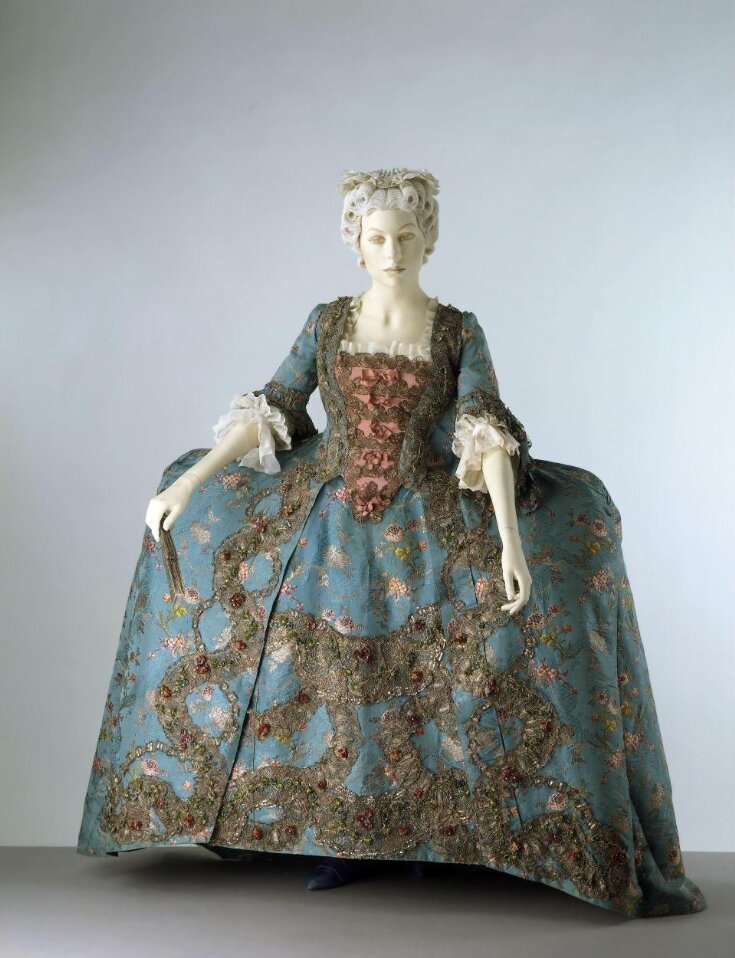
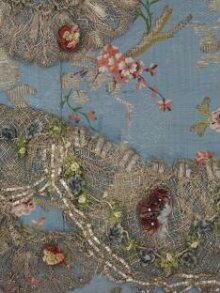
This formal gown of the late 1750s illustrates the very decorative nature of women's dress at the height of the Rococo period. The silk itself is brocaded in a pattern of flowers with coloured and silver thread. The gown and petticoat have then been trimmed with silver bobbin lace, flowers made of ruched ribbons and beads, silk tassels and feathers. Such an elaborate ensemble would have been reserved for evening dress, dancing at the Assembly rooms, or attending the opera or theatre. The dress is said to have been worn by Mrs Craster. Before her marriage, she was a maid of honour to Queen Caroline (1683–1737), consort of George II.
Object details
| Categories | |
| Object type | |
| Parts | This object consists of 4 parts.
|
| Materials and techniques | Silk, linen, silk thread, silver thread, silver strip, wire, feathers, beads; hand-woven, hand-made bobbin lace and trimmings, hand-sewn |
| Brief description | A woman's sack and petticoat 1755-1760, British; Blue figured silk brocaded with floral sprays and silver, French, 1755, silver bobbin lace, feathers, flower trim; altered 1760s, and 1870-1910 |
| Physical description | A woman's sack and petticoat of blue figured silk brocaded with floral sprays and silver. The sack is open at the front with robings to the waist and elbow-length sleeves with double, scalloped sleeve ruffles. The bodice and sleeves are lined with linen. At the back are two double box pleats, stitched at the neckline. The sack is made of 7 widths of silk and a triangular gore of silk on the side of each front panel. There is no waist seam. The skirts are shaped for a fan-shaped hoop, with pocket openings in the side seams. The hem is faced with blue silk ribbon. The skirt fronts are pleated to form a robing, wider at the bottom. The bodice robings are trimmed with broad silver strip bobbin lace, which continues down the skirt facings, looped with a narrower woven strip lace. These are trimmed with garlands and sprays of flowers of ribbon and wired silk chenille and feathers. The back of the neck band is trimmed with the silk flowers; the sleeeve ruffles are edged with narrow silver bobbin lace and silk flowers. Stitched into each sleeve lining is a large weight. The petticoat is made of 6 widths of silk, with a wide box pleat at the front and flat pleats at the side and back. The waist is bound with blue silk ribbon, which is threaded through a casing either side of the opening at centre back. The hem is faced with silk ribbon. The front is decorated with silver strip bobbin lace, of two widths, arranged in intersecting serpentine lines. Attached to these are small garlands and single artificial flowers made from wired silk chenille, gathered ribbon and feathers. The ensemble was altered, probably in the early 1760s, possibly for another wearer. The robings, originally continuous down the front, were cut at the waist and opened out above. A length of wide blue silk ribbon made the transition between bodice robing and skirt robing, and the lace was rearranged to cover it. The linen lining was cut at the back and ties added to adjust to a larger wearer. The side pleats and pocket openings of the petticoat were unpicked, a band of white silk added front and back to lengthen it, and the petticoat gathered at the sides. Further alterations were made for fancy dress in the late 19th century. A band of silk with hooks was added to the right side of the gown front. Tucks were made (some now removed) in the waist binding of the petticoat. |
| Dimensions |
|
| Style | |
| Gallery label | ROBE ('SACK') & PETTICOAT
English; about 1755-60.
French brocaded silk trimmed with silver bobbin lace, feathers and artificial flowers.
Said to have been worn by Mrs Carter who as Miss Catherine Villiers was Maid of Honour to Queen Caroline. Mrs Carter died in 1772, and the dresses ultimately passed into the hands of the Pocklington Senhouse family of Netherhall, Cumberland.
T.251 & A - 1959.(1962 - 1979) |
| Object history | Exhibited in the Costume Court from 1962 to 1979. |
| Summary | This formal gown of the late 1750s illustrates the very decorative nature of women's dress at the height of the Rococo period. The silk itself is brocaded in a pattern of flowers with coloured and silver thread. The gown and petticoat have then been trimmed with silver bobbin lace, flowers made of ruched ribbons and beads, silk tassels and feathers. Such an elaborate ensemble would have been reserved for evening dress, dancing at the Assembly rooms, or attending the opera or theatre. The dress is said to have been worn by Mrs Craster. Before her marriage, she was a maid of honour to Queen Caroline (1683–1737), consort of George II. |
| Bibliographic reference | Published in: Rothstein, Natalie, Madeleine Ginsburg, and Avril Hart. Four hundred years of fashion. Victoria and Albert Museum in association with Collins, 1984. |
| Collection | |
| Accession number | T.251 to C-1959 |
About this object record
Explore the Collections contains over a million catalogue records, and over half a million images. It is a working database that includes information compiled over the life of the museum. Some of our records may contain offensive and discriminatory language, or reflect outdated ideas, practice and analysis. We are committed to addressing these issues, and to review and update our records accordingly.
You can write to us to suggest improvements to the record.
Suggest feedback
You can write to us to suggest improvements to the record.
Suggest feedback
| Record created | February 8, 2003 |
| Record URL |
Download as: JSONIIIF Manifest
