Bowl
10th century (made)
| Artist/Maker | |
| Place of origin |
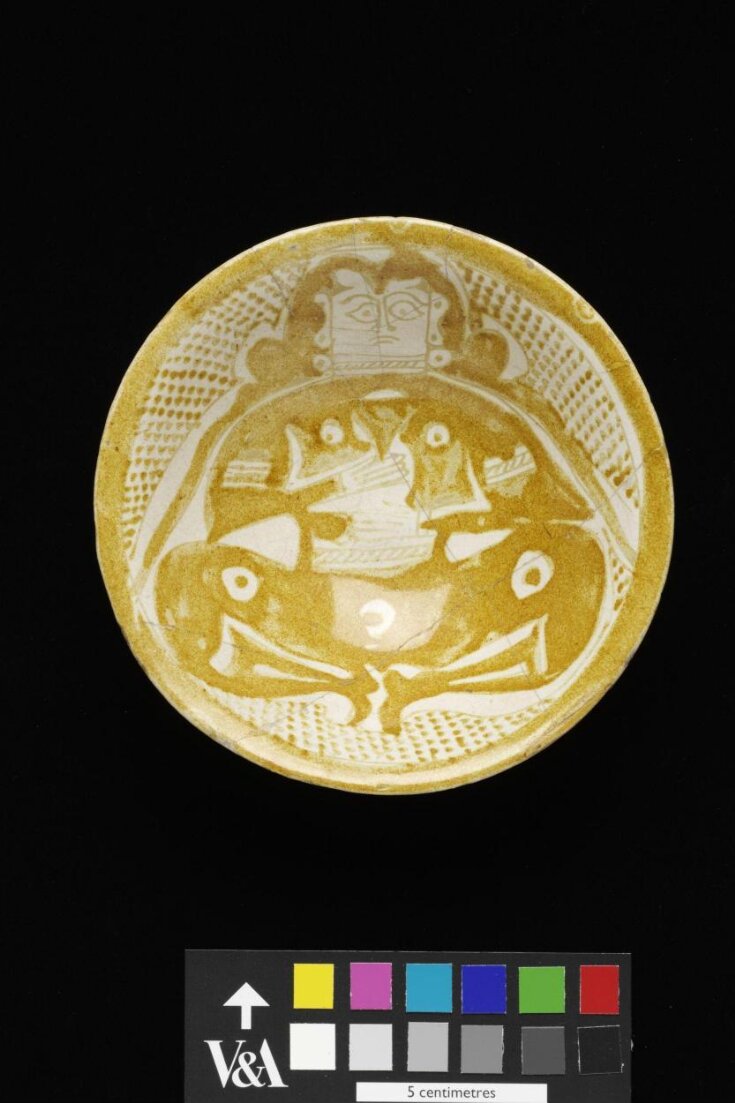
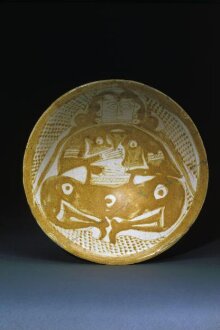
This bowl features an image of a seated drinker, who is depicted in a rather naïve style. The bowl belongs to a type of Islamic pottery known as Abbasid lustreware, which was produced in Iraq after the Abbasid dynasty of caliphs had established their capital there in AD 750. During this period, Iraqi potters developed a type of earthenware with an opaque white glaze in imitation of the white porcelains then being imported from China. They subsequently applied the technique of staining glass with metallic pigments to this whiteware and in the process created the world's first lustre-painted ceramics.
The decoration here is in the monochrome yellow lustre typical of surviving Abbasid lustrewares. After a short period of experimenting with polychrome and two-colour lustre decoration, Abbasid potters settled on this yellow pigment. The reason may have been its greater dependability during the firing phase. The more likely reason, however, was that it resembled gold. Achieving a high quality yellow-gold lustre was difficult, because the lustre will not develop properly unless the firing conditions are precise. It was also expensive, since the pigment used was silver oxide. These wares also cost a good deal to produce because the tin oxide required to make the glaze opaque and white had to be imported.
The decoration here is in the monochrome yellow lustre typical of surviving Abbasid lustrewares. After a short period of experimenting with polychrome and two-colour lustre decoration, Abbasid potters settled on this yellow pigment. The reason may have been its greater dependability during the firing phase. The more likely reason, however, was that it resembled gold. Achieving a high quality yellow-gold lustre was difficult, because the lustre will not develop properly unless the firing conditions are precise. It was also expensive, since the pigment used was silver oxide. These wares also cost a good deal to produce because the tin oxide required to make the glaze opaque and white had to be imported.
Object details
| Categories | |
| Object type | |
| Materials and techniques | Tin-glazed earthenware (fritware) with lustre decoration |
| Brief description | Bowl, whiteware, painted in gold lustre with a seated figure holding a goblet; Iraq (probably Basra), 10th century. |
| Physical description | Bowl, buff-coloured earthenware (fritware), covered with a tin-opacified glaze, the glazed surface painted a yellow-gold lustre depicting a seated figure holding a goblet within contour panels against a dotted ground. |
| Dimensions |
|
| Styles | |
| Gallery label |
|
| Historical context | Bears label with initials "PH" in monogram. |
| Subject depicted | |
| Summary | This bowl features an image of a seated drinker, who is depicted in a rather naïve style. The bowl belongs to a type of Islamic pottery known as Abbasid lustreware, which was produced in Iraq after the Abbasid dynasty of caliphs had established their capital there in AD 750. During this period, Iraqi potters developed a type of earthenware with an opaque white glaze in imitation of the white porcelains then being imported from China. They subsequently applied the technique of staining glass with metallic pigments to this whiteware and in the process created the world's first lustre-painted ceramics. The decoration here is in the monochrome yellow lustre typical of surviving Abbasid lustrewares. After a short period of experimenting with polychrome and two-colour lustre decoration, Abbasid potters settled on this yellow pigment. The reason may have been its greater dependability during the firing phase. The more likely reason, however, was that it resembled gold. Achieving a high quality yellow-gold lustre was difficult, because the lustre will not develop properly unless the firing conditions are precise. It was also expensive, since the pigment used was silver oxide. These wares also cost a good deal to produce because the tin oxide required to make the glaze opaque and white had to be imported. |
| Bibliographic reference | Oliver Watson, "Acquisitions in the Department of Ceramics at the V&A, 1981-2", Burlington Magazine, May, 1983, p. 289 |
| Collection | |
| Accession number | C.62-1981 |
About this object record
Explore the Collections contains over a million catalogue records, and over half a million images. It is a working database that includes information compiled over the life of the museum. Some of our records may contain offensive and discriminatory language, or reflect outdated ideas, practice and analysis. We are committed to addressing these issues, and to review and update our records accordingly.
You can write to us to suggest improvements to the record.
Suggest feedback
You can write to us to suggest improvements to the record.
Suggest feedback
| Record created | January 28, 1998 |
| Record URL |
Download as: JSONIIIF Manifest
