Dish
ca. 1585 (made)
| Artist/Maker | |
| Place of origin |
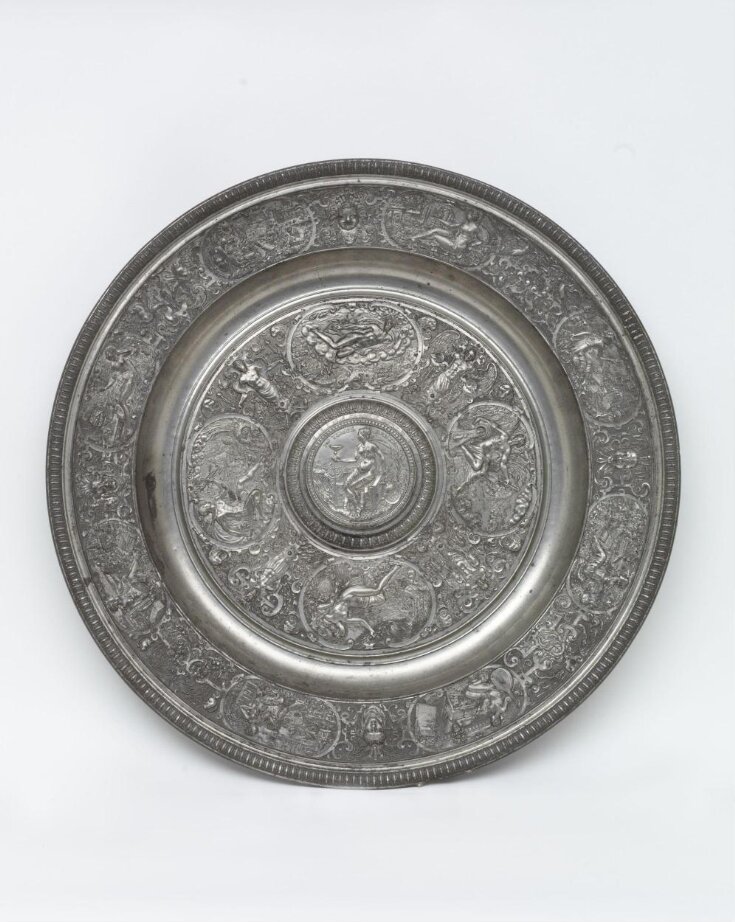
The 'Temperantia' Basin is one of the highlights of the V&A's pewter collection. It is a fine example of Edelzinn, literally 'precious pewter', which was produced in France and Germany during the late sixteenth and early seventeenth centuries. The dish was probably made to decorate the buffet of a prince or of a civic body such as a town guild. Contemporary illustrations show these buffets could be enormous, multi-tiered structures supporting rich displays of gold, silver, mounted exotic shells and colourful stones, and other items from their owners' treasuries.
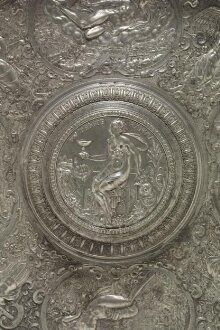
By the late 16th century, most fashionable patrons favoured fantastical Manneristpieces for their displays. Mannerism was a courtly style based around the idea of difficultà: complex design, virtuoso craftsmanship and decoration infused with intellectual references. The surface of this dish is decorated with cast designs in relief with its central plaque depicting a figure of Temperance holding a wine-cup and ewer. Around the central boss a broad band of ornament contains four plaques with figures representing AER (air), AQUA (water), TERRA (earth), and IGNIS (fire). On the rim there are oval panels depicting the Seven Liberal Arts and their patron Minerva: GRAMMATIC (Grammar), DIALECTICA, RHETORICA (rhetoric), MUSICA (music), ARITHMETIQUA (Arithmetic), GEOMETRIA (Geometry) and ASTROLOGIA (Astrology). Between the plaques the dish is covered with finely cast strapwork, birds, masks, serpents, fruit, flowers and winged horses. As Edelzinn was designed for display it tends to survive in excellent condition.
The dish is signed 'FB' on the central boss for Francois Briot, the most celebrated member of a French family of medallists and die-cutters. Briot was a model carver, medallist and pattern-maker rather than a pewterer, creating copper moulds in which pewter was cast. The Temperantia dish, is his only known signed work. It would have been extremely costly to produce. The intricate modelling was highly skilled work. Briot's most likely patron was Friedrich I, Duke of Württemberg (1557-1608), Count of Montbéliard (1581-93). Briot moved to Montbeliard in 1579 and by 1585 was appointed seal-engraver to the count and is known to have made medals for Friedrich.
Briot's 'Temperantia' and similar 'Mars' basins have had a widespread influence. The V&A owns an almost identical dish by the early 17th-century Nuremberg modeller, Caspar Enderlein (Mus. No. 5477-1859). The Enderlein versions were not cast from an original but were made from moulds cut as line-for-line copies of the Briot dish. The model was further disseminated by polychrome pottery versions in Palissyware which were in turn imitated during the 19th century (see Museum no. 1080-1871). Every year the winner of the women's singles at the Wimbledon Tennis Championships holds a silver copy made by Elkington of Birmingham in 1864 of an Enderlein version of Briot's Temperantia basin that was cast from a plaster mould taken from the version in The Louvre. The V&A has an electrotype made from the same pattern in 1852 (Museum no. REPRO.1852B-6).
By the late 16th century, most fashionable patrons favoured fantastical Manneristpieces for their displays. Mannerism was a courtly style based around the idea of difficultà: complex design, virtuoso craftsmanship and decoration infused with intellectual references. The surface of this dish is decorated with cast designs in relief with its central plaque depicting a figure of Temperance holding a wine-cup and ewer. Around the central boss a broad band of ornament contains four plaques with figures representing AER (air), AQUA (water), TERRA (earth), and IGNIS (fire). On the rim there are oval panels depicting the Seven Liberal Arts and their patron Minerva: GRAMMATIC (Grammar), DIALECTICA, RHETORICA (rhetoric), MUSICA (music), ARITHMETIQUA (Arithmetic), GEOMETRIA (Geometry) and ASTROLOGIA (Astrology). Between the plaques the dish is covered with finely cast strapwork, birds, masks, serpents, fruit, flowers and winged horses. As Edelzinn was designed for display it tends to survive in excellent condition.
The dish is signed 'FB' on the central boss for Francois Briot, the most celebrated member of a French family of medallists and die-cutters. Briot was a model carver, medallist and pattern-maker rather than a pewterer, creating copper moulds in which pewter was cast. The Temperantia dish, is his only known signed work. It would have been extremely costly to produce. The intricate modelling was highly skilled work. Briot's most likely patron was Friedrich I, Duke of Württemberg (1557-1608), Count of Montbéliard (1581-93). Briot moved to Montbeliard in 1579 and by 1585 was appointed seal-engraver to the count and is known to have made medals for Friedrich.
Briot's 'Temperantia' and similar 'Mars' basins have had a widespread influence. The V&A owns an almost identical dish by the early 17th-century Nuremberg modeller, Caspar Enderlein (Mus. No. 5477-1859). The Enderlein versions were not cast from an original but were made from moulds cut as line-for-line copies of the Briot dish. The model was further disseminated by polychrome pottery versions in Palissyware which were in turn imitated during the 19th century (see Museum no. 1080-1871). Every year the winner of the women's singles at the Wimbledon Tennis Championships holds a silver copy made by Elkington of Birmingham in 1864 of an Enderlein version of Briot's Temperantia basin that was cast from a plaster mould taken from the version in The Louvre. The V&A has an electrotype made from the same pattern in 1852 (Museum no. REPRO.1852B-6).
Object details
| Categories | |
| Object type | |
| Materials and techniques | Pewter with cast reliefs |
| Brief description | 'Temperantia' dish, France (Montbeliard), around 1585, pewter, cast in relief from a mould by François Briot (working 1550-1616). |
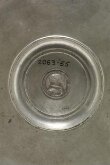
| Physical description | 'Temperantia' dish, pewter, circular with a deeply sunk well and raised centre, its central boss with a plaque depicting a figure of Temperance holding a wine-cup and ewer. The central boss is signed in the mould: FB for Francis Briot. Around the central boss a broad band of ornament contains four plaques with figures representing AER (air), AQUA (water), TERRA (earth), and IGNIS (fire). The boss and the outer rim are surrounded by a cast band of ovals on a ground of fine diaper. Within this outer rim is a broad flat band divided into eight oval cartouches containing relief compositions of the Seven Liberal Arts and their patron Minerva: GRAMMATIC (Grammar), DIALECTICA, RHETORICA (rhetoric), MUSICA (music), ARITHMETIQUA (Arithmetic), GEOMETRIA (Geometry) and ASTROLOGIA (Astrology). Between the plaques the dish is covered with finely cast strapwork, birds, masks, serpents, fruit, flowers and winged horses. The reverse of the dish is plain but shows clear concentric rings where the dish was turned on a lathe after casting to remove excess pewter. Inside the hollow created by the central boss is a medallion depicting the modeller, Franci Briot with the inscription: SCVLPEBAT FRANSISCVS BRIOT. |
| Dimensions |
|
| Style | |
| Marks and inscriptions |
|
| Gallery label |
|
| Object history | This dish dates from around 1585 and was cast using a mould made by Francois Briot, the celebrated medallist and die-cutter. The dish was probably designed to decorate the buffet of a prince or of a civic body such as a town guild. Contemporary illustrations show that buffets could be enormous, multi-tiered structures supporting rich displays of gold, silver, mounted exotic shells and colourful stones, and other items from their treasuries. By the late 16th century, most fashionable patrons favoured fantastical Mannerist pieces for their displays. Mannerism was a courtly style based around the idea of difficultà: complex design, virtuoso craftsmanship and decoration infused with intellectual references. The surface of this dish is decorated with cast designs in relief with its central plaque depicting a figure of Temperance holding a wine-cup and ewer. Around the central boss a broad band of ornament contains four plaques with figures representing AER (air), AQUA (water), TERRA (earth), and IGNIS (fire). On the rim there are oval panels depicting the Seven Liberal Arts and their patron Minerva: GRAMMATIC (Grammar), DIALECTICA, RHETORICA (rhetoric), MUSICA (music), ARITHMETIQUA (Arithmetic), GEOMETRIA (Geometry) and ASTROLOGIA (Astrology). Between the plaques the dish is covered with finely cast strapwork, birds, masks, serpents, fruit, flowers and winged horses. The style was best suited to objects intended for display rather than for use. The dish is signed 'FB' on the central boss for Francois Briot, the most celebrated member of a French family of medallists and die-cutters. Briot was a model carver, medallist and pattern-maker rather than a pewterer, creating copper moulds in which pewter was cast. The Temperantia dish, is his only known signed work. It would have been extremely costly to produce. The intricate modelling was highly skilled work. Briot's most likely patron was Friedrich I, Duke of Württemberg (1557-1608), Count of Montbéliard (1581-93). Briot moved to Montbeliard in 1579 and by 1585 was appointed seal-engraver to the count and is known to have made medals for Friedrich. This basin was one of the Museum's early purchases, bought in 1855 from the sale collection of Ralph Bernal. The Bernal Collection was an enormous collection of metalwork, glass, ceramics and miniatures belonging to Ralph Bernal, a lawyer, MP and former absentee slave owner whose plantations appear to have funded much of his collecting. The sale by Christie, Manson and Woods took 32 days during which 4294 lots fetched nearly £71,000. The Museum bought 730 lots including this dish for which it paid £19. Its provenance until the 19th century is not known. |
| Historical context | The dish was probably designed to decorate the buffet of a prince or of a civic body such as a town guild. Contemporary illustrations show that buffets could be enormous, multi-tiered structures supporting rich displays of gold, silver, mounted exotic shells and colourful stones, and other items from princely treasuries. By the late 16th century, most fashionable patrons favoured fantastical Mannerist pieces for their displays. Mannerism was a courtly style based around the idea of difficultà: complex design, virtuoso craftsmanship and decoration infused with intellectual references. Elaborate French and German buffet dishes of the 1580s, including this example, show pewter mould-making and casting at its most skilled. Pewter is an alloy or mixture of metals consisting primarily of tin. Adding metals such as copper and antimony makes pewter harder and more durable. The best alloys contain over 90% tin. Before 1800 lead was allowed in 'lay metal', a lower-quality alloy used for measures and boxes. Soft lead made casting easier, but was poisonous, so it was forbidden in 'flatware' such as plates, dishes and porringers. Tests do reveal small amounts of up to 2%. Modern pewter contains no lead. Pewter's low melting point makes it suitable for casting, though early casting moulds were expensive. This dish be seen as one of those instructional objects bought at the very beginnings of the museum's existence as art school under the supervision of the Government's Department of Science and Art. Under the museum's first Director, Henry Cole and first Curator, John Charles Robinson, both historic and contemporary works of art were collected as models for artists, designers and students to learn to draw and copy from as inspiration for their own products. The aim, which Cole described as 'economic' (commercial) was to get good design into Britain's factories to improve the country's manufacturing products. Good models might also inspire the visiting public to become more discerning in the choices they made when decirating their homes. In this sense the V&A (then known as the South Knesington Museum) saw itself as ther arbiter of national taste. Some of the earliest purchases by the Museum included outstanding examples of European pewter. Briot's 'Temperantia' and similar 'Mars' basins have had a widespread influence. The V&A owns an almost identical dish by the early 17th-century Nuremberg modeller, Caspar Enderlein (Mus. No. 5477-1859). The Enderlein versions were not cast from an original but were made from moulds cut as line-for-line copies of the Briot dish. The model was further disseminated by polychrome pottery versions in Palissyware which were in turn imitated during the 19th century (see Museum no. 1080-1871). Every year the winner of the women's singles at the Wimbledon Tennis Championships holds a silver copy made by Elkington of Birmingham in 1864 of an Enderlein version of Briot's Temperantia basin that was cast from a plaster mould taken from the version in The Louvre. The V&A has an electrotype made from the same pattern in 1852 (Museum no. REPRO.1852B-6). |
| Production | François Briot designed the model and made the mould from which this dish was cast. The signature FB on the central boss of the dish was signed in the mould before casting. The pewterer who cast the dish is not known. The pewterer did not strike a 'touch mark' on the finished dish. |
| Association | |
| Summary | The 'Temperantia' Basin is one of the highlights of the V&A's pewter collection. It is a fine example of Edelzinn, literally 'precious pewter', which was produced in France and Germany during the late sixteenth and early seventeenth centuries. The dish was probably made to decorate the buffet of a prince or of a civic body such as a town guild. Contemporary illustrations show these buffets could be enormous, multi-tiered structures supporting rich displays of gold, silver, mounted exotic shells and colourful stones, and other items from their owners' treasuries. By the late 16th century, most fashionable patrons favoured fantastical Manneristpieces for their displays. Mannerism was a courtly style based around the idea of difficultà: complex design, virtuoso craftsmanship and decoration infused with intellectual references. The surface of this dish is decorated with cast designs in relief with its central plaque depicting a figure of Temperance holding a wine-cup and ewer. Around the central boss a broad band of ornament contains four plaques with figures representing AER (air), AQUA (water), TERRA (earth), and IGNIS (fire). On the rim there are oval panels depicting the Seven Liberal Arts and their patron Minerva: GRAMMATIC (Grammar), DIALECTICA, RHETORICA (rhetoric), MUSICA (music), ARITHMETIQUA (Arithmetic), GEOMETRIA (Geometry) and ASTROLOGIA (Astrology). Between the plaques the dish is covered with finely cast strapwork, birds, masks, serpents, fruit, flowers and winged horses. As Edelzinn was designed for display it tends to survive in excellent condition. The dish is signed 'FB' on the central boss for Francois Briot, the most celebrated member of a French family of medallists and die-cutters. Briot was a model carver, medallist and pattern-maker rather than a pewterer, creating copper moulds in which pewter was cast. The Temperantia dish, is his only known signed work. It would have been extremely costly to produce. The intricate modelling was highly skilled work. Briot's most likely patron was Friedrich I, Duke of Württemberg (1557-1608), Count of Montbéliard (1581-93). Briot moved to Montbeliard in 1579 and by 1585 was appointed seal-engraver to the count and is known to have made medals for Friedrich. Briot's 'Temperantia' and similar 'Mars' basins have had a widespread influence. The V&A owns an almost identical dish by the early 17th-century Nuremberg modeller, Caspar Enderlein (Mus. No. 5477-1859). The Enderlein versions were not cast from an original but were made from moulds cut as line-for-line copies of the Briot dish. The model was further disseminated by polychrome pottery versions in Palissyware which were in turn imitated during the 19th century (see Museum no. 1080-1871). Every year the winner of the women's singles at the Wimbledon Tennis Championships holds a silver copy made by Elkington of Birmingham in 1864 of an Enderlein version of Briot's Temperantia basin that was cast from a plaster mould taken from the version in The Louvre. The V&A has an electrotype made from the same pattern in 1852 (Museum no. REPRO.1852B-6). |
| Associated objects |
|
| Bibliographic references |
|
| Collection | |
| Accession number | 2063-1855 |
About this object record
Explore the Collections contains over a million catalogue records, and over half a million images. It is a working database that includes information compiled over the life of the museum. Some of our records may contain offensive and discriminatory language, or reflect outdated ideas, practice and analysis. We are committed to addressing these issues, and to review and update our records accordingly.
You can write to us to suggest improvements to the record.
Suggest feedback
You can write to us to suggest improvements to the record.
Suggest feedback
| Record created | January 20, 2003 |
| Record URL |
Download as: JSONIIIF Manifest
