Bacchus
Pendant
1854 (made)
1854 (made)
| Artist/Maker | |
| Place of origin |
Coral has been used in jewellery since antiquity. Believed to be an amulet which could protect against the evil eye, it was often worn by children or used in rosaries. In the early 19th century, it began to be exploited in conventional jewellery and became highly fashionable. According to the 19th century French jeweller Henri Vever 'Every day, the coral merchant of H.R.H. Madame, Duchesse d'Angouleme, offers the most elaborate and elegant parures to customers and passers-by: the jewels which are sold there are created with exquisite taste'.
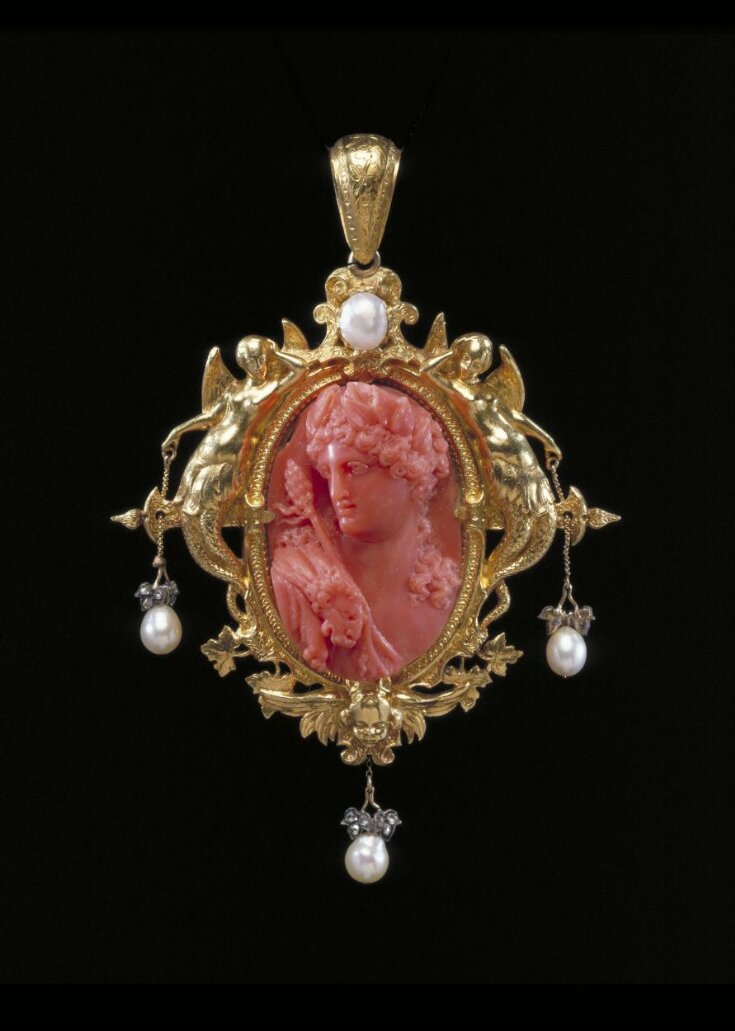
Many 19th century designers used historical styles. This piece looks back to the elaborate pendants of the Renaissance with their intricately sculpted gold. It has two matching brooches. The pendant and brooches were probably one of the last sets of jewellery to be sold by the Paris jeweller François-Désiré Froment-Meurice before his death in 1855. This pendant is similar to an item his widow showed at the Paris Universal Exhibition in 1855.
It is carved with a figure of Bacchus, the Greek god of wine.
Many 19th century designers used historical styles. This piece looks back to the elaborate pendants of the Renaissance with their intricately sculpted gold. It has two matching brooches. The pendant and brooches were probably one of the last sets of jewellery to be sold by the Paris jeweller François-Désiré Froment-Meurice before his death in 1855. This pendant is similar to an item his widow showed at the Paris Universal Exhibition in 1855.
It is carved with a figure of Bacchus, the Greek god of wine.
Object details
| Categories | |
| Object type | |
| Title | Bacchus (generic title) |
| Materials and techniques | Coral, carved as a cameo, and set in a gold frame hung with pearls and rose-cut diamond sparks set in silver. |
| Brief description | Pendant, cameo of Bacchus by François-Désiré Froment-Meurice, gold, coral & pearls, France, about 1854 |
| Physical description | Pendant with a coral cameo depicting Bacchus, the sculpted gold frame decorated with winged mermaids and hung with pearls and diamond sparks. |
| Dimensions |
|
| Style | |
| Credit line | Given by Dame Joan Evans |
| Object history | Part of a set of a pendant and pair of brooches M.30&A, B-1962). Coral cameos of Bacchus, Apollo and Venus set in gold and hung with pealrs; the drop on the pendant also set with diamond sparks. All three items originally convertible, the pendant into a brooch and the brooches into pendants. The fittings now incomplete. Made in Paris about 1854, the pendant has an illegible maker's mark; the two brooches stamped: F. MEURICE, with Paris warranty marks for 1838 onwards. The set came to the Museum in its original case with the label of F.-D. Froment-Meurice. Probably one of the last sets of jewellery to be sold by Francois-Desire Froment-Meurice (1802 - 1855) before his death, and similar to an item shown by his widow at the Pais Univeral Exhibition, 1855. |
| Subjects depicted | |
| Summary | Coral has been used in jewellery since antiquity. Believed to be an amulet which could protect against the evil eye, it was often worn by children or used in rosaries. In the early 19th century, it began to be exploited in conventional jewellery and became highly fashionable. According to the 19th century French jeweller Henri Vever 'Every day, the coral merchant of H.R.H. Madame, Duchesse d'Angouleme, offers the most elaborate and elegant parures to customers and passers-by: the jewels which are sold there are created with exquisite taste'. Many 19th century designers used historical styles. This piece looks back to the elaborate pendants of the Renaissance with their intricately sculpted gold. It has two matching brooches. The pendant and brooches were probably one of the last sets of jewellery to be sold by the Paris jeweller François-Désiré Froment-Meurice before his death in 1855. This pendant is similar to an item his widow showed at the Paris Universal Exhibition in 1855. It is carved with a figure of Bacchus, the Greek god of wine. |
| Associated objects |
|
| Collection | |
| Accession number | M.30-1962 |
About this object record
Explore the Collections contains over a million catalogue records, and over half a million images. It is a working database that includes information compiled over the life of the museum. Some of our records may contain offensive and discriminatory language, or reflect outdated ideas, practice and analysis. We are committed to addressing these issues, and to review and update our records accordingly.
You can write to us to suggest improvements to the record.
Suggest feedback
You can write to us to suggest improvements to the record.
Suggest feedback
| Record created | January 20, 2003 |
| Record URL |
Download as: JSONIIIF Manifest
