
Sir Isaac Newton (1642-1727)
Model
ca. 1730 (made)
ca. 1730 (made)
| Artist/Maker | |
| Place of origin |
Object Type
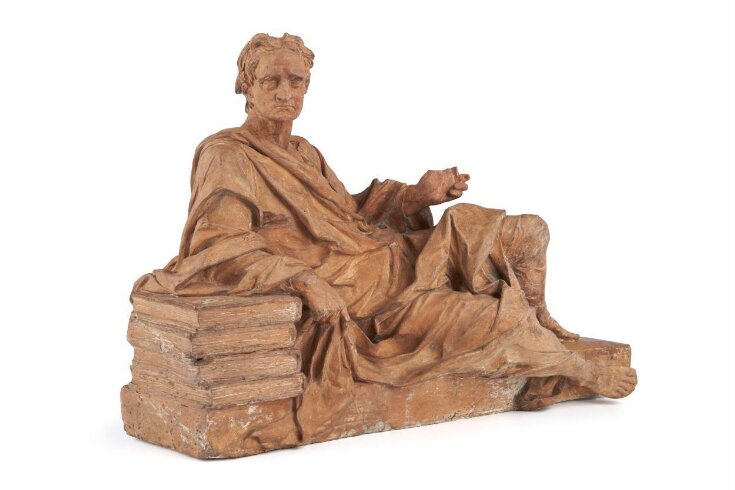
This terracotta figure is a study for the full-size marble by John Michael Rysbrack (1694-1770) for the monument to Sir Isaac Newton (1642-1727) erected in Westminster Abbey in 1730. Rysbrack's monument was based on a design by the painter, designer and architect William Kent (1685-1748).
Design & Designing
Rysbrack adapted and improved Kent's design, a fact which was recognised by his contemporary and friend George Vertue, who noted that the monument was 'a noble and Elegant work by Mr Michael Rysbrack. much to his Reputation. tho the design or drawing of it on paper was poor enough, yet for that only Mr Kent is honourd with his name on it (Pictor et Architect inventor). which if it had been deliverd to any other Sculptor besides Rysbrack, he might have been glad to have his name omitted'.
People
Rysbrack was one of the leading sculptors active in Britain in the first half of the 18th century. Born in Antwerp, the son of a painter, he arrived in London in 1720 with his brother, also an artist. Rysbrack specialised in portrait busts and funerary monuments, and executed many in Westminster Abbey, often in conjunction with the architect James Gibbs, or as here, William Kent. Rysbrack's deft and sensitive handling of terracotta may well reflect his Flemish training and background.
Materials & Making
Terracotta (fired clay) was often used for sculptors' models, although it could also be employed for finished works. This is likely to have been a preliminary model, and may even have formed part of the sculptor's contract.
This terracotta figure is a study for the full-size marble by John Michael Rysbrack (1694-1770) for the monument to Sir Isaac Newton (1642-1727) erected in Westminster Abbey in 1730. Rysbrack's monument was based on a design by the painter, designer and architect William Kent (1685-1748).
Design & Designing
Rysbrack adapted and improved Kent's design, a fact which was recognised by his contemporary and friend George Vertue, who noted that the monument was 'a noble and Elegant work by Mr Michael Rysbrack. much to his Reputation. tho the design or drawing of it on paper was poor enough, yet for that only Mr Kent is honourd with his name on it (Pictor et Architect inventor). which if it had been deliverd to any other Sculptor besides Rysbrack, he might have been glad to have his name omitted'.
People
Rysbrack was one of the leading sculptors active in Britain in the first half of the 18th century. Born in Antwerp, the son of a painter, he arrived in London in 1720 with his brother, also an artist. Rysbrack specialised in portrait busts and funerary monuments, and executed many in Westminster Abbey, often in conjunction with the architect James Gibbs, or as here, William Kent. Rysbrack's deft and sensitive handling of terracotta may well reflect his Flemish training and background.
Materials & Making
Terracotta (fired clay) was often used for sculptors' models, although it could also be employed for finished works. This is likely to have been a preliminary model, and may even have formed part of the sculptor's contract.
Object details
| Categories | |
| Object type | |
| Title | Sir Isaac Newton (1642-1727) (generic title) |
| Materials and techniques | Terracotta |
| Brief description | Sculpture model, terracotta, for a memorial to Sir Isaac Newton for Westminster Abbey, by John Michael Rysbrack, Britain, ca. 1730 |
| Physical description | Sculpture, terracotta model for monument of Sir Isaac Newton by John Michael Rysbrack. Newton is shown reclining on an oblong plinth resting his right arm on a pile of books. He wears an ample drapery over classical dress. |
| Dimensions |
|
| Gallery label | British Galleries:
This is a model for the figure on the marble monument to the great scientific thinker, Sir Isaac Newton (1642-1727), in Westminster Abbey. He is shown in classical dress, as if he were a citizen of ancient Rome. The design for the whole monument is shown in the drawer below.(27/03/2003) |
| Credit line | Given by Dr W. L. Hildburgh FSA |
| Object history | Modelled in London by John Michael Rysbrack (born in Antwerp, Belgium, 1694, died in London, 1770). Illustrated in a photograph of the Museum at Badger Hall, Shropshire, 1888 (National Monuments Record BB74/2928). Previoulsy on loan to the Museum by Dr. Hildburgh F.S.A. from 7 October 1945, and subsequently given by him to the Museum as a New Year gift in 1938. |
| Historical context | Rysbrack's retirement sale of 24/25 January 1766, Langford's Covent Garden. First day sale, lot 42: 'Two ditto (figures) a sketch of Sir Isaac Newton, and a Bishop' in a section headed 'MODELS', which seems to mean 3 dimensional models, though not specified as terracotta. |
| Subjects depicted | |
| Summary | Object Type This terracotta figure is a study for the full-size marble by John Michael Rysbrack (1694-1770) for the monument to Sir Isaac Newton (1642-1727) erected in Westminster Abbey in 1730. Rysbrack's monument was based on a design by the painter, designer and architect William Kent (1685-1748). Design & Designing Rysbrack adapted and improved Kent's design, a fact which was recognised by his contemporary and friend George Vertue, who noted that the monument was 'a noble and Elegant work by Mr Michael Rysbrack. much to his Reputation. tho the design or drawing of it on paper was poor enough, yet for that only Mr Kent is honourd with his name on it (Pictor et Architect inventor). which if it had been deliverd to any other Sculptor besides Rysbrack, he might have been glad to have his name omitted'. People Rysbrack was one of the leading sculptors active in Britain in the first half of the 18th century. Born in Antwerp, the son of a painter, he arrived in London in 1720 with his brother, also an artist. Rysbrack specialised in portrait busts and funerary monuments, and executed many in Westminster Abbey, often in conjunction with the architect James Gibbs, or as here, William Kent. Rysbrack's deft and sensitive handling of terracotta may well reflect his Flemish training and background. Materials & Making Terracotta (fired clay) was often used for sculptors' models, although it could also be employed for finished works. This is likely to have been a preliminary model, and may even have formed part of the sculptor's contract. |
| Bibliographic references |
|
| Collection | |
| Accession number | A.1-1938 |
About this object record
Explore the Collections contains over a million catalogue records, and over half a million images. It is a working database that includes information compiled over the life of the museum. Some of our records may contain offensive and discriminatory language, or reflect outdated ideas, practice and analysis. We are committed to addressing these issues, and to review and update our records accordingly.
You can write to us to suggest improvements to the record.
Suggest feedback
You can write to us to suggest improvements to the record.
Suggest feedback
| Record created | January 16, 2003 |
| Record URL |
Download as: JSONIIIF Manifest
