Beaker and Cover
1450-1500 (made)
| Artist/Maker | |
| Place of origin |
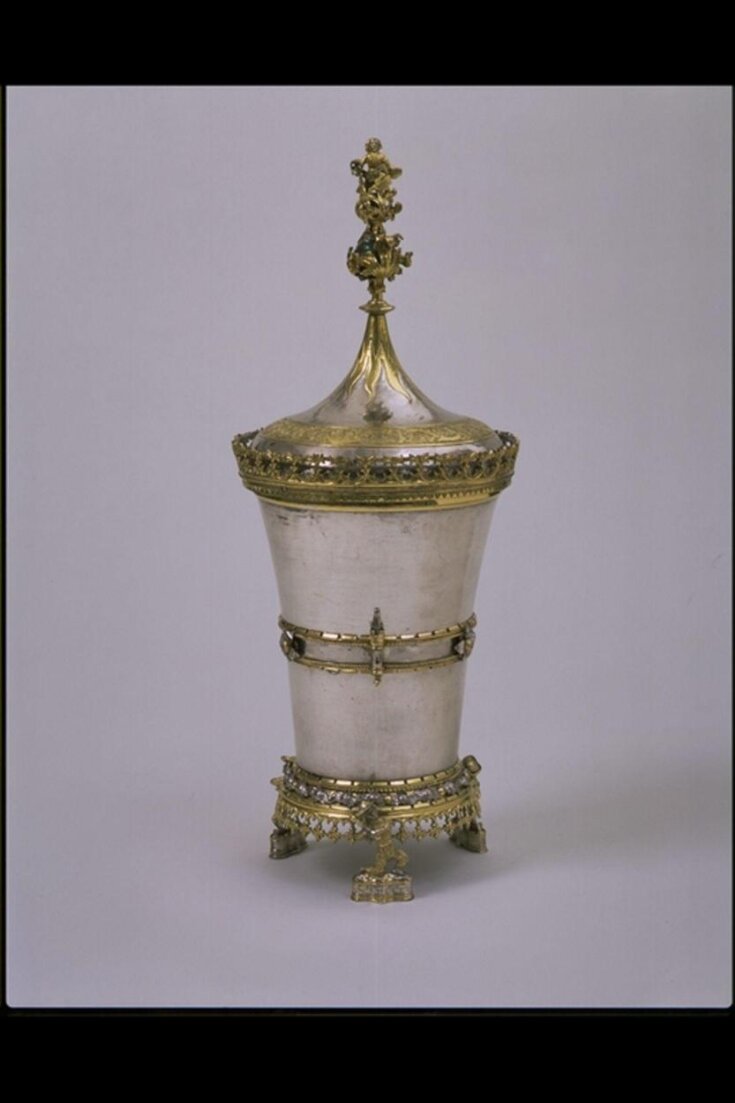
This beaker and cover used to belong to the Treasury of Basel Cathedral in Switzerland. Inventory records from the cathedral reveal that it was given to the Cathedral Treasury by a chaplain called Eucharius Vol between 1477 and 1511. After entering this ecclesiastical context, the beaker was transformed from a domestic vessel into a reliquary.
One of the most striking features of this object is the presence of the four wild men. In the later medieval period Wild Men were popular decorative motifs and could be found across a wide range of artistic media. On the beaker a Wild Man crowns the finial and three Wild Men act as the beaker’s feet. Crouched on pedestals, the Wild Men hold clubs as if to defend the precious object. Their distinctive long, shaggy hair covers their entire bodies and is belted at the waist to demonstrate that the hair serves as the Wild Men’s clothes. This hair is gilded so that a visual contrast is created with the silver used for their skin. Using Wild Men as the feet for beakers was a popular device in the later medieval period, and other examples of this practice can be found in The Metropolitan Museum of Art in New York.
One of the most striking features of this object is the presence of the four wild men. In the later medieval period Wild Men were popular decorative motifs and could be found across a wide range of artistic media. On the beaker a Wild Man crowns the finial and three Wild Men act as the beaker’s feet. Crouched on pedestals, the Wild Men hold clubs as if to defend the precious object. Their distinctive long, shaggy hair covers their entire bodies and is belted at the waist to demonstrate that the hair serves as the Wild Men’s clothes. This hair is gilded so that a visual contrast is created with the silver used for their skin. Using Wild Men as the feet for beakers was a popular device in the later medieval period, and other examples of this practice can be found in The Metropolitan Museum of Art in New York.
Object details
| Categories | |
| Object type | |
| Parts | This object consists of 2 parts.
|
| Materials and techniques | Raising, casting, stamping, engraving, gilding, enamelling |
| Brief description | German (Augsburg). About 1600. Silver, parcel-gilt; Silver, Continental Silver, Continental |
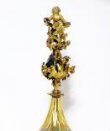
| Physical description | Cylindrical beaker and cover made of silver. The main body of the beaker is of silver, but the mounts, horizontal decorative bands, and finial are gilded. The cover is surrounded with a gilded band of fleur-de-lis and quatrefoil arcading and is surmounted by a decorative finial. The finial is made up of scrolling foliage and flowers, and contains translucent enamel amongst the foliage. The finial is topped with a figure of a Wild Man. Three similar Wild Men, crouching on pedestals, can be found acting as the feet for the beaker. |
| Dimensions |
|
| Marks and inscriptions | Inscribed on the banderole: h.d.g. (Helf dir Gott: God help you) |
| Object history | This beaker and cover is from the Treasury at Basel Cathedral, whose contents were dispersed in 1827, after a dispute between the cathedral and the canton. Inventories reveal that it was given by a chaplain, Eucharius Vol (died. 1502), between 1477 and 1511, when it first appears in the inventory. It was sold at auction in 1836 at Liestal, when it was purchased by the Basel goldsmith Johann Friedrich II. It was later sold to the Soltykoff Collection in Paris, from where it was purchased by the V&A for £122. New York Exhibition RF.96/1812 Historical significance: This is one of the finest surviving examples of a secular Gothic vessel from an ecclesiastical Treasury. Its provenance from the Cathedral Treasury at Basel is attested through inventory records which show the object being given by one of its chaplains, Eucharius Vol. The beaker was given a religious purpose through its transformation into a reliquary. This new function was achieved by ensuring that the lid was fastened securely to the beaker. The motif of the Wild Man, which this beaker employs for the feet and the finial, was popular during the medieval period, and was associated with power and fertility. For the feet, the Wild Men are depicted as crouching on pedestals and holding a club in their hand. Their characteristic long, shaggy hair that completely covers their bodies in place of clothes is belted at the waist and gilded in order to contrast visually with the silver used for their skin. It is possible that the motif of the Wild Man was selected for highly decorative beakers such as this because of their ability to defend. The appearance of a weapon in the form of a club stresses the protective role that the Wild Man could play. |
| Historical context | Beakers such as this were secular objects. Often described as a drinking vessel, it is unlikely that this example served a practical function due to its elaborate decoration including translucent enamel and the abundant use of gilding. It is more probable that its primary role was to be displayed in order to demonstrate the magnificence, taste, and wealth of its owner. |
| Summary | This beaker and cover used to belong to the Treasury of Basel Cathedral in Switzerland. Inventory records from the cathedral reveal that it was given to the Cathedral Treasury by a chaplain called Eucharius Vol between 1477 and 1511. After entering this ecclesiastical context, the beaker was transformed from a domestic vessel into a reliquary. One of the most striking features of this object is the presence of the four wild men. In the later medieval period Wild Men were popular decorative motifs and could be found across a wide range of artistic media. On the beaker a Wild Man crowns the finial and three Wild Men act as the beaker’s feet. Crouched on pedestals, the Wild Men hold clubs as if to defend the precious object. Their distinctive long, shaggy hair covers their entire bodies and is belted at the waist to demonstrate that the hair serves as the Wild Men’s clothes. This hair is gilded so that a visual contrast is created with the silver used for their skin. Using Wild Men as the feet for beakers was a popular device in the later medieval period, and other examples of this practice can be found in The Metropolitan Museum of Art in New York. |
| Bibliographic references |
|
| Collection | |
| Accession number | 7941-1862 |
About this object record
Explore the Collections contains over a million catalogue records, and over half a million images. It is a working database that includes information compiled over the life of the museum. Some of our records may contain offensive and discriminatory language, or reflect outdated ideas, practice and analysis. We are committed to addressing these issues, and to review and update our records accordingly.
You can write to us to suggest improvements to the record.
Suggest feedback
You can write to us to suggest improvements to the record.
Suggest feedback
| Record created | January 15, 2003 |
| Record URL |
Download as: JSONIIIF Manifest
