
Guitar
1755-1760 (made)
| Artist/Maker | |
| Place of origin |
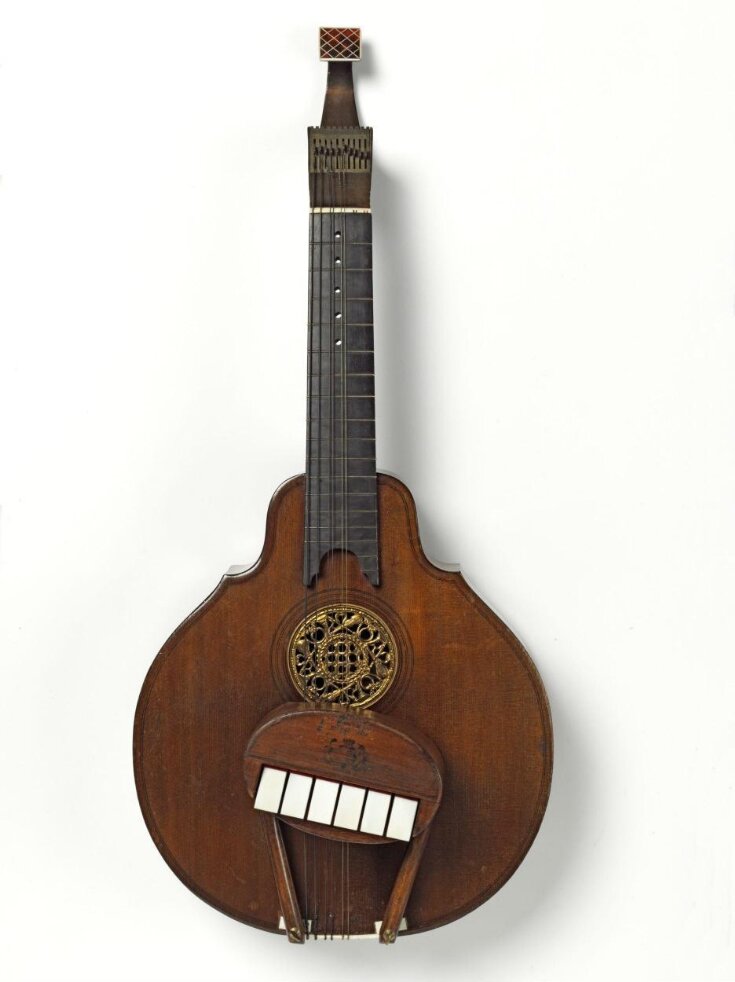
The English guitar was in vogue from about 1750 until 1790. It was particularly popular among fashionable ladies who often preferred the version, like this one, that was fitted with piano-keys so as to preserve their nails from wire strings. Examples like this one were also tuned with a watch-key, most often in C major. The modern Portuguese guitar is descended from this type of instrument. This English guitar was made by Friederich Hintz (d. 1772), a German immigrant cabinetmaker, who specialised in making metal-inlaid furniture as well as musical instruments.
Object details
| Categories | |
| Object type | |
| Materials and techniques | Sycamore, ebony and ivory, with stamped copper |
| Brief description | Guitar; by Frederick Hintz; London, Britain; 1755-60. |
| Physical description | Guitar; sycamore back, pine belly, pointed shoulders, rose of stamped copper gilt with a musical instrument & diaper pattern in centre. Ebony fingerboard with fifteen brass frets, square finial on neck with chequerboard pattern in ebony & ivory, detachable mechanism on body for striking strings with felted hammers, box with Royal Arms of England. |
| Dimensions |
|
| Marks and inscriptions |
|
| Subject depicted | |
| Summary | The English guitar was in vogue from about 1750 until 1790. It was particularly popular among fashionable ladies who often preferred the version, like this one, that was fitted with piano-keys so as to preserve their nails from wire strings. Examples like this one were also tuned with a watch-key, most often in C major. The modern Portuguese guitar is descended from this type of instrument. This English guitar was made by Friederich Hintz (d. 1772), a German immigrant cabinetmaker, who specialised in making metal-inlaid furniture as well as musical instruments. |
| Collection | |
| Accession number | 37-1870 |
About this object record
Explore the Collections contains over a million catalogue records, and over half a million images. It is a working database that includes information compiled over the life of the museum. Some of our records may contain offensive and discriminatory language, or reflect outdated ideas, practice and analysis. We are committed to addressing these issues, and to review and update our records accordingly.
You can write to us to suggest improvements to the record.
Suggest feedback
You can write to us to suggest improvements to the record.
Suggest feedback
| Record created | January 8, 2003 |
| Record URL |
Download as: JSONIIIF Manifest
