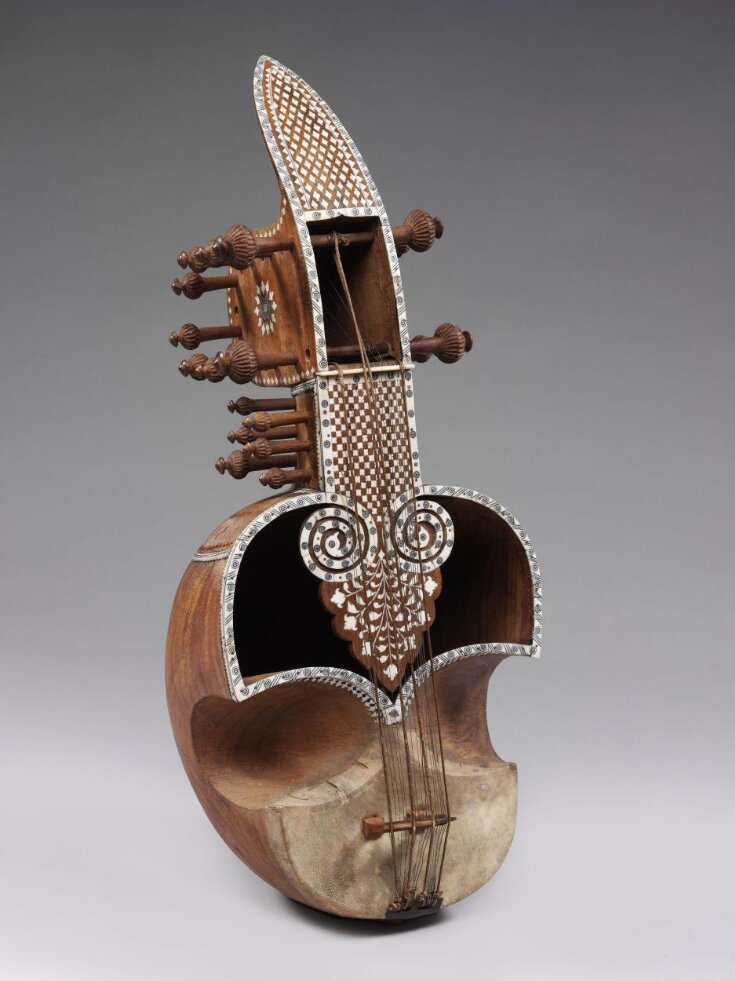

Stringed Instrument (Sarinda)
19th century (made)
| Artist/Maker | |
| Place of origin |
This sarinda would originally have had four gut strings and a number of sympathetic wires – additional strings to give extra resonance – made of brass. The hollow body is of wood inlaid with ivory, the belly half covered with parchment chamfered or pared away (the chief characteristic of this kind of instrument). The sarinda is held with the left hand and rests against the performer’s body with the neck at the top resting on the left shoulder. The bow is held in the right hand with an underhand grip similar to that used by an Elizabethan viol player. An almost identical sarinda is in the Golden Temple in Amritsar, India, and the inlaid decoration is typical of 19th-century work from Hoshiarpur in north-west India.
Object details
| Categories | |
| Object type | |
| Parts | This object consists of 2 parts.
|
| Materials and techniques | Teak and ivory |
| Brief description | Sarinda (stringed instrument); teak and ivory; Punjab, India; 19th century. |
| Physical description | Sarinda (stringed instrument); teak and ivory. Four gut strings and a number of sympathetic wires made of brass. The hollow is of wood inlaid with ivory, the belly is half covered with parchment pared away. |
| Dimensions |
|
| Gallery label | SARINDA AND BOW
Teak with ivory and lac inlay, parchment, gut and metal strings; the bow wood, ivory, textile, string and horsehair
Possibly Hoshiarpur, Punjab
1800-1900
IM.67-1911
Given by Mrs R. Irvine
(15/09/2015) |
| Credit line | Given by Mrs R. Irvine |
| Object history | Given by Mrs R. Irvine, Barkston Gardens Hotel, S. Kensington. This acquisition information reflects that found in the Museum records (Asia Department registers and/or Central Inventory) as part of a 2023 provenance research project. RP 1911- 3100M |
| Summary | This sarinda would originally have had four gut strings and a number of sympathetic wires – additional strings to give extra resonance – made of brass. The hollow body is of wood inlaid with ivory, the belly half covered with parchment chamfered or pared away (the chief characteristic of this kind of instrument). The sarinda is held with the left hand and rests against the performer’s body with the neck at the top resting on the left shoulder. The bow is held in the right hand with an underhand grip similar to that used by an Elizabethan viol player. An almost identical sarinda is in the Golden Temple in Amritsar, India, and the inlaid decoration is typical of 19th-century work from Hoshiarpur in north-west India. |
| Bibliographic references |
|
| Collection | |
| Accession number | IM.67&A-1911 |
About this object record
Explore the Collections contains over a million catalogue records, and over half a million images. It is a working database that includes information compiled over the life of the museum. Some of our records may contain offensive and discriminatory language, or reflect outdated ideas, practice and analysis. We are committed to addressing these issues, and to review and update our records accordingly.
You can write to us to suggest improvements to the record.
Suggest feedback
You can write to us to suggest improvements to the record.
Suggest feedback
| Record created | January 2, 2003 |
| Record URL |
Download as: JSONIIIF Manifest
