
Subjects from Milton's Paradise Lost
Vase
ca. 1856 (made)
ca. 1856 (made)
| Artist/Maker | |
| Place of origin |
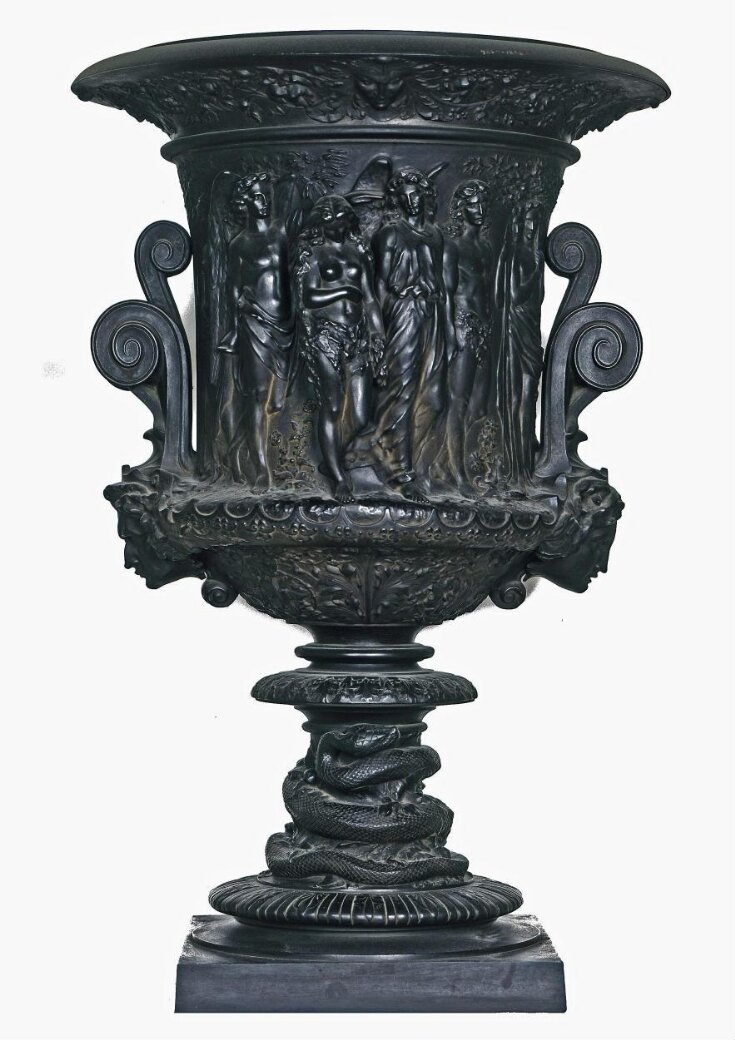
While the Coalbrookdale Co. is best known for its production of iron wares, ranging from railway tracks to garden furniture, this vase was electroformed in copper and then patinated (coloured) to look like bronze. When the vase was new, electroforming as a technology was less than 20 years old. The process deposits copper, particle by particle, into a mould using an electric current. It creates very accurate impressions of the moulds.The vase was eletroformed in parts and then assembled to create the whole object. Electroforms (or electrotypes) are more brittle than traditional bronzes but they are easier to produce in multiples. When the vase was first shown in the museum it was an expression of Victorian modernity - a combination of artistic and ornamental creativity made real by industrial methods.
The vase is an example of the decorative work produced by the Coalbrookdale Company; the Museum purchased it as a modern example of such work. The frieze around the vase depicts two passages from Milton's Paradise Lost: the expulsion of Satan and the expulsion of Adam and Eve. A snake is coiled around the stem. The producers included an illustration of the vase in a trade catalogue: Coalbrookdale. Designs for Iron Gates, Railings, Balconies, Stoves, Fenders, Tables, Hatstands, Garden Chairs, Vases, Fountains etc., describing it as 'The Milton Vase'. Milton's Paradise Lost became a popular subject for mid-century Victorians particularly during commemorations of the 200th anniversay of the English Civil War and the revolution that followed, and artists frequently depicted the best known scenes on a range of artworks.
Coalbrookdale benefited from its ideal location for industrial metalworking, with a local supply of ironstone and nearby coal and water for fuel and power respectively. When Abraham Darby took over the works in 1708 the company produced mostly pots, pans and kettles. As new processes were developed, manufacturing methods improved, furnace capacities increased, and the Coalbrookdale Co. became one of the most important cast-iron manufacturers of the 19th century. It produced many architectural and domestic objects, making increasing use of cast iron rather than wrought iron as cast iron allowed repetitive patterns to be accurately reproduced at a fraction of the cost. The Coalbrookdale Company was established in 1709 and ceased production in 1959. It originally specialised in the production of a range of cast-iron industrial products, diversifying in the nineteenth century to include more decorative items.
The vase is an example of the decorative work produced by the Coalbrookdale Company; the Museum purchased it as a modern example of such work. The frieze around the vase depicts two passages from Milton's Paradise Lost: the expulsion of Satan and the expulsion of Adam and Eve. A snake is coiled around the stem. The producers included an illustration of the vase in a trade catalogue: Coalbrookdale. Designs for Iron Gates, Railings, Balconies, Stoves, Fenders, Tables, Hatstands, Garden Chairs, Vases, Fountains etc., describing it as 'The Milton Vase'. Milton's Paradise Lost became a popular subject for mid-century Victorians particularly during commemorations of the 200th anniversay of the English Civil War and the revolution that followed, and artists frequently depicted the best known scenes on a range of artworks.
Coalbrookdale benefited from its ideal location for industrial metalworking, with a local supply of ironstone and nearby coal and water for fuel and power respectively. When Abraham Darby took over the works in 1708 the company produced mostly pots, pans and kettles. As new processes were developed, manufacturing methods improved, furnace capacities increased, and the Coalbrookdale Co. became one of the most important cast-iron manufacturers of the 19th century. It produced many architectural and domestic objects, making increasing use of cast iron rather than wrought iron as cast iron allowed repetitive patterns to be accurately reproduced at a fraction of the cost. The Coalbrookdale Company was established in 1709 and ceased production in 1959. It originally specialised in the production of a range of cast-iron industrial products, diversifying in the nineteenth century to include more decorative items.
Object details
| Categories | |
| Object type | |
| Title | Subjects from Milton's Paradise Lost (generic title) |
| Materials and techniques | Electroformed copper ('electro-bronze'), with cast and applied components, patinated |
| Brief description | Vase, electro-bronze (electroformed copper), depicting subjects from Milton's Paradise Lost, designed by T.and W.J. Wills, made by the Coalbrookdale Company, England, about 1856 |
| Physical description | The vase is of monumental, classical form with a frieze in high relief around the body and a snake coiled around the stem. The frieze around the vase depicts two scenes from Milton's "Paradise Lost: The Expulsion of Satan" and "The Expulsion of Adam and Eve". The vase was electroformed in copper and then patinated to look bronze. Additional features with pronounced undercuts have been cast and applied. The inside reveals the assembly points showing that the body was formed in 4 sections. |
| Dimensions |
|
| Object history | The vase is an example of the decorative work produced by the Coalbrookdale Company; the Museum bought it directly from the firm in 1860 for £50, as a modern example of such work. This vase was electroformed in copper and then patinated (coloured) to look like bronze. When the vase was new, electroforming as a technology was less than 20 years old. The process deposits copper, particle by particle, into a mould using an electric current. It creates very accurate impressions of the moulds.The vase was eletroformed in parts and then assembled to create the whole object. Electroforms (or electrotypes) are more brittle than traditional bronzes but they are easier to produce in multiples. The frieze around the vase depicts two passages from Milton's Paradise Lost: the expulsion of Satan and the expulsion of Adam and Eve. A snake is coiled around the stem. The producers included an illustration of the vase in a trade catalogue: Coalbrookdale. Designs for Iron Gates, Railings, Balconies, Stoves, Fenders, Tables, Hatstands, Garden Chairs, Vases, Fountains etc., describing it as 'The Milton Vase'. Milton's Paradise Lost became a popular subject for mid-century Victorians particularly during commemorations of the 200th anniversay of the English Civil War and the revolution that followed, and artists frequently depicted the best known scenes on a range of artworks. |
| Historical context | Coalbrookdale benefited from its ideal location for industrial metalworking, with a local supply of ironstone and nearby coal and water for fuel and power respectively. When Abraham Darby took over the works in 1708 the company produced mostly pots, pans and kettles. As new processes were developed, manufacturing methods improved, furnace capacities increased, and the Coalbrookdale Co. became one of the most important cast-iron manufacturers of the 19th century. It produced many architectural and domestic objects, making increasing use of cast iron rather than wrought iron as cast iron allowed repetitive patterns to be accurately reproduced at a fraction of the cost. The Coalbrookdale Company was established in 1709 and ceased production in 1959. It originally specialised in the production of a range of cast-iron industrial products, diversifying in the nineteenth century to include more decorative items. |
| Subjects depicted | |
| Literary reference | Paradise Lost |
| Summary | While the Coalbrookdale Co. is best known for its production of iron wares, ranging from railway tracks to garden furniture, this vase was electroformed in copper and then patinated (coloured) to look like bronze. When the vase was new, electroforming as a technology was less than 20 years old. The process deposits copper, particle by particle, into a mould using an electric current. It creates very accurate impressions of the moulds.The vase was eletroformed in parts and then assembled to create the whole object. Electroforms (or electrotypes) are more brittle than traditional bronzes but they are easier to produce in multiples. When the vase was first shown in the museum it was an expression of Victorian modernity - a combination of artistic and ornamental creativity made real by industrial methods. The vase is an example of the decorative work produced by the Coalbrookdale Company; the Museum purchased it as a modern example of such work. The frieze around the vase depicts two passages from Milton's Paradise Lost: the expulsion of Satan and the expulsion of Adam and Eve. A snake is coiled around the stem. The producers included an illustration of the vase in a trade catalogue: Coalbrookdale. Designs for Iron Gates, Railings, Balconies, Stoves, Fenders, Tables, Hatstands, Garden Chairs, Vases, Fountains etc., describing it as 'The Milton Vase'. Milton's Paradise Lost became a popular subject for mid-century Victorians particularly during commemorations of the 200th anniversay of the English Civil War and the revolution that followed, and artists frequently depicted the best known scenes on a range of artworks. Coalbrookdale benefited from its ideal location for industrial metalworking, with a local supply of ironstone and nearby coal and water for fuel and power respectively. When Abraham Darby took over the works in 1708 the company produced mostly pots, pans and kettles. As new processes were developed, manufacturing methods improved, furnace capacities increased, and the Coalbrookdale Co. became one of the most important cast-iron manufacturers of the 19th century. It produced many architectural and domestic objects, making increasing use of cast iron rather than wrought iron as cast iron allowed repetitive patterns to be accurately reproduced at a fraction of the cost. The Coalbrookdale Company was established in 1709 and ceased production in 1959. It originally specialised in the production of a range of cast-iron industrial products, diversifying in the nineteenth century to include more decorative items. |
| Bibliographic references |
|
| Collection | |
| Accession number | 7229-1860 |
About this object record
Explore the Collections contains over a million catalogue records, and over half a million images. It is a working database that includes information compiled over the life of the museum. Some of our records may contain offensive and discriminatory language, or reflect outdated ideas, practice and analysis. We are committed to addressing these issues, and to review and update our records accordingly.
You can write to us to suggest improvements to the record.
Suggest feedback
You can write to us to suggest improvements to the record.
Suggest feedback
| Record created | December 12, 2002 |
| Record URL |
Download as: JSONIIIF Manifest
